.

General Discussion on any topic relating to CPAP and/or Sleep Apnea.
User avatar
Uncle_Bob
Posts: 2777
Joined: Tue Feb 24, 2009 12:10 pm
Location: Arizona

Re: pap treatment, take 2 (re-named)

Post by Uncle_Bob » Mon Feb 14, 2011 1:32 pm

rested gal wrote:
HoseCrusher wrote:Basal SpO2 on this software refers to an average over the whole recording time.
I keep learning...thank you, HoseCrusher.
So whats its meaning when you first put the oximeter and observe the initial reading?

I put mine on my finger last night and it read 90-91%, my wife then took a turn and it read 98%. Why did did she beat me?

User avatar
SleepingUgly
Posts: 4690
Joined: Sat Nov 28, 2009 9:32 pm

Re: .

Post by SleepingUgly » Mon Feb 14, 2011 1:46 pm

NotMuffy wrote:Well, I am so disappointed that no one challenged these to actually be hypopneas.
I looked back at some of my data on the S9 and it's hard to tell why the flow looks like it does, as often the hypopneas seem to come around the same time as the FLs (although there are many more FLs than hypopneas). It seems like the hypopneas are a bit flatter than the FLs, but I really wouldn't be able to tell one from the other, I don't think.

I need to go back and re-read the last couple pages of this thread, and try to assimilate the responses.
Never put your fate entirely in the hands of someone who cares less about it than you do. --Sleeping Ugly

jnk
Posts: 5781
Joined: Mon Jun 30, 2008 3:03 pm

Re: pap treatment, take 2 (re-named)

Post by jnk » Mon Feb 14, 2011 2:27 pm

Uncle_Bob wrote: . . . it read 90-91%, . . .
Maybe the sensor wasn't on your finger well?
A fit, healthy person should have an SpO2 level of 97% to 99% on room air; most experts consider a reading as low as 95% to be "clinically acceptable" in someone with a normal hemoglobin level. As one review states, a reading of 90% should be considered "a red flag"; anything less indicates hypoxemia.
http://www.nursingcenter.com/prodev/ce_ ... tid=864063

Robespierre
Posts: 168
Joined: Sun Feb 15, 2009 3:36 pm
Location: S Colorado

Re: .

Post by Robespierre » Mon Feb 14, 2011 3:10 pm

94% is the highest SpO2 reading I've ever had, even when on oxygen.

_________________
Mask: Swift™ FX Nasal Pillow CPAP Mask with Headgear
Humidifier: S9™ Series H5i™ Heated Humidifier with Climate Control
Additional Comments: Climateline hose; SleepyHead

User avatar
Rebecca R
Posts: 367
Joined: Tue Aug 04, 2009 7:40 pm

Re: .

Post by Rebecca R » Mon Feb 14, 2011 5:10 pm

NotMuffy wrote:
Rebecca R wrote:
NotMuffy wrote: As luck would have it, this shows 3 areas of FL, with some recovery breaths following the first two:

Image

RERAs can be subtle, so there may not be huge "resuscitive" breathing post event, but this example clearly shows several "rounded breaths" post-FL, with the first series more obvious than the second.
Thanks for the examples. They are much more subtle than I imagined.
Well, I am so disappointed that no one challenged these to actually be hypopneas.

Oh. Was it trick answer? I don't know what the time frame is on your examples, but aren't they too long (over 10 seconds) to qualify as hypopneas?


r

User avatar
SleepingUgly
Posts: 4690
Joined: Sat Nov 28, 2009 9:32 pm

Re: .

Post by SleepingUgly » Mon Feb 14, 2011 5:32 pm

I feel like Muffy is shaking his head with disappointment at us, and thinking, "Even for a REMEDIAL flow limitation class, these students STINK!"
Never put your fate entirely in the hands of someone who cares less about it than you do. --Sleeping Ugly

free sex videos

wotowt

Post by free sex videos » Mon Feb 14, 2011 5:54 pm

man that was a good one..really

jnk
Posts: 5781
Joined: Mon Jun 30, 2008 3:03 pm

Re: .

Post by jnk » Mon Feb 14, 2011 7:30 pm

Quizmaster Flash wrote:I am so disappointed that no one challenged these to actually be hypopneas.
Well, as I see it, it's a flow channel.

So in the context of home machines, the label attached to the home-estimated "events" would depend on the scoring algorithm of whichever blower the patient happened to be using at the time.

For example, if the patient was using an S8, those would probably be counted as hypopneas.

If the patient was using some other machine, those would probably be counted as flow limitations.

And if the patient was using an S9, they probably wouldn't be counted at all, since the patient will likely get 0.0 AHI that night!


User avatar
LoQ
Posts: 1475
Joined: Sun Apr 06, 2008 1:59 pm
Location: America

Re: .

Post by LoQ » Mon Feb 14, 2011 9:51 pm

jnk wrote:For example, if the patient was using an S8, those would probably be counted as hypopneas.

If the patient was using some other machine, those would probably be counted as flow limitations.

And if the patient was using an S9, they probably wouldn't be counted at all, since the patient will likely get 0.0 AHI that night!
Can you have a hypopnea without flow limitation?

Isn't whether it is a FL or hypopnea really about different aspects of the flow graph? Mightn't you have both?

HoseCrusher
Posts: 2744
Joined: Tue Oct 12, 2010 6:42 pm

Re: pap treatment, take 2 (re-named)

Post by HoseCrusher » Mon Feb 14, 2011 10:14 pm

Uncle_Bob wrote:
rested gal wrote:
HoseCrusher wrote:Basal SpO2 on this software refers to an average over the whole recording time.
I keep learning...thank you, HoseCrusher.
So whats its meaning when you first put the oximeter and observe the initial reading?

I put mine on my finger last night and it read 90-91%, my wife then took a turn and it read 98%. Why did did she beat me?
Here is a whole study on oxygen in our bodies...

http://www.ccmtutorials.com/rs/oxygen/index.htm

_________________
Mask: Brevida™ Nasal Pillow CPAP Mask with Headgear
Additional Comments: Machine is an AirSense 10 AutoSet For Her with Heated Humidifier.
SpO2 96+% and holding...

jnk
Posts: 5781
Joined: Mon Jun 30, 2008 3:03 pm

Re: .

Post by jnk » Mon Feb 14, 2011 10:24 pm

LoQ wrote:
jnk wrote:For example, if the patient was using an S8, those would probably be counted as hypopneas.

If the patient was using some other machine, those would probably be counted as flow limitations.

And if the patient was using an S9, they probably wouldn't be counted at all, since the patient will likely get 0.0 AHI that night!
Can you have a hypopnea without flow limitation?

Isn't whether it is a FL or hypopnea really about different aspects of the flow graph? Mightn't you have both?
There are many answers to that question.

From a sleep-tech point of view, they are two completely different things. If it's one, it ain't the other. Even flow limitations get divided up into different kinds, and when "flow limitation" is spoken of in that context, it is actually usually shorthand for "inspiratory flow limitation," as I understand it.

From a home-machine point of view, it really depends. An aggressively scoring machine is likely to call some flow limitations hypopneas. S8, for example. One brand says it treats hypopneas. Another says it treats flow limitations. Part of the reason for that is patent issues, not clinically significant issues.

From a common-sense point of view, I agree that "hypopnea" is just a name given to a great big obvious flow limitation that does something else besides limiting flow. That way of looking at it, though, is using the terms much more loosely than most professionals would use them, unless it is a doc lecturing non-sleep-medicine people. It depends on context.

Scientifically speaking, it is VERY useful to be very specific in how all the events are divided up and named. That's what science does. BUT, from an OSA patient's point of view, I maintain that the names given to all the stuff that messes up sleep don't really matter for most of us unless we are troubleshooting a problem.

That [being] said, the names do very much matter in the cases where NotMuffy is troubleshooting someone's treatment, as he did here, since, as NotMuffy so elegantly pointed out, ignoring flow limitations isn't smart in the treatment of a patient that is still sleepy and tired, as so many of the patients NotMuffy tries to help on this board are. And too many labs seem to figure 'hey, why bother documenting flow limitations if insurance ain't payin' for UARS anyway these days.'

That is only my personal interpretation and point of view on it, though, which doesn't always line up so well with the real experts.

ozij
Posts: 10544
Joined: Fri Mar 18, 2005 11:52 pm

Re: .

Post by ozij » Mon Feb 14, 2011 10:40 pm

LoQ wrote:
jnk wrote:For example, if the patient was using an S8, those would probably be counted as hypopneas.

If the patient was using some other machine, those would probably be counted as flow limitations.

And if the patient was using an S9, they probably wouldn't be counted at all, since the patient will likely get 0.0 AHI that night!
Can you have a hypopnea without flow limitation?

Isn't whether it is a FL or hypopnea really about different aspects of the flow graph? Mightn't you have both?
A hyponea is more about overall reduction in flow - you breathe shallow, a flow limitation is more about the non-round shape of a breath. You can have both.

FL's are not counted by the ResMeds, but boy do they shoot the pressure up! They did in the S8 too, by the way.
My S8 graphs were peppered by ResMed_defined_hyponeas to which the machine did not respond. My S9 charts rarely show ResMed_defined_hypopneas, but, in my case, no matter what the pressure, my AI on the S9 (enhanced Autoset) is higher than on the older algorithm (S8). I don't compare the AHI between machines - I compare my ability to get good therapy from them. The S9 treats me better.

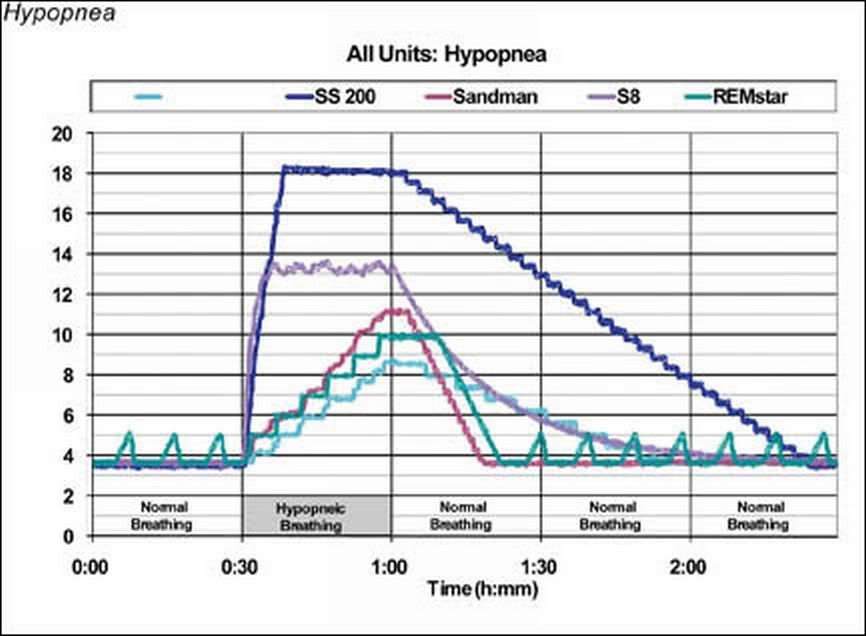
This chart - from a bechmark study throwing real life events at APAP's was linked to recently by NotMuffy on another thread. It show that the S8 does indeed respond to events that are scored in PSG's as hypopneas:
Image

Here's chart showing what the machines were challenged with - you can see the difference between hypopneas on flow limitations.
Image

And here you can compare the S8's response to FL: whereas "hypopneic breathing" as_scored_by_professionals_in_a_psg drove it up to 12.5, FL's drove it up to 16.

Image

_________________
Mask: AirFit™ P10 Nasal Pillow CPAP Mask with Headgear
Additional Comments: Machine: Resmed AirSense10 for Her with Climateline heated hose ; alternating masks.
And now here is my secret, a very simple secret; it is only with the heart that one can see rightly, what is essential is invisible to the eye.
Antoine de Saint-Exupery

Good advice is compromised by missing data
Forum member Dog Slobber Nov. 2023

User avatar
NotMuffy
Posts: 962
Joined: Wed Sep 16, 2009 6:56 am
Location: Dunno. GPS is dead.

Re: .

Post by NotMuffy » Tue Feb 15, 2011 5:02 am

Rebecca R wrote:Was it (a) trick answer?
Of course. Did you think this was going to be easy?
Rebecca R wrote:I don't know what the time frame is on your examples, but aren't they too long (over 10 seconds) to qualify as hypopneas?
That's a great starting point. The event needs to have a minimum duration (so it can't be too long)(within reason, cause if overall breathing is reduced, then that becomes the "baseline", and there can be no relative "flow reduction").

Anyway, in response to your query, that is a 120-second epoch, so the vertical lines are 30 second marakers. That would make the events (let's call 'em IFLs for the time being) ~27, 25, and 17 seconds in duration, respectively:

Image
"Don't Blame Me...You Took the Red Pill..."

User avatar
rested gal
Posts: 12880
Joined: Thu Sep 09, 2004 10:14 pm
Location: Tennessee

Re: .

Post by rested gal » Tue Feb 15, 2011 8:37 am

Rebecca R wrote:I don't know what the time frame is on your examples
Very good, Rebecca. I wondered about that, too.
NotMuffy wrote:That's a great starting point. The event needs to have a minimum duration
----
that is a 120-second epoch, so the vertical lines are 30 second marakers. That would make the events (let's call 'em IFLs for the time being) ~27, 25, and 17 seconds in duration, respectively:
As a squiggle-interpretation-challenged person muddling my way onward from the "30 second markers" info...

The SpO2 was doing what during those "events?"
Since they're already scored and have been stamped "inspiratory flow limitation" I suppose the SpO2 wasn't doing the obligatory percentage of drop (3%? 4%? I never can remember which) to earn them official hypopnea status.

The effort belts are showing what during each "event?"

The EEG is showing what regarding "stage" and "arousals?"
ResMed S9 VPAP Auto (ASV)
Humidifier: Integrated + Climate Control hose
Mask: Aeiomed Headrest (deconstructed, with homemade straps
3M painters tape over mouth
ALL LINKS by rested gal:
viewtopic.php?t=17435

User avatar
Rebecca R
Posts: 367
Joined: Tue Aug 04, 2009 7:40 pm

Re: .

Post by Rebecca R » Tue Feb 15, 2011 10:55 pm

NotMuffy wrote:
Rebecca R wrote:Was it (a) trick answer?
Of course. Did you think this was going to be easy?
Thanks for replacing that article. Actually, yes, I was hoping for easy!
NotMuffy wrote: That's a great starting point. The event needs to have a minimum duration (so it can't be too long)(within reason, cause if overall breathing is reduced, then that becomes the "baseline", and there can be no relative "flow reduction").
If overall breathing is reduced, then is the person just a flatish breather?
NotMuffy wrote: Anyway, in response to your query, that is a 120-second epoch, so the vertical lines are 30 second marakers. That would make the events (let's call 'em IFLs for the time being) ~27, 25, and 17 seconds in duration, respectively:

Image
So then...let's just say that no one challenged them as hypopneas because:
rested gal wrote:The SpO2 was doing what during those "events?"
Since they're already scored and have been stamped "inspiratory flow limitation" I suppose the SpO2 wasn't doing the obligatory percentage of drop (3%? 4%? I never can remember which) to earn them official hypopnea status.
SpO2 didn't drop...
rested gal wrote: The effort belts are showing what during each "event?"
...and they were not central in nature, because there was effort to breathe...
rested gal wrote: The EEG is showing what regarding "stage" and "arousals?"
...and there was an arousal..
...and they were long enough (more than ten seconds)...but not too long...

...and they were terminated by recovery breaths.

But, since we were talking about "inferring" RERAs at home, isn't all we have to infer with the
jnk wrote: ....flow channel.
length of occurence and the presence of recovery breaths?
jnk wrote:
Quizmaster Flash wrote: