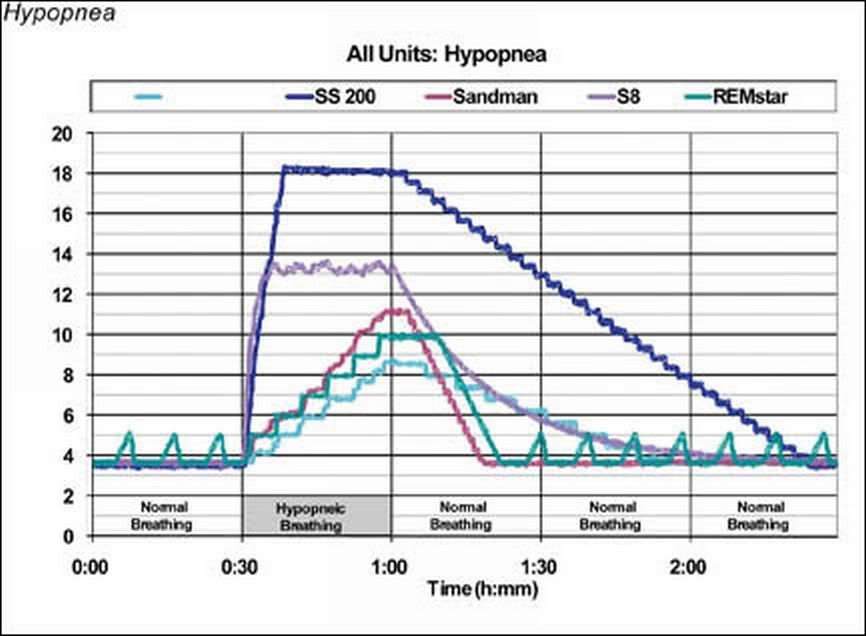
LoQ wrote:jnk wrote:For example, if the patient was using an S8, those would probably be counted as hypopneas.
If the patient was using some other machine, those would probably be counted as flow limitations.
And if the patient was using an S9, they probably wouldn't be counted at all, since the patient will likely get 0.0 AHI that night!
Can you have a hypopnea without flow limitation?
Isn't whether it is a FL or hypopnea really about different aspects of the flow graph? Mightn't you have both?
There are many answers to that question.
From a sleep-tech point of view, they are two completely different things. If it's one, it ain't the other. Even flow limitations get divided up into different kinds, and when "flow limitation" is spoken of in that context, it is actually usually shorthand for "inspiratory flow limitation," as I understand it.
From a home-machine point of view, it really depends. An aggressively scoring machine is likely to call some flow limitations hypopneas. S8, for example. One brand says it treats hypopneas. Another says it treats flow limitations. Part of the reason for that is patent issues, not clinically significant issues.
From a common-sense point of view, I agree that "hypopnea" is just a name given to a great big obvious flow limitation that does something else besides limiting flow. That way of looking at it, though, is using the terms much more loosely than most professionals would use them, unless it is a doc lecturing non-sleep-medicine people. It depends on context.
Scientifically speaking, it is VERY useful to be very specific in how all the events are divided up and named. That's what science does. BUT, from an OSA
patient's point of view, I maintain that the names given to all the stuff that messes up sleep don't really matter for most of us unless we are troubleshooting a problem.
That [being] said, the names do very much matter in the cases where NotMuffy is troubleshooting someone's treatment, as he did here, since, as NotMuffy so elegantly pointed out, ignoring flow limitations isn't smart in the treatment of a patient that is still sleepy and tired, as so many of the patients NotMuffy tries to help on this board are. And too many labs seem to figure 'hey, why bother documenting flow limitations if insurance ain't payin' for UARS anyway these days.'
That is only my personal interpretation and point of view on it, though, which doesn't always line up so well with the real experts.