




I look forward to avi's impressions and comments as well as those of anyone else here who has impressions or suggestions.
Many thanks, Nate




| Mask: DreamWear Nasal CPAP Mask with Headgear |
| Additional Comments: ResMed AirCurve 10 ASV; Dreamwear Nasal Mask Original; CPAPMax Pillow; ResScan & SleepyHead |
In the download process before you do the download I think there is a default to "summary" data and you have to change it to "all data" or similar wording prior to doing the download.NateS wrote:I get Summary Graphs all the way back to my first day, but when I click on Detailed Graphs I get "No detailed data available."
| Machine: AirCurve™ 10 VAuto BiLevel Machine with HumidAir™ Heated Humidifier |
| Additional Comments: Mask Bleep Eclipse https://bleepsleep.com/the-eclipse/ |
That was soooo helpful!Pugsy wrote:In the download process before you do the download I think there is a default to "summary" data and you have to change it to "all data" or similar wording prior to doing the download.NateS wrote:I get Summary Graphs all the way back to my first day, but when I click on Detailed Graphs I get "No detailed data available."
The default download is the summary stuff...you have to tell it to grab the other data.
If you can't find it..this video might help. http://montfordhouse.com/cpap/resscan_tutorial/
I used ResScan briefly during a S9 trial..didn't like it. Prefer SleepyHead.
To get individual breath wave form you have to zoom in and change your daily details (when you get them) to a very small time frame.
Or you can use SleepyHead and do the same thing manually or clicking on the individual events under the Events tab. Have you seen that feature? Events tab...shows the different events category with a number in parenthesis which indicates the number of such events...click on one of the categories and you get all the events in that category along with when they occurred and how long they lasted...click on an individual event say at 01:15....and your graphs will change to show that event up close, zoomed in and individual breaths will show.
| Mask: DreamWear Nasal CPAP Mask with Headgear |
| Additional Comments: ResMed AirCurve 10 ASV; Dreamwear Nasal Mask Original; CPAPMax Pillow; ResScan & SleepyHead |
| Humidifier: S9™ Series H5i™ Heated Humidifier with Climate Control |
| Additional Comments: S9 Autoset machine; Ruby chinstrap under the mask straps; ResScan 5.6 |
Whoops! Too late - I was in the process of posting them above before I saw your new reply of this evening, which I only saw afterwards. My post somehow appears above yours though. I will now read and study your detailed new comments and discussion, for which I am very grateful!avi123 wrote:Nate, So, …
to glance at your Complex SAS RescSan graphs would be interesting to see but, at this time, imo, you should better concentrate on John Fisher's suggestions instead of wasting your time on the Rescan graphs.
p.s. if you got the time check this debate on Complex SA:
http://www.ncbi.nlm.nih.gov/pmc/article ... 5.403.pdfV
| Mask: DreamWear Nasal CPAP Mask with Headgear |
| Additional Comments: ResMed AirCurve 10 ASV; Dreamwear Nasal Mask Original; CPAPMax Pillow; ResScan & SleepyHead |
AVI, thank you for this!avi123 wrote:Nate, I asked to see your results on a ResScan graphs b/c I thought that you have CSAS only and I have been trying to study it in a Rescan wave shape graph. But it turns out that you have Complex SAS which Resmed describes as:
What is complex sleep apnea?
Complex sleep apnea (CompSA) is a form of sleep apnea in which central apneas persist or emerge during attempts to treat obstructive events with a continuous positive airway pressure (CPAP) or bilevel device.
CompSA is characterized by the following:
•The persistence or emergence of central apneas or hypopneas upon exposure to CPAP or bilevel when obstructive events have disappeared
•CompSA patients have predominately obstructive or mixed apneas during the diagnostic sleep study, occurring at least 5 times per hour
•With use of a CPAP or bilevel, they show a pattern of central apneas and hypopneas that meets the Centers for Medicare Services (CMS) definition of CSA (described below)
A diagnosis of central sleep apnea (CSA) requires all of the following:
•An apnea index > 5
•Central apneas/hypopneas > 50% of total apneas/hypopneas
•Central apneas or hypopneas occurring at least 5 times per hour
•Symptoms of either excessive sleepiness or disrupted sleep
The difference between central, mixed and complex sleep apnea CSA is a form of sleep-disordered breathing (SDB) caused by the temporary absence of a signal from the brain’s respiratory center. Without this signal, there is no effort to breathe. Mixed sleep apnea is fairly common and consists of both central and obstructive components. On the other hand, CompSA consists of all or predominantly obstructive apneas which convert to all or predominantly central apneas when treated with a CPAP or bilevel devices.
The challenge to treat CompSA
Patients with CompSA cannot be adequately treated with CPAP or bilevel device. The clinical consequences are residual symptoms (fatigue, sleepiness, depressed mood) and intolerance to therapy.
Patients with CompSA may be seen as those who cannot tolerate conventional CPAP or bilevel therapy both during lab titration and at home. Neither CPAP nor bilevel therapy seems to alleviate their sleep disorders. For CompSA patients, treatment with CPAP or bilevel therapy will leave them with a somewhat elevated AHI, and their disorder will not be completely resolved.
How does the VPAP Adapt SV treat CompSA?
Our VPAP Adapt SV is the first FDA-cleared device designed to treat CSA, CompSA, mixed apnea and periodic breathing. VPAP Adapt SV uses adaptive servo-ventilation to adapt to a patient’s ventilatory needs on a breath-by-breath basis.
Source:
http://www.resmed.com/us/clinicians/abo ... clinicians
So,
to glance at your Complex SAS RescSan graphs would be interesting to see but, at this time, imo, you should better concentrate on John Fisher's suggestions instead of wasting your time on the Rescan graphs.
p.s. if you got the time check this debate on Complex SA:
http://www.ncbi.nlm.nih.gov/pmc/article ... .5.403.pdf
| Mask: DreamWear Nasal CPAP Mask with Headgear |
| Additional Comments: ResMed AirCurve 10 ASV; Dreamwear Nasal Mask Original; CPAPMax Pillow; ResScan & SleepyHead |
| Machine: AirCurve™ 10 VAuto BiLevel Machine with HumidAir™ Heated Humidifier |
| Additional Comments: Mask Bleep Eclipse https://bleepsleep.com/the-eclipse/ |
| Mask: DreamWear Nasal CPAP Mask with Headgear |
| Additional Comments: ResMed AirCurve 10 ASV; Dreamwear Nasal Mask Original; CPAPMax Pillow; ResScan & SleepyHead |
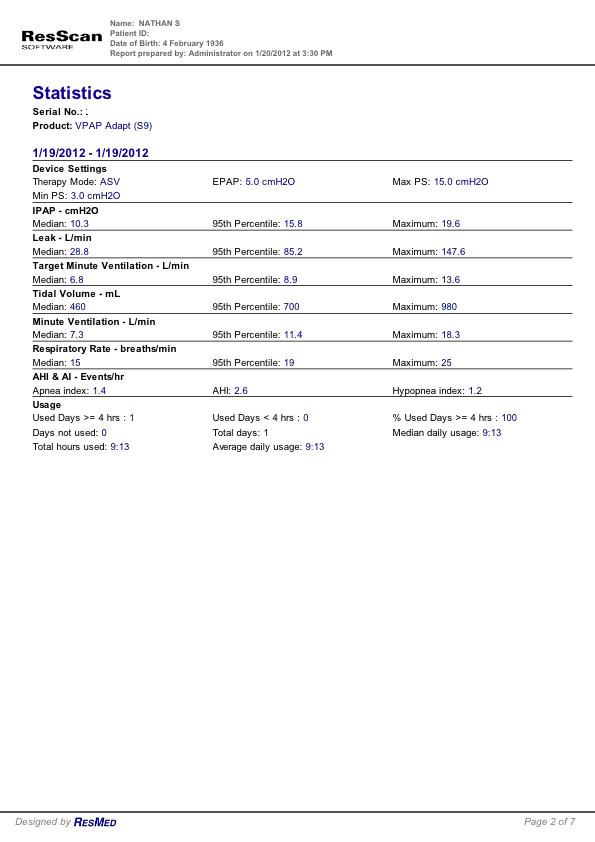
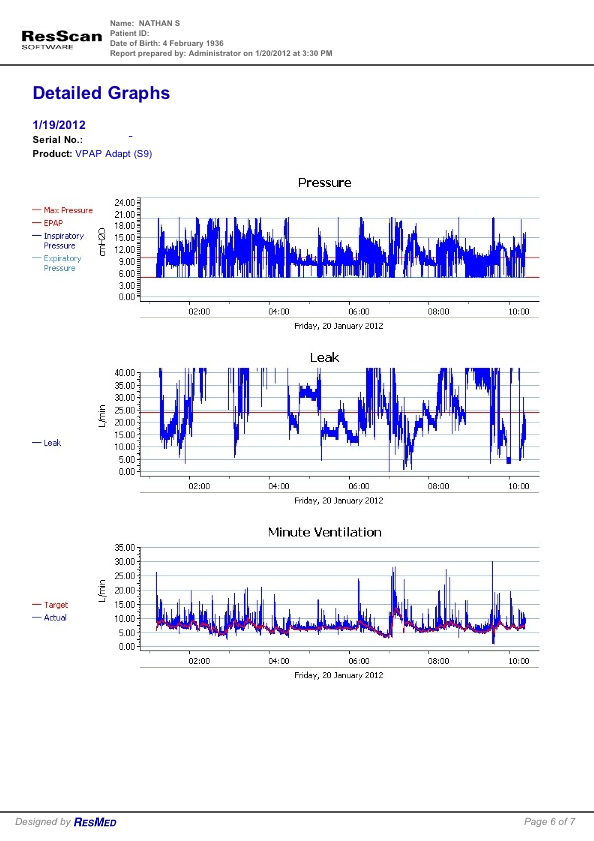
Unknown really from what we can see here. Pretty much your leak is way excessive for the bulk of the night. Let me see if I can get my ResScan to show you what a decent leak line should look like. I have trouble managing the graphs.NateS wrote:did something happen to cause me to tear my mark off?

| Machine: AirCurve™ 10 VAuto BiLevel Machine with HumidAir™ Heated Humidifier |
| Additional Comments: Mask Bleep Eclipse https://bleepsleep.com/the-eclipse/ |
Wow! That's a pretty impressive low leak chart! I see that you wear the same nasal pillow mask that I do - are there any tips or secrets you can pass on as to how you keeps the leaks so low with it?Pugsy wrote:Unknown really from what we can see here. Pretty much your leak is way excessive for the bulk of the night. Let me see if I can get my ResScan to show you what a decent leak line should look like. I have trouble managing the graphs.NateS wrote:did something happen to cause me to tear my mark off?
Well, not the greatest image but a very decent leak line...only a couple of small little blips. Most likely the nasal pillow slipped around a bit. You are new to all this and I have been doing it a long time. So we don't expect you to have a perfect leak line but you can see yours and look at mine. Now if your other nights were a lot better than last night I won't say anything.
| Mask: DreamWear Nasal CPAP Mask with Headgear |
| Additional Comments: ResMed AirCurve 10 ASV; Dreamwear Nasal Mask Original; CPAPMax Pillow; ResScan & SleepyHead |
Gosh, I don't do anything special. I don't route my hose over my head. I let it flop around when I toss and turn. I have it so loose that I can put the mask on easily with one hand and I haven't made any adjustment to the straps since I got it about 6 months ago. I have minimal slippage of that back strap. I don't use Lansinoh ointment. I toss and turn a lot.NateS wrote:How do you do it to get a chart like yours?
| Machine: AirCurve™ 10 VAuto BiLevel Machine with HumidAir™ Heated Humidifier |
| Additional Comments: Mask Bleep Eclipse https://bleepsleep.com/the-eclipse/ |


| Humidifier: S9™ Series H5i™ Heated Humidifier with Climate Control |
| Additional Comments: S9 Autoset machine; Ruby chinstrap under the mask straps; ResScan 5.6 |

| Mask: Quattro™ FX Full Face CPAP Mask with Headgear |
| Additional Comments: User of xPAP therapy for over 20 yrs. Resmed & Respironics ASV units with EEP=9cm-14cm H2O; PSmin=4cm H2O; PSmax=15cm H2O; Max=25cm H2O |
| Machine: AirCurve™ 10 VAuto BiLevel Machine with HumidAir™ Heated Humidifier |
| Additional Comments: Mask Bleep Eclipse https://bleepsleep.com/the-eclipse/ |
Avi, here is an excerpt from my sleep doc's recommendations:avi123 wrote:Nate, since you show much interest in your situation, I am bombarding you with more stuff.
****************
When I look at your Leak graph I see that the hi leaks spikes are correlated with the hi pressure spikes. Why are you setting max pressure so hi? **********
| Mask: DreamWear Nasal CPAP Mask with Headgear |
| Additional Comments: ResMed AirCurve 10 ASV; Dreamwear Nasal Mask Original; CPAPMax Pillow; ResScan & SleepyHead |