Link between OSA and the "beer gut"

General Discussion on any topic relating to CPAP and/or Sleep Apnea.
User avatar
Muffy
Posts: 960
Joined: Tue Apr 21, 2009 5:28 am
Location: Schenectady, New York

Re: Link between OSA and the "beer gut"

Post by Muffy » Sun Dec 20, 2009 8:12 pm

split_city wrote:Figure from Ninane et al 1993.

But, coming back to an earlier point...is my 20cmH20 guy an obstructed airways patient? After looking at his spirometry results, he had an FEV1 of 87% predicted and FVC of 80% predicted so maybe something there.
Have you totally lost your mind? The Nihane group FEV1% was 28%!! They're running around with iPEEP no matter what they do!!!

What possible relevance does that have with anything! If you thought your guy had supine EFL, why didn't you do supine spirometry? What is the physiology behind your iPEEP?

Muffy
________________________________

Machine: Dell Dimension 8100
Mask: 3M N-95 (during flu season)
Humidifier: Avoided, tends to make me moldy
Software: XP Pro
Additional Comments: You can't find a solution when you don't know the problem

split_city
Posts: 465
Joined: Mon Apr 23, 2007 2:46 am
Location: Adelaide, Australia

Re: Link between OSA and the "beer gut"

Post by split_city » Sun Dec 20, 2009 8:37 pm

Muffy wrote:If you thought your guy had supine EFL, why didn't you do supine spirometry?


We didn't enrol patients if they had a history of abnormal lung function. We didn't suspect he did at the time of testing. In hindsight, perhaps we should also perform PFTs in the supine posture.
Muffy wrote:What is the physiology behind your iPEEP?


Increased expiratory swings in gastric pressure.

split_city
Posts: 465
Joined: Mon Apr 23, 2007 2:46 am
Location: Adelaide, Australia

Re: Link between OSA and the "beer gut"

Post by split_city » Sun Dec 20, 2009 11:08 pm

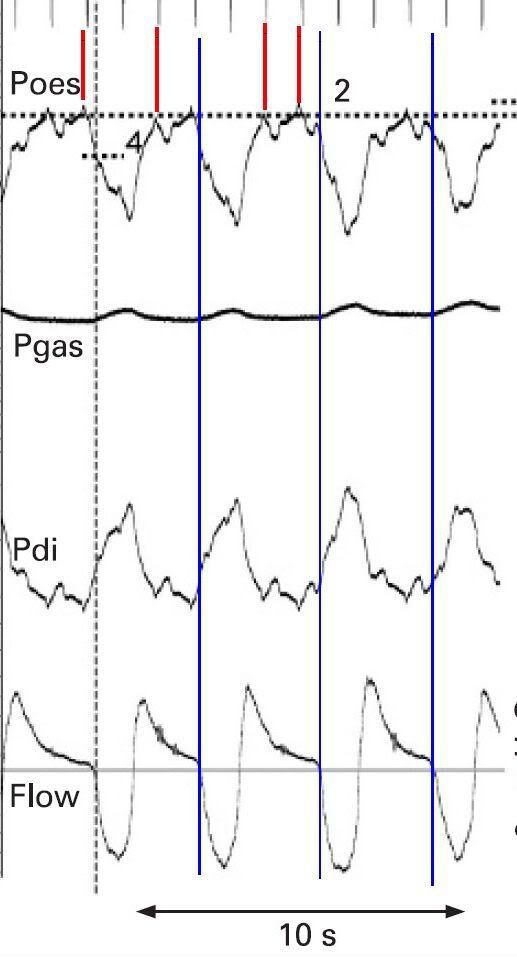
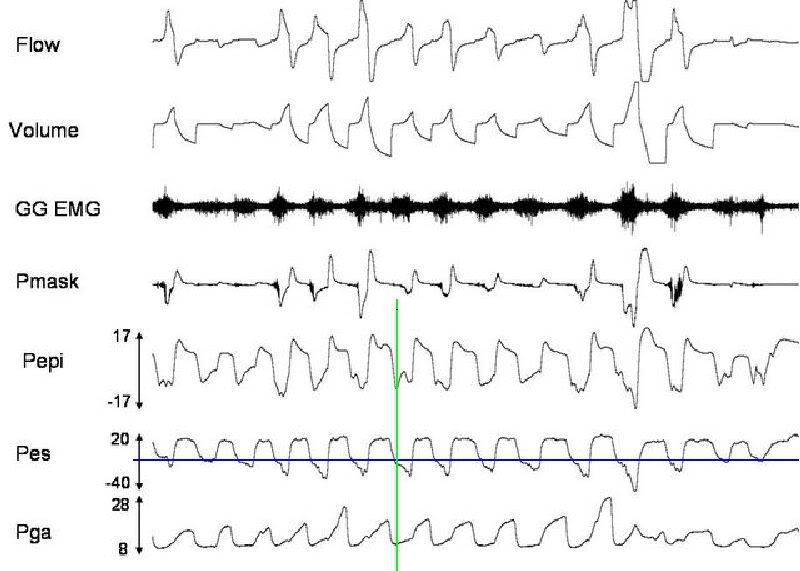
While I believe that the increased expiratory drive in gastric pressure is contributing to the increase in end-expiratory Pes (explaining the 20cmH20), the crux of the argument is, what is causing the expiratory obstruction? PFTs don't suggest anything out of the ordinary. Back to the 20cmH20 guy, I have also added in an epiglottic pressure trace (probably something that should have been added a long time ago!) Maybe this will also tell us where the obstruction is? Muffy, do you believe it might be an obstruction in the upper airway? Obviously excluding OSA, which this guy has (RDI 91). There is about a +4cmH20 offset in epiglottic pressure, probably due to some catheter blockage. But peak expiratory epiglottic pressure is also very high. Would that point to an obstruction above the epiglottis? Perhaps the soft palate is somehow impeding expiratory flow. Patients were only breathing through their nose in this study. This, in combination with increase expiratory gastric pressure swings, is potentially causing the increased end-expiratory Pes? Maybe this is why we didn't pick anything up during PFTs as this is likely to be only a sleep phenomenon. Plausible?

Image

User avatar
Muffy
Posts: 960
Joined: Tue Apr 21, 2009 5:28 am
Location: Schenectady, New York

Re: Link between OSA and the "beer gut"

Post by Muffy » Mon Dec 21, 2009 6:06 am

I think there's 2 cruxi to the problem:

What is the site and phenomena that creates the obstruction (we obviously agree that there is a fairly hefty obstruction); and
what in turn, causes that.

I have a little difficulty accepting the whole iPEEP (or AutoPEEP) thing in that events at that particular moment in time are extremely dynamic. iPEEP is most often associated with incomplete exhalation (or continuing exhalation) which is interrupted by an inspiration. Measuring this moment, on mechanical ventilatory support for instance, involves slamming the circuit shut at the moment an inspiration is expected to occur (and you really need the patient to be paralyzed to do this), allowing the chest and abdominal contents to continue to collapse, and then measuring the end result. The obvious fault in this technique is that you're really measuring the net effect of collapsing forces rather than any actual given moment of iPEEP.

Instead of looking at iPEEP, I believe it would have been far more helpful to track end expiratory lung volume (EELV), as suggested by your reference 7 (the Boston crowd)(the article link won't post, there's something in it that generates that "Internal Server Error" message on the board)

as well as the poster SAG, who went through the trouble of testing himself over 2 years ago to demonstrate how simple it would be to perform that test:

A Comparison of Postural PFTs in a Normal Population

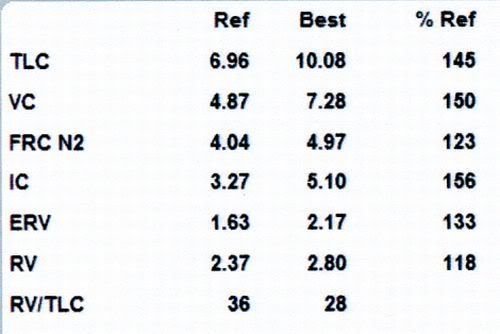
Lung Volumes - Sitting
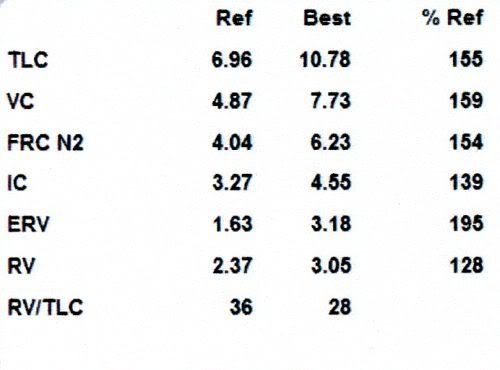
Image

Lung Volumes - Supine

Image

viewtopic.php?f=1&t=25185&p=222003&hili ... es#p222003

as well as revealing valuable information on much ERV would drop when moving from sitting to supine.

It becomes extremely noteworthy when one realizes that the poster SAG is also "incredibly fit" (for his age, anyway), so doing a supine PFT on somebody morbidly obese gives information that absolutely must be considered.

Your new image offers further support that tracking iPEEP is either inaccurate or irrelevant:

Image

The calculation of iPEEP is based on looking for that stupid blip. As the blue line notes, sometimes you got a blip, sometime you don't. So in answer to your question, yes, I believe there is upper airway obstruction present, the blip represents airway opening, and the flatness of Pes after opening flow is a reflection of the flow limitation (literally).

Muffy
________________________________

Machine: Dell Dimension 8100
Mask: 3M N-95 (during flu season)
Humidifier: Avoided, tends to make me moldy
Software: XP Pro
Additional Comments: You can't find a solution when you don't know the problem

split_city
Posts: 465
Joined: Mon Apr 23, 2007 2:46 am
Location: Adelaide, Australia

Re: Link between OSA and the "beer gut"

Post by split_city » Mon Dec 21, 2009 7:35 am

Muffy wrote:I think there's 2 cruxi to the problem:

What is the site and phenomena that creates the obstruction (we obviously agree that there is a fairly hefty obstruction); and
what in turn, causes that.

Instead of looking at iPEEP, I believe it would have been far more helpful to track end expiratory lung volume (EELV), as suggested by your reference 7 (the Boston crowd)(the article link won't post, there's something in it that generates that "Internal Server Error" message on the board)
Arrggghh, EELV has been a major component of my thesis. So do you mean it would have been useful to track EELV during these times of high end-expiratory Pes? Just in relation to the Boston crowd, which actually relates to a lot of my work, they actually measured change in EELV as measured by magnetometers, not absolute EELV.

Back to SAG. Silly question, but how was the test performed in the supine posture? Was it done by plethysmography? Or does the N2 represent nitrogen washout? We have previously measured FRC using helium dilution during wakefulness but we found it fiddly, with quite variable results within individuals. I couldn't imagine doing it during sleep. Plus, don't you need relatively large tidal volumes to ensure gas mixing and to allow mixing in smaller airways which might be closed at lower tidal volumes?
Muffy wrote:as well as the poster SAG, who went through the trouble of testing himself over 2 years ago to demonstrate how simple it would be to perform that test:

A Comparison of Postural PFTs in a Normal Population

Lung Volumes - Sitting

Image

Lung Volumes - Supine

Image

viewtopic.php?f=1&t=25185&p=222003&hili ... es#p222003
Muffy wrote:as well as revealing valuable information on much ERV would drop when moving from sitting to supine.
But FRC changes very little in the obese following the same change in posture, despite increased mass loading. This formed the basis of my second study + manuscript which is in the process of being reviewed. We have been interested as to why lung volume doesn't decrease in the obese. We thought of a few possibilities and I would love to hear your thoughts.

1) This was our major hypothesis. Similar to increased genioglossus activity during wakefulness, we speculated that there would be increased expiratory (tonic) diaphragm muscle activity in obese OSA patients when supine, which prevents/limits the cranial displacement of the diaphragm, and thus preventing/limiting the decrease in EELV
2) EELV in obese individuals is already close to RV i.e. ERV is low. Given that RV changes very little when moving to the supine position, EELV doesn't have much room to fall
3) Something discussed amongst us recently. Given the findings by Steier, it appears that iPEEP increases in the obese when they move to the supine position, which may also limit the decrease in EELV

We found no evidence to suggest that tonic diaphragm activity is higher in obese OSA patients during wake compared to age-matched, healthy-weight controls, thus ruling out point number 1.
Muffy wrote:It becomes extremely noteworthy when one realizes that the poster SAG is also "incredibly fit" (for his age, anyway), so doing a supine PFT on somebody morbidly obese gives information that absolutely must be considered.
hhhmmm, very large volumes! 6L FRC??
Muffy wrote:Your new image offers further support that tracking iPEEP is either inaccurate or irrelevant:
Image

The calculation of iPEEP is based on looking for that stupid blip. As the blue line notes, sometimes you got a blip, sometime you don't. So in answer to your question, yes, I believe there is upper airway obstruction present, the blip represents airway opening, and the flatness of Pes after opening flow is a reflection of the flow limitation (literally).

Muffy
Yeah it's a bit confusing to me. So iPEEP is the pressure difference between end-expiratory Pes and the onset of flow. But I guess there isn't any flow to begin with because he is initially obstructed. So should iPEEP represent the pressure difference between end-expiratory Pes and when (expiratory) flow reaches zero? Please correct me if I'm wrong!

It's obviously hard to tell on your side but I reckon that my additional line represents the time when expiratory flow reaches zero and when he should be generating airflow, if it weren't for upper airway obstruction. Not much of a difference from your line but it does make a difference in regards to what Pes is.

Image

But it would certainly be interesting to know what's obstructing his airway during expiration. Time to stick a camera down his airway I reckon.

User avatar
Muffy
Posts: 960
Joined: Tue Apr 21, 2009 5:28 am
Location: Schenectady, New York

Re: Link between OSA and the "beer gut"

Post by Muffy » Mon Dec 21, 2009 1:05 pm

split_city wrote:Silly question, but how was the test performed in the supine posture? Was it done by plethysmography? Or does the N2 represent nitrogen washout?
Right. The plethysmograph didn't work very well on its side.
split_city wrote:Given the findings by Steier, it appears that iPEEP increases in the obese when they move to the supine position, which may also limit the decrease in EELV
Just goes to show ya, iPEEP may not necessarily be bad PEEP. Intubate the patient and then measure EELV and see what you get.
split_city wrote:hhhmmm, very large volumes! 6L FRC??
One could assume that he'd have some good potential to perform high-intensity long-duration aerobic exercise given that physiology.

Muffy
________________________________

Machine: Dell Dimension 8100
Mask: 3M N-95 (during flu season)
Humidifier: Avoided, tends to make me moldy
Software: XP Pro
Additional Comments: You can't find a solution when you don't know the problem

User avatar
LinkC
Posts: 3154
Joined: Wed Oct 29, 2008 1:06 pm
Location: Amelia Island, FL

Re: Link between OSA and the "beer gut"

Post by LinkC » Mon Dec 21, 2009 1:40 pm

[boggle] Whoa! I used to think I spoke English... Ya'll lost me after "beer gut"!

_________________
MachineMaskHumidifier
Additional Comments: 11-14 cmH2O
The OSA patient died quietly in his sleep.
Unlike his passengers who died screaming as the car went over the cliff...

split_city
Posts: 465
Joined: Mon Apr 23, 2007 2:46 am
Location: Adelaide, Australia

Re: Link between OSA and the "beer gut"

Post by split_city » Mon Dec 21, 2009 6:27 pm

Muffy wrote:
split_city wrote:Silly question, but how was the test performed in the supine posture? Was it done by plethysmography? Or does the N2 represent nitrogen washout?
Right. The plethysmograph didn't work very well on its side.
I wouldn't laugh as our lung function lab asked us if we wanted one of their older plethysmograph devices. We were considering how to modify it so we could both perform tests in the upright and supine postures. Unfortunately, we just didn't have the room to store it!
Muffy wrote:
split_city wrote:Given the findings by Steier, it appears that iPEEP increases in the obese when they move to the supine position, which may also limit the decrease in EELV
Just goes to show ya, iPEEP may not necessarily be bad PEEP. Intubate the patient and then measure EELV and see what you get.
As a matter of fact, my supervisor and I have been discussing that exact point! For example, my supervisor has said "While OSA is generally considered a disorder of impaired inspiration due to partial or complete upper airway collapse, impaired expiration and development of iPEEP could further impact on subsequent inspiratory effectiveness. On the other hand, increased lung volume may have some advantages in OSA patients who are generally obese and with a substantially reduced lung volume. Low lung volume in itself may impact on upper airway function via upper airway tethering effects, and destabilised respiratory control via reduced CO2 buffering effects with ventilation at low lung volume. Consequently, the development of iPEEP either by a) passive mechanisms related to airway collapse and possibly obesity effects on lung volume and/or b) active respiratory control mechanisms, could play an important role in modulating respiratory events in OSA."

Going back to my study where I measured tonic diaphragm activity during wakefulness between obese OSA patients and healthy-weight controls. We also investigated changes in lung volume at sleep onset between the two groups. We hypothesized that the obese would experience a greater loss in EELV at sleep onset due to mass loading effects and muscle relaxtion. If so, this may contribute to the development of unstable breathing commonly seen shortly after sleep onset (first three breaths). We actually found no overall difference in lung volume changes between the two groups but there was a group x breath interaction, indicating that EELV fell more rapidly in the obese. Nevertheless, EELV only fell by ~60ml and ~33ml by the 3rd post-sleep onset breath in the obese group and controls respectively. Not the kind of results we predicted. However, we did also show that there were greater decrements in EELV when respiratory events shortly followed (within 30secs) of sleep onset.

It would actually be interesting to see what iPEEP does over the sleep onset transition.

Private communications with Paolo Pelosi (excuse the English)

"What we know is that obese patients in supine develop airway flow limitation and PEEPi. What we know also is that
the obese patients may keep the EELV or FRC becouse they have PEEPi. In my opinion PEEPi is a "safe" reflex in order to avoid excessive changes in PEEPi when supine or in th eperioperative period. In other terms if these patients do not have PEEPi they decrease their EELV or FRC. On the other hand we know that if they are flow limited they develop more complications, sue ot increased WOB to keep enough FRC/EELV. Thus we have two categories of patients. Those that who do not need PEEPi to keep lung volume at end exp, and they are better and OK. Other that they need PEEPi, for some of the the WOB is to high in the post op ( see also our paper on Chest ) and they are likely to develop post op complications, and those for whom thi sload is not so excessive.
It would be interesting to look at all these factors related to sleep apnea. We neevr investigated that"

User avatar
Muffy
Posts: 960
Joined: Tue Apr 21, 2009 5:28 am
Location: Schenectady, New York

Re: Link between OSA and the "beer gut"

Post by Muffy » Tue Dec 22, 2009 5:41 am

split_city wrote:Given the findings by Steier, it appears that iPEEP increases in the obese when they move to the supine position, which may also limit the decrease in EELV
Well, returning to that portion of the thread, I don't think Steier has found anything.
split_city wrote:
Muffy wrote:
split_city wrote:But please feel free to write a letter to the editor of Thorax expressing your concerns with the Steier article and perhaps also Journal of Applied Physiology in regards to the Carley paper.
Have their people call my people and I'll see if I can work them in, but you're the one who just bad-mouthed his iPEEP thing, not me.

Oooooh, is he ever gonna be mad.....

Muffy
What you talking about willis? Nope, I didn't bad mouth it at all. I keep referring to it to support my work. You're the one expressing concerns with their data. You follow it up with him. Why not send an email directly to Steier to ask him for his biocals?
But since you apparently aren't going to tell him, and I'm obviously way too busy putting up my Christmas wreath and a few other things that I'm sure I could come up with, I have no intention of emailing anybody, so I guess people who read that can believe what they want.

In the meanwhile, to help them evaluate the Steier data, I would offer the following:

End-expiration must be defined, and it can only be this:
Muffy wrote:End-expiration is the point that immediately precedes the ensuing inspiration.
In the references presented thus far, Pdi has been used to define that moment. It was used in Pankow:

Image

In Steier awake sitting:

Image

And in Steier sleeping supine intervention:

Image

However, in an argument of convenience, the definition of end-expiration has now shifted well into inspiration:

Image

so the calculation of iPEEP is not valid. Pes has been sucked down by diaphragmatic effort. If he were to be consistent in his measurements and put end-expiration at Pdi, iPEEP would = 0:

Image

Perhaps I will email him with these concerns after the holidays.

No wait-- I have to take my wreath down.

Muffy
________________________________

Machine: Dell Dimension 8100
Mask: 3M N-95 (during flu season)
Humidifier: Avoided, tends to make me moldy
Software: XP Pro
Additional Comments: You can't find a solution when you don't know the problem

split_city
Posts: 465
Joined: Mon Apr 23, 2007 2:46 am
Location: Adelaide, Australia

Re: Link between OSA and the "beer gut"

Post by split_city » Tue Dec 22, 2009 8:34 am

Muffy wrote:
split_city wrote:
Muffy wrote:
split_city wrote:But please feel free to write a letter to the editor of Thorax expressing your concerns with the Steier article and perhaps also Journal of Applied Physiology in regards to the Carley paper.
Have their people call my people and I'll see if I can work them in, but you're the one who just bad-mouthed his iPEEP thing, not me.

Oooooh, is he ever gonna be mad.....

Muffy
What you talking about willis? Nope, I didn't bad mouth it at all. I keep referring to it to support my work. You're the one expressing concerns with their data. You follow it up with him. Why not send an email directly to Steier to ask him for his biocals?
But since you apparently aren't going to tell him, and I'm obviously way too busy putting up my Christmas wreath and a few other things that I'm sure I could come up with, I have no intention of emailing anybody, so I guess people who read that can believe what they want.
So pretty much all huff and puff on your behalf?
Muffy wrote:
split_city wrote:Given the findings by Steier, it appears that iPEEP increases in the obese when they move to the supine position, which may also limit the decrease in EELV
Well, returning to that portion of the thread, I don't think Steier has found anything.

In the meanwhile, to help them evaluate the Steier data, I would offer the following:

End-expiration must be defined, and it can only be this:
Muffy wrote:End-expiration is the point that immediately precedes the ensuing inspiration.
In the references presented thus far, Pdi has been used to define that moment. It was used in Pankow:

Image
I'm with ya.
Muffy wrote:In Steier awake sitting:

Image
In this example, end-expiration/start inspiratory effort (corner point of Pes, upwards deflection in Pdi) and start flow (downwards deflection in flow), all coincide with each other. Therefore, iPEEP = 0.
Muffy wrote:And in Steier sleeping supine intervention:

Image
That's supine + CPAP, but go ahead. But same as above i.e. end-expiration/start inspiratory effort (corner point of Pes, upwards deflection in Pdi) and start flow (downwards deflection in flow), all coincide with each other. Therefore, iPEEP = 0.
Muffy wrote:However, in an argument of convenience, the definition of end-expiration has now shifted well into inspiration:

Image
Say what?? Have you totally lost your mind? That vertical line doesn't represent end-expiration/start inspiratory effort, it represents start inspiratory flow, as it does in both the other figures. It even says that in the figure legend. Whoops!
Muffy wrote:so the calculation of iPEEP is not valid. Pes has been sucked down by diaphragmatic effort. If he were to be consistent in his measurements and put end-expiration at Pdi, iPEEP would = 0:
Oh dear
Muffy wrote:Image
Yeah, what you did was add in end-expiration/start inspiratory effort. Their vertical line doesn't represent that. The difference between this figure and the Steier seated one is the that start flow doesn't coincide with end-expiration/start inspiratory effort (rise in Pdi). Thus there is iPEEP.
Muffy wrote:
Muffy wrote: End-expiration is the point that immediately precedes the ensuing inspiration.
In the references presented thus far, Pdi has been used to define that moment. It was used in Pankow:

Image
Back to this picture. This is pretty much the same as Steier except they put in both lines; (1) end-expiration/start inspiratory effort (downward deflection in Pes, rise in Pdi) and (2) start flow. The difference = iPEEP.
Muffy wrote:Perhaps I will email him with these concerns after the holidays.

No wait-- I have to take my wreath down.
Be my guest! I'm sure Steier would love to hear from ya!

User avatar
Muffy
Posts: 960
Joined: Tue Apr 21, 2009 5:28 am
Location: Schenectady, New York

Re: Link between OSA and the "beer gut"

Post by Muffy » Tue Dec 22, 2009 10:31 am

split_city wrote:
Muffy wrote:And in Steier sleeping supine intervention:
That's supine + CPAP, but go ahead.
Right. Medical people will label a treatment modality an "intervention".
split_city wrote:Gee I wish I understood what was being discussed here.
You're in luck! It's Christmas! Perhaps the Wizard will give you a brain!

Oh, sorry. Wrong story.

Muffy
________________________________

Machine: Dell Dimension 8100
Mask: 3M N-95 (during flu season)
Humidifier: Avoided, tends to make me moldy
Software: XP Pro
Additional Comments: You can't find a solution when you don't know the problem

split_city
Posts: 465
Joined: Mon Apr 23, 2007 2:46 am
Location: Adelaide, Australia

Re: Link between OSA and the "beer gut"

Post by split_city » Tue Dec 22, 2009 2:44 pm

Muffy wrote:
split_city wrote:
Muffy wrote:And in Steier sleeping supine intervention:
That's supine + CPAP, but go ahead.
Right. Medical people will label a treatment modality an "intervention".
split_city wrote:Gee I wish I understood what was being discussed here.
You're in luck! It's Christmas! Perhaps the Wizard will give you a brain!

Oh, sorry. Wrong story.

Muffy
No need to start making up quotes to deflect away from your misunderstanding.

But I guess it was hard to understand what was being discussed considering you were a little confused. Please feel free to flick me that email that you plan to send to Steier. I wouldn't want you to embarrass yourself by showing that you couldn't read a figure legend correctly. Here's hoping you learn from your mistake. Remember, baby steps

User avatar
Muffy
Posts: 960
Joined: Tue Apr 21, 2009 5:28 am
Location: Schenectady, New York

Re: Link between OSA and the "beer gut"

Post by Muffy » Tue Dec 22, 2009 10:02 pm

Split_City wrote:Their vertical line doesn't represent that. The difference between this figure and the Steier seated one is the that start flow doesn't coincide with end-expiration/start inspiratory effort (rise in Pdi). Thus there is iPEEP.
Are you now totally berserk? The supine example continues to show poor support for this concept and borderline accuracy at best.

Clearly, breaths 2, 3 and 4 (blue lines) do not exhibit any iPEEP characteristics, so even if breath 1 had iPEEP characteristics, it can be best qualified as an outlier:

Image

One of my earlier points pertained to performing some verification of signals (biocalibrations or the like) to insure that all signals were accurate in time relative to each other. As an aside, Pankow did this:
Pankow wrote:Time synchronicity of pressure and flow measurements was assessed by placing the flow sensor, the Pao sensor, and the CMT into the tube of a bass-reflex loudspeaker. Over the range of 5–10 Hz, there was a constant time delay (Dt) of airflow in relation to pressures of 0.03 s.
but I can see no evidence of that being done in Steier (good news and bad news on that later).

However, in a review of channel synchronicity, the electrical signals seen at the top most likely represent EKG artifact. The red lines on top trace EKG down to the Pes where it can now be seen that there is a huge amount of pulse artifact contaminating the waveform, all of which needs to be subtracted from peak Pes. Consequently, that iPEEP calculation measurement would be more in the neighborhood of about 2. And given the very steep descent of Pes at that point, moving that vertical line just a tiny bit to the left (which looks quite justifiable) would give iPEEP = 0.

Muffy
________________________________

Machine: Dell Dimension 8100
Mask: 3M N-95 (during flu season)
Humidifier: Avoided, tends to make me moldy
Software: XP Pro
Additional Comments: You can't find a solution when you don't know the problem

User avatar
Muffy
Posts: 960
Joined: Tue Apr 21, 2009 5:28 am
Location: Schenectady, New York

Re: Link between OSA and the "beer gut"

Post by Muffy » Tue Dec 22, 2009 10:24 pm

In re: the point that the Steier channels are not synchronized, it seems clear that the Pdi signal has a delay of approximately 0.3 seconds (reference the little lump following the green line), obtained by comparing it against the electrical and ballistocardiographic EKG artifact:

Image

which in a study of this nature is huge.

Unfortunately, to support my point about position of Pdi to discount the presence of iPEEP in breath 1, the shift would have needed to go to the left (flow would need the delay) but I do not see clear evidence of that surrogate biocal in the flow waveform.

Muffy
________________________________

Machine: Dell Dimension 8100
Mask: 3M N-95 (during flu season)
Humidifier: Avoided, tends to make me moldy
Software: XP Pro
Additional Comments: You can't find a solution when you don't know the problem

-SWS
Posts: 5301
Joined: Tue Jan 11, 2005 7:06 pm

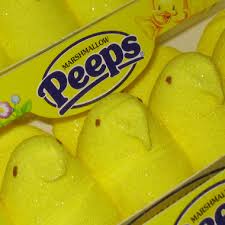
Re: Link between OSA and "Marshmallow PEEPs"

Post by -SWS » Tue Dec 22, 2009 10:36 pm

ImageImage Image

Sorry for getting to this PEEP discussion late...

But I think I might have discovered why the purple ones are having trouble breathing at night.


___________________________________________________________________________________________________________________


Good to see you, Split. And congratulations not once but twice!
split_city wrote:my study was published in the Journal of Sleep this month...
...I have also recently submitted my PhD for review.