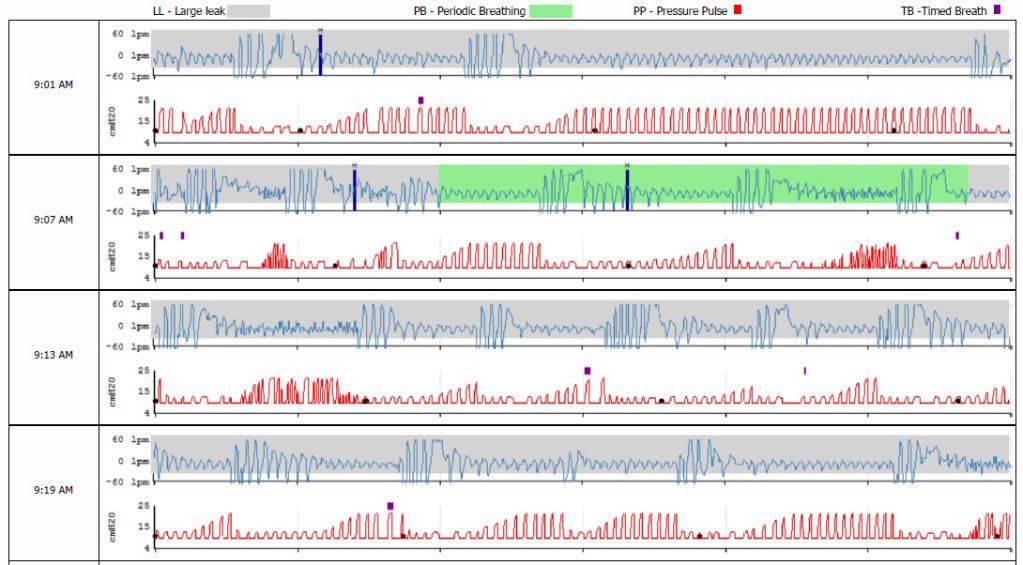
icipher wrote:Thanks for your insight. To clarify, the timed breathing episodes are basically would-be centrals?
How's this for an equivocal answer: "maybe". The machine is deciding that it has been too long since your last breath and giving you a nudge (switching to inhale pressure). If the machine's guess was right, then yes, it averted a central apnea. But sometimes it's just you and the machine not being in sync.
I've encountered this in two situations: after an active dream (breathing rate spikes during dream, then drops after the dream is over) and when waking up in the middle of the night (when I take slower, deeper breaths).
The PR is pretty good at ignoring gradual changes (apparently the ResMed ASV is much pickier about keeping you on a fixed breathing rate), but anything sudden enough makes it think you're skipping a breath. If you find that happening to you, here's the trick: it seems to be based on the pause in between breaths. If you exhale slowly and keep the pause between exhale and inhale short, it won't try to make you breathe when you don't want to. So I just do that for a few breaths, and usually drift off shortly thereafter.
When you mention the "100%, do you mean that all the events i am having look to be centrals and none appear to be obstructive?
No, I mean that the patient triggered breath percentage graph is 100% nearly all of the time, with a few dips.
Does it look as the the hypopneas i am having should be anything to be concerned with or do you THINK they are relatively harmless?
It entirely depends on you. My diagnosis was modera OHA comprised entirely of hypopneas, and I definitely feel worse when I have more than one or two hypopneas in a night, but I suspect the feeling isn't due to the hypopneas themselves, but rather due to whatever sleep disturbance caused the hypopneas. (Certainly one or two hypopneas shouldn't disrupt sleep that much by themselves.)
So again it comes down to the question of your original diagnosis and how you feel. I don't see anything obviously wrong. What was your original AHI number & what was the breakdown between hypopnea, obstructive apnea, and central apnea?
Also, as John often points out, it can take months to fully adjust to ASV, so you might see the hypopneas recede over time as your sleep continues to improve.
I should get an oximeter.
I always recommend Kevin at
Cooper Medical Supplies because of his fantastic customer support.