


...and it's importance.
If it is important enough for PR to include it as one of the few parameters shown on the LED display on my 760P I guess it must be important enough for me to understand. Encore shows my average Periodic Breathing since therapy began on 4/16/13 to be 1.3%; this sounds right given that the actual number usually seems to run from 0% to 2%.
Is this good or bad, and what can I do to improve it?
I'm using a FF mask and currently using BiPap pressures of 15/11 (down from 17/13).
For what it's worth my SH numbers from last night are fairly typical (when I have a good LL night):
LL = 0%
AHI = 1.2
Hypopnea 0.41
Obstructive 0.0 (I almost never have OAs, just Hypopneas and CAs)
Clear Airway 0.82
PB = 2%
Vibratory Snore #2 ( 9 Events of just a few minutes duration each)
Thanks for your help!
Please help me understand Periodic Breathing ...


12 posts
• Page 1 of 1
Please help me understand Periodic Breathing ...
_________________
| Machine: ResMed AirSense™ 10 AutoSet™ CPAP Machine with HumidAir™ Heated Humidifier |
| Mask: DreamWear Full Face CPAP Mask with Headgear (Small and Medium Frame Included) |
| Additional Comments: Pressure 11.0 Min-->14.0 Max EPR 2 |

Re: Please help me understand Periodic Breathing ...
oh gosh, ANOTHER term to learn. man, this is worse than college anatomy!
_________________
| Mask: Swift™ FX For Her Nasal Pillow CPAP Mask with Headgear |
| Humidifier: S9™ Series H5i™ Heated Humidifier with Climate Control |
| Additional Comments: Sleepyhead software, Pressure 9-14, EPRx1, Pad-a-cheek barrel cozy, Resmed hose cover |
Re: Please help me understand Periodic Breathing ...
Periodic breathing is a term describing a repetitive increase and then decrease in the amount of air you breath. To see graphic examples, look up Cheyne-Stokes respiration.
If the measure got significantly high, then it would be important to discuss it with your doctor. That level reported in your machine is quite low.
If the measure got significantly high, then it would be important to discuss it with your doctor. That level reported in your machine is quite low.
_________________
| Mask: Oracle HC452 Oral CPAP Mask |
| Humidifier: DreamStation Heated Humidifier |
| Additional Comments: EverFlo Q 3.0 Liters O2 PR DSX900 ASV |
Oracle 452 Lessons Learned Updated
DSX900 AutoSV with HC150 extra humidifier and Hibernite heated hose
Settings: EPAP Min-10.0, EPAP Max-17, PS Min-3, PS Max-10, Max Pressure-20, Rate-Auto, Biflex-1.
Sleepyhead and Encore Pro 2.21.
DSX900 AutoSV with HC150 extra humidifier and Hibernite heated hose
Settings: EPAP Min-10.0, EPAP Max-17, PS Min-3, PS Max-10, Max Pressure-20, Rate-Auto, Biflex-1.
Sleepyhead and Encore Pro 2.21.

Re: Please help me understand Periodic Breathing ...
Very low. Cheyne-Stokes is much more serious and I really wouldn't worry about it.
Re: Please help me understand Periodic Breathing ...
okay - so I am also new and concerned about periodic breathing - I looked up Cheyne-Stokes (http://lungcancer.about.com/od/glossary ... stokes.htm) and this link sure scared the you know what out me me - I am awake now -
Then I went to - http://en.wikipedia.org/wiki/Cheyne%E2% ... spiration- and now I need to sleep again
I will try to post some graphs for everyone to see my question as soon as I find the post that told me how to do that again...
Then I went to - http://en.wikipedia.org/wiki/Cheyne%E2% ... spiration- and now I need to sleep again
I will try to post some graphs for everyone to see my question as soon as I find the post that told me how to do that again...
_________________
| Mask: Mirage™ FX Nasal CPAP Mask with Headgear |
| Additional Comments: 14/10 with REM Sleep Behavior Disorder |
Re: Please help me understand Periodic Breathing ...
_________________
| Machine | Mask | |
 |  |

Re: Please help me understand Periodic Breathing ...
While Cheyenne Stokes Respiration is a form of Periodic Breathing not all Periodic Breathing is Cheyenne Stokes Respiration.
To have some Periodic Breathing flags by the PR S1 is actually not all that alarming. We all might do it every now and then.
If a person has a LOT of PB accompanied by a large number of central apneas (Clear Airway) in the middle of the PB...then a discussion with a doctor is indicated.
To have some Periodic Breathing flags by the PR S1 is actually not all that alarming. We all might do it every now and then.
If a person has a LOT of PB accompanied by a large number of central apneas (Clear Airway) in the middle of the PB...then a discussion with a doctor is indicated.
_________________
| Machine: AirCurve™ 10 VAuto BiLevel Machine with HumidAir™ Heated Humidifier |
| Additional Comments: Mask Bleep Eclipse https://bleepsleep.com/the-eclipse/ |
I may have to RISE but I refuse to SHINE.


Re: Please help me understand Periodic Breathing ...
They often model the breathing control systems in the body as a servo control system. Sensors in the brain and other places determine how much O2 and CO2 are in our blood and develop a signal to drive our breathing muscles. The central nervous system appears to be part of this as well.
Now remember hearing feedback at a concert or other event. Often a single tone starts to rise above whatever else may be there and perhaps very quickly becomes a very loud screech. The signal from the microphone (sensor) develops a signal which drives a speaker (air muscle if you will) which makes a sound wave which the microphone senses - the system amplifies - and returns to the speaker as an enhanced version of what was sent. The system breaks first into oscillation (the tone) and then goes crazy with the screech (full volume flat top waveforms with crazy harmonics). If the audio mixer guy catches the tone and reduces the volume of the offending microphone he can spare the audience (and the system) from the horrible screech. If not, we are all toast.
In periodic breathing the breathing control system has broken into oscillation. It has developed it's own very low frequency tone if you will. The system gain is too high. So there is too much breathing for a time which the system over compensates to become too little breathing which the system over compensates to become too much breathing. So if you look at the peaks of the flow data they will scribe out a rough sine wave.
If the gain continues to increase more severe forms of oscillatory breathing such as Cheyne-Stokes respiration will occur (a breathing “Screech” if you will).
One of the reasons to be concerned about periodic breathing is that arousals in sleep disordered breathing come from respiratory effort. If your breathing control systems are messed up enough to produce periodic breathing, indeed during any one of those peak times, a Respiratory Effort Related Arousal (RERA) may occur and fracture your sleep. The gain of the breathing system, you see, is too high. You are ripe for RERAs, whether your machine notices them or not. The only indication you probably will have is feeling unrested and lower performance during the day.
When I see periodic breathing in my data it is cause for concern. I start looking very carefully for times of high breathing levels and times when breathing seems to “take off”. Those will fracture your sleep and do need to be taken care of.
When I see periodic breathing in my data I:
Work hard to reduce my stress levels. The central nervous system appears to be part of the “gain” which has become too much. Reduced stress levels for me produce better breathing.
Make sure to keep up with my aerobic exercise and am likely to add a session or two of 85% of maximum heart rate interval training (not for the newbie!). Part of this is about our chemoreflexes and aerobic and maximum heart rate interval training, I believe, gives them a workout.
Spend some quality time with my machine during the day. This is another way to keep the chemoreflexes with the machine current. I often use my pulse oximeter matching SpO2 levels which have been shown to produce the minimum heart rates at the given exertion rates in an effort to see that I breath in a eucapnic way. Basically my breathing is very quiet.
I will do more pulse oximeter guided eucapnic breathing which seems to consistently help.
If the problem continues several nights I will consider adding EERS[1] into my therapy. I have Post Traumatic Stress (PTS) so my central nervous system is unstable and so my breathing control is sometimes unstable (sometimes even during the day!). EERS reserves enough CO2 in my system to maintain the circulation of blood in my brain and has proven to keep my breathing much more stable even when my nervous system is at high activity. During the winter near the anniversary of the traumatic event and now during summer time during the first times of the really hot days seem to be the only times I really need it. I hope the machines of the future use Dynamic CO2[2] therapy which would probably work even better.
I really do wish more people would take issues of breathing stability more seriously. I think that the reduced levels of fractured sleep would help to gain the long term efficacy rates CPAP therapy needs to become respected.
May we find the best sleep!
Todzo
[1]: Gilmartin G, McGeehan B, Vigneault K, Daly RW, Manento M, Weiss JW, Thomas RJ.
Treatment of positive airway pressure treatment-associated respiratory instability with enhanced expiratory rebreathing space (EERS).
Source: J Clin Sleep Med. 2010 Dec 15;6(6):529-38. Division of Pulmonary, Critical Care and Sleep Medicine, Beth Israel Deaconess Medical Center, Boston, MA, USA.
Link: http://www.ncbi.nlm.nih.gov/pubmed/21206741
[2]: Dynamic CO2 therapy in periodic breathing: a modeling study to determine optimal timing and dosage regimes
Yoseph Mebrate, Keith Willson, Charlotte H. Manisty, Resham Baruah, Jamil Mayet, Alun D. Hughes, Kim H. Parker and Darrel P. Francis
J Appl Physiol 107:696-706, 2009. First published 23 July 2009; doi: 10.1152/japplphysiol.90308.2008
Link: http://www.ncbi.nlm.nih.gov/pubmed/19628721
Now remember hearing feedback at a concert or other event. Often a single tone starts to rise above whatever else may be there and perhaps very quickly becomes a very loud screech. The signal from the microphone (sensor) develops a signal which drives a speaker (air muscle if you will) which makes a sound wave which the microphone senses - the system amplifies - and returns to the speaker as an enhanced version of what was sent. The system breaks first into oscillation (the tone) and then goes crazy with the screech (full volume flat top waveforms with crazy harmonics). If the audio mixer guy catches the tone and reduces the volume of the offending microphone he can spare the audience (and the system) from the horrible screech. If not, we are all toast.
In periodic breathing the breathing control system has broken into oscillation. It has developed it's own very low frequency tone if you will. The system gain is too high. So there is too much breathing for a time which the system over compensates to become too little breathing which the system over compensates to become too much breathing. So if you look at the peaks of the flow data they will scribe out a rough sine wave.
If the gain continues to increase more severe forms of oscillatory breathing such as Cheyne-Stokes respiration will occur (a breathing “Screech” if you will).
One of the reasons to be concerned about periodic breathing is that arousals in sleep disordered breathing come from respiratory effort. If your breathing control systems are messed up enough to produce periodic breathing, indeed during any one of those peak times, a Respiratory Effort Related Arousal (RERA) may occur and fracture your sleep. The gain of the breathing system, you see, is too high. You are ripe for RERAs, whether your machine notices them or not. The only indication you probably will have is feeling unrested and lower performance during the day.
When I see periodic breathing in my data it is cause for concern. I start looking very carefully for times of high breathing levels and times when breathing seems to “take off”. Those will fracture your sleep and do need to be taken care of.
When I see periodic breathing in my data I:
Work hard to reduce my stress levels. The central nervous system appears to be part of the “gain” which has become too much. Reduced stress levels for me produce better breathing.
Make sure to keep up with my aerobic exercise and am likely to add a session or two of 85% of maximum heart rate interval training (not for the newbie!). Part of this is about our chemoreflexes and aerobic and maximum heart rate interval training, I believe, gives them a workout.
Spend some quality time with my machine during the day. This is another way to keep the chemoreflexes with the machine current. I often use my pulse oximeter matching SpO2 levels which have been shown to produce the minimum heart rates at the given exertion rates in an effort to see that I breath in a eucapnic way. Basically my breathing is very quiet.
I will do more pulse oximeter guided eucapnic breathing which seems to consistently help.
If the problem continues several nights I will consider adding EERS[1] into my therapy. I have Post Traumatic Stress (PTS) so my central nervous system is unstable and so my breathing control is sometimes unstable (sometimes even during the day!). EERS reserves enough CO2 in my system to maintain the circulation of blood in my brain and has proven to keep my breathing much more stable even when my nervous system is at high activity. During the winter near the anniversary of the traumatic event and now during summer time during the first times of the really hot days seem to be the only times I really need it. I hope the machines of the future use Dynamic CO2[2] therapy which would probably work even better.
I really do wish more people would take issues of breathing stability more seriously. I think that the reduced levels of fractured sleep would help to gain the long term efficacy rates CPAP therapy needs to become respected.
May we find the best sleep!
Todzo
[1]: Gilmartin G, McGeehan B, Vigneault K, Daly RW, Manento M, Weiss JW, Thomas RJ.
Treatment of positive airway pressure treatment-associated respiratory instability with enhanced expiratory rebreathing space (EERS).
Source: J Clin Sleep Med. 2010 Dec 15;6(6):529-38. Division of Pulmonary, Critical Care and Sleep Medicine, Beth Israel Deaconess Medical Center, Boston, MA, USA.
Link: http://www.ncbi.nlm.nih.gov/pubmed/21206741
[2]: Dynamic CO2 therapy in periodic breathing: a modeling study to determine optimal timing and dosage regimes
Yoseph Mebrate, Keith Willson, Charlotte H. Manisty, Resham Baruah, Jamil Mayet, Alun D. Hughes, Kim H. Parker and Darrel P. Francis
J Appl Physiol 107:696-706, 2009. First published 23 July 2009; doi: 10.1152/japplphysiol.90308.2008
Link: http://www.ncbi.nlm.nih.gov/pubmed/19628721
May any shills trolls sockpuppets or astroturfers at cpaptalk.com be like chaff before the wind!
Re: Please help me understand Periodic Breathing ...
Hello Todzo and Pugsy
Thanks for the posts - they sure help - I have only been using "my" machine for 3 days and a loaner machine for 10 days before. I found the old post that tells me how to add pictures (viewtopic/t35702/viewtopic.php?f=1&t=77 ... st#p706743)so here I will give it a try...
In the first picture I did not zoom all the way in so the pressure shows on the graph, if I zoom all the way in that graph goes away.

The next picture zooms into the area of concern to me:
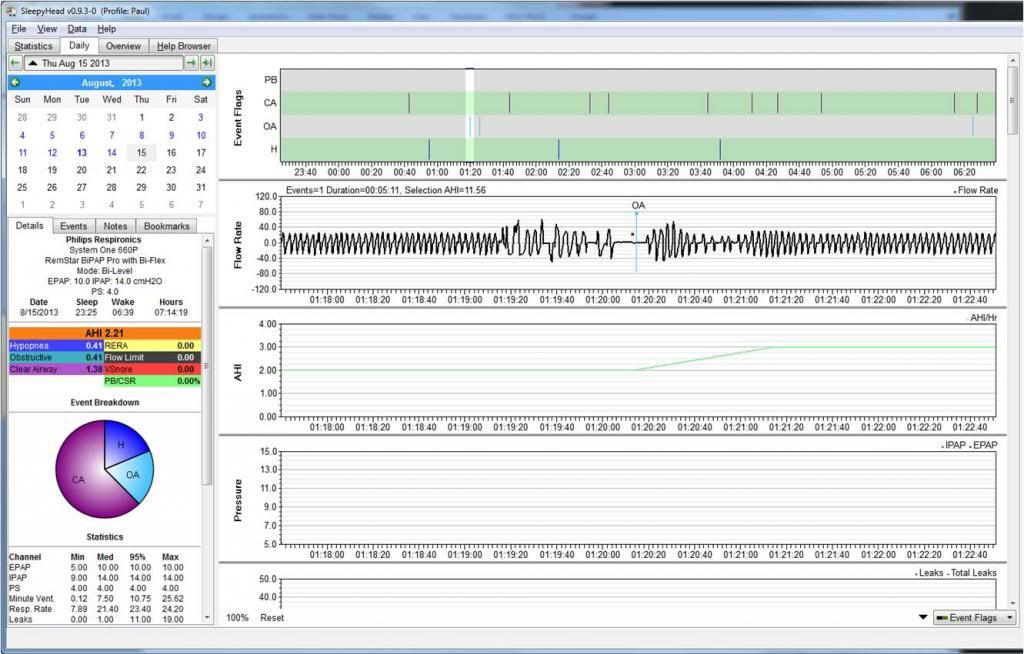
I see this often in my plot where I have either an OA or CA event and then a sine wave type of breathing to follow. Typically it is not flagged in the software as PB, but I did have it flagged once:

My doctor appointment for followup is not for a few more weeks - so I am wondering is this something I should call him on now or do we think this is more of something normal ish? My AHI is 41 untreated with pressure setting in the BiPAP at 14/10 currently.
thanks! Paul
Thanks for the posts - they sure help - I have only been using "my" machine for 3 days and a loaner machine for 10 days before. I found the old post that tells me how to add pictures (viewtopic/t35702/viewtopic.php?f=1&t=77 ... st#p706743)so here I will give it a try...
In the first picture I did not zoom all the way in so the pressure shows on the graph, if I zoom all the way in that graph goes away.

The next picture zooms into the area of concern to me:

I see this often in my plot where I have either an OA or CA event and then a sine wave type of breathing to follow. Typically it is not flagged in the software as PB, but I did have it flagged once:

My doctor appointment for followup is not for a few more weeks - so I am wondering is this something I should call him on now or do we think this is more of something normal ish? My AHI is 41 untreated with pressure setting in the BiPAP at 14/10 currently.
thanks! Paul
_________________
| Mask: Mirage™ FX Nasal CPAP Mask with Headgear |
| Additional Comments: 14/10 with REM Sleep Behavior Disorder |
Re: Please help me understand Periodic Breathing ...
The easy way to zoom to a event is to open the events tab and click on a event that I am interested in and it will zoom to the event. I do not see anything really alarming and would need to see trends for a few days to give a opinion. I have good and bad days.
_________________
| Machine | Mask | |
| |
Re: Please help me understand Periodic Breathing ...
That little bit of PB towards the end of the night? That's nothing alarming at all. You might have even been sort of semi awake when that got flagged. It's relatively short lived too.
This is the official definition for PB found in the Respironics manual.
'Periodic Breathing is a Respironics data feature defined as a persistent waning and waxing breathing pattrn which repeats itself between 30 and 100 seconds. The nadir of the breathing pattern is characterized by at least a 40% reduction in airflow from an established baseline flow. The pattern must be present for several minutes before it can be identified as periodic breathing. No therapy adjustments are made in response to periodic breathing. '
What you are seeing is just a little general waxing and waning with a little event thrown in now and then. Nothing to get excited about. I have seen similar on my own reports.
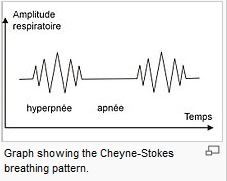
This is what CSR looks like.
Now if we saw a lot of this below...then we talk to the doctor about it.
This is was a fluke. My report from about a year ago I guess. Never before or since have I seen anything like this.
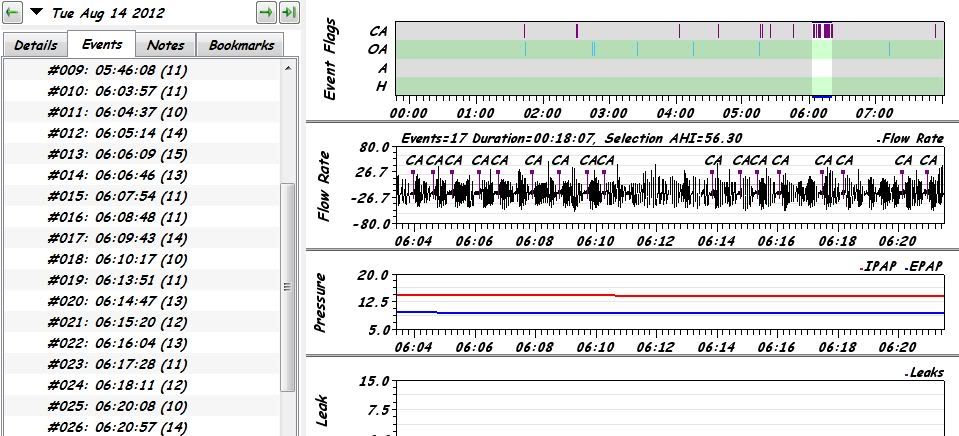
Here is wave form graphs from someone who had a lot of flagged PB...it still wasn't CSR.

This is the official definition for PB found in the Respironics manual.
'Periodic Breathing is a Respironics data feature defined as a persistent waning and waxing breathing pattrn which repeats itself between 30 and 100 seconds. The nadir of the breathing pattern is characterized by at least a 40% reduction in airflow from an established baseline flow. The pattern must be present for several minutes before it can be identified as periodic breathing. No therapy adjustments are made in response to periodic breathing. '
What you are seeing is just a little general waxing and waning with a little event thrown in now and then. Nothing to get excited about. I have seen similar on my own reports.
This is what CSR looks like.

Now if we saw a lot of this below...then we talk to the doctor about it.
This is was a fluke. My report from about a year ago I guess. Never before or since have I seen anything like this.

Here is wave form graphs from someone who had a lot of flagged PB...it still wasn't CSR.

_________________
| Machine: AirCurve™ 10 VAuto BiLevel Machine with HumidAir™ Heated Humidifier |
| Additional Comments: Mask Bleep Eclipse https://bleepsleep.com/the-eclipse/ |
I may have to RISE but I refuse to SHINE.
Re: Please help me understand Periodic Breathing ...
thanks everyone - this sure helps - I love the sleepyhead software - it is good to see charts and be able to ask questions.
_________________
| Mask: Mirage™ FX Nasal CPAP Mask with Headgear |
| Additional Comments: 14/10 with REM Sleep Behavior Disorder |
12 posts
• Page 1 of 1