


UARS and my treatment plan: need help

General Discussion on any topic relating to CPAP and/or Sleep Apnea.
User avatar
Pugsy
Posts: 65140
Joined: Thu May 14, 2009 9:31 am
Location: Missouri, USA

Re: UARS and my treatment plan: need help

Post by Pugsy » Tue May 21, 2013 9:42 am

musculus wrote:Is there a baseline mask leak ~28?
Yes...that is the "baseline" or probable vent/intentional leak rate.
All masks have a vent rate and as pressure increases then the vent rate also increases...so baseline increases.
Resmed machines remove that vent rate prior to reporting but Respironics machines include that vent rate.
Large leak territory value includes the vent rate so I always tell people to just stay below large leak territory and they will be fine as long as the leaks aren't disturbing sleep.
We are never actually given a set value for large leak territory but past experience (mine and others) using Respironics machines..we have seen reports where large leaks aren't flagged on the Encore reports until over 80 and 90 L/min.
So when in doubt I tell people to use Encore software to see if Encore wants to flag a leak as large. SleepyHead just reports the numerical L/min and it is up to us to decided where/what is the number to worry about.

If you were spending a lot of time above 70 L/min then I would suggest that you confirm with Encore software if your machine is flagging large leak since we don't have an exact number to go by.
I don't have an Encore report showing large leak handy...I will see if I can find one and show you what I mean.


_________________
Machine: AirCurve™ 10 VAuto BiLevel Machine with HumidAir™ Heated Humidifier
Additional Comments: Mask Bleep Eclipse https://bleepsleep.com/the-eclipse/
I may have to RISE but I refuse to SHINE.

User avatar
Pugsy
Posts: 65140
Joined: Thu May 14, 2009 9:31 am
Location: Missouri, USA

Re: UARS and my treatment plan: need help

Post by Pugsy » Tue May 21, 2013 9:45 am

I had this one stored online....not my report but someone else
I think you can see the light green 2 short blocks of large leak...
People think that the green line is large leak territory...it isn't..it's a bar graph and the light green is large leak time.

Image

_________________
Machine: AirCurve™ 10 VAuto BiLevel Machine with HumidAir™ Heated Humidifier
Additional Comments: Mask Bleep Eclipse https://bleepsleep.com/the-eclipse/
I may have to RISE but I refuse to SHINE.

User avatar
avi123
Posts: 4509
Joined: Tue Dec 21, 2010 5:39 pm
Location: NC

Re: UARS and my treatment plan: need help

Post by avi123 » Tue May 21, 2013 9:48 am

[quote="musculus"]Hi, I am a 30 yrs male with UARS (daytime sleepiness and AHI number about 2: very few apneas and hyponeas, a lot of microarousals during stage 3 sleep and REM).

I have somnomed MAS dental appliance, AVEO tsd, and a Respironic BIPAP AUTO. There is no compliance issue whatsoever. I can tolerate all those treatment options with IPAP pressure up to 13cm H2O.

The problem is I cannot get refreshing sleep with those treatments. Sometime I even use dental appliance together with BIPAP to little avail. I use sleepyhead to see the airflow data everyday and there are a lot of flow limitations and irregular breathing throughout the night. Here are the summarized findings:

[quote]

Your SH shows no RERA, and no Flow Limitation. So why you say that you suffer from UAR (Syndrome)?
As to daytime sleepiness, almost 20% of XPAP users suffer from Residual Excessive Sleepiness (RES) during day time. If you exclude Depression and Resless legs, this number drops by half. Very few have it as a result of past CPAP usage that effected their brains.

_________________
Humidifier: S9™ Series H5i™ Heated Humidifier with Climate Control
Additional Comments:  S9 Autoset machine; Ruby chinstrap under the mask straps; ResScan 5.6

User avatar
Pugsy
Posts: 65140
Joined: Thu May 14, 2009 9:31 am
Location: Missouri, USA

Re: UARS and my treatment plan: need help

Post by Pugsy » Tue May 21, 2013 9:53 am

avi123 wrote: Your SH shows no RERA, and no Flow Limitation. So why you say that you suffer from UAR (Syndrome)?
Maybe because the SleepyHead report is showing that the machine is showing that there is nothing to report because the cpap machine is preventing those RERAs and Flow Limitations.
Remember the machines are reporting post therapy results...not pre therapy results.
On paper..the machine is doing a great job preventing whatever it is supposed to be preventing.
Once again you are confusing post therapy reports with pre therapy reports.

_________________
Machine: AirCurve™ 10 VAuto BiLevel Machine with HumidAir™ Heated Humidifier
Additional Comments: Mask Bleep Eclipse https://bleepsleep.com/the-eclipse/
I may have to RISE but I refuse to SHINE.

musculus
Posts: 241
Joined: Tue Feb 26, 2013 8:35 am

Re: UARS and my treatment plan: need help

Post by musculus » Tue May 21, 2013 10:08 am

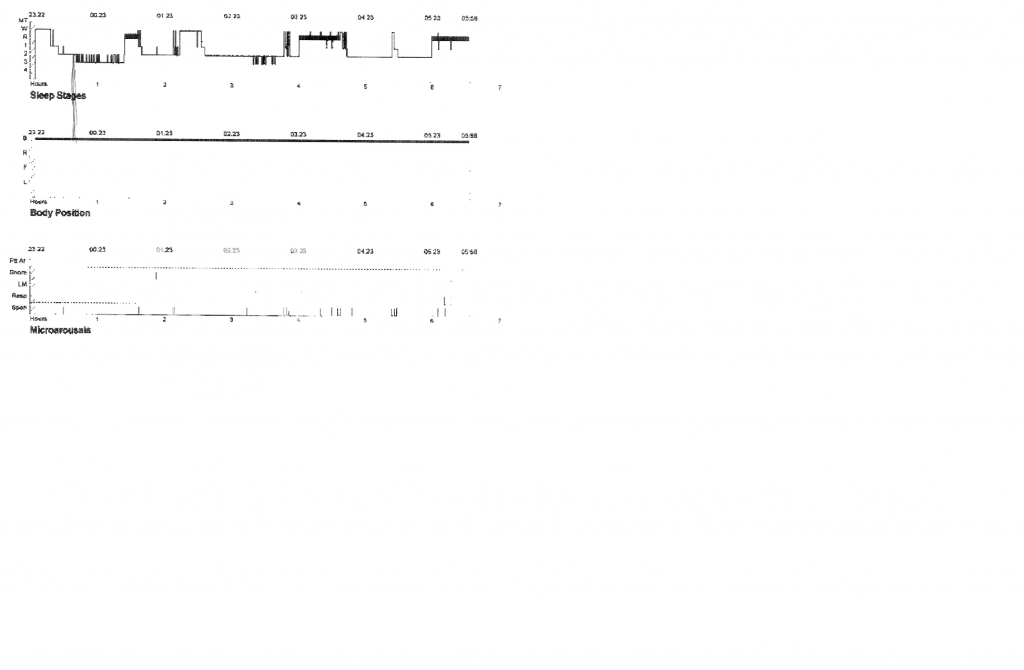
This is the overnight sleep structure from my titration study. I slept the first two hours with MAS dental appliance and the rest with CPAP (Pressure increase from 7 to 10).

You can see a lot of deep sleep and REM sleep interruptions, most of which are not caused by A&H events. Report calls them spon arousals.

Image


avi123 wrote:
musculus wrote:Hi, I am a 30 yrs male with UARS (daytime sleepiness and AHI number about 2: very few apneas and hyponeas, a lot of microarousals during stage 3 sleep and REM).

I have somnomed MAS dental appliance, AVEO tsd, and a Respironic BIPAP AUTO. There is no compliance issue whatsoever. I can tolerate all those treatment options with IPAP pressure up to 13cm H2O.

The problem is I cannot get refreshing sleep with those treatments. Sometime I even use dental appliance together with BIPAP to little avail. I use sleepyhead to see the airflow data everyday and there are a lot of flow limitations and irregular breathing throughout the night. Here are the summarized findings:

Your SH shows no RERA, and no Flow Limitation. So why you say that you suffer from UAR (Syndrome)?
As to daytime sleepiness, almost 20% of XPAP users suffer from Residual Excessive Sleepiness (RES) during day time. If you exclude Depression and Resless legs, this number drops by half. Very few have it as a result of past CPAP usage that effected their brains.

_________________
Mask: Quattro™ Air Full Face Mask with Headgear
Additional Comments: sleepyhead

musculus
Posts: 241
Joined: Tue Feb 26, 2013 8:35 am

Re: UARS and my treatment plan: need help

Post by musculus » Tue May 21, 2013 10:14 am

This is an interesting research article published at New England Journal of Medicine.

Prone position have better clinical outcomes than supine position for patients with Severe Acute Respiratory Distress Syndrome.

"A total of 237 patients were assigned to the prone group, and 229 patients were assigned to the supine group. The 28-day mortality was 16.0% in the prone group and 32.8% in the supine group (P<0.001). The hazard ratio for death with prone positioning was 0.39 (95% confidence interval [CI], 0.25 to 0.63). Unadjusted 90-day mortality was 23.6% in the prone group versus 41.0% in the supine group (P<0.001), with a hazard ratio of 0.44 (95% CI, 0.29 to 0.67). The incidence of complications did not differ significantly between the groups, except for the incidence of cardiac arrests, which was higher in the supine group."

http://www.nejm.org/doi/full/10.1056/NE ... #t=article
musculus wrote:1. No, I don't wake up from sleep.
2. Leak may be a problem. I'll try putting on smaller nasal pillow and chin strap.
3. Sleeping on my stomach is uncomfortable for me so I cannot sleep in that position for full night. In term of breathing, it's a great position. The below graph is the recording of a period of stomach sleeping. The pattern is uniform, no fluctuations in breathing rate and tidal volume, etc.

Image


Somnolence wrote:
musculus wrote: There is definitely something wrong with my airway since I sleep very well on my stomach. The problem is I cannot keep that position very long, maybe at most one and half hours. I think I can rule out the tongue since even with dental appliance and aveo tsd, the sleep quality is very poor. That's why I want to address the soft palate.
Do you fully wake frequently? If so, have you kept some type of log noting the timing of these events? I would not be surprised to hear they coincide with your entrance into REM sleep.

What do you mean that you can't keep the position for long? It becomes so uncomfortable that you wake? Or do you experience more breathing irregularities in this position?

_________________
Mask: Quattro™ Air Full Face Mask with Headgear
Additional Comments: sleepyhead

User avatar
avi123
Posts: 4509
Joined: Tue Dec 21, 2010 5:39 pm
Location: NC

Re: UARS and my treatment plan: need help

Post by avi123 » Tue May 21, 2013 11:18 am

Pugsy wrote:
avi123 wrote: Your SH shows no RERA, and no Flow Limitation. So why you say that you suffer from UAR (Syndrome)?
Maybe because the SleepyHead report is showing that the machine is showing that there is nothing to report because the cpap machine is preventing those RERAs and Flow Limitations.
Remember the machines are reporting post therapy results...not pre therapy results.
On paper..the machine is doing a great job preventing whatever it is supposed to be preventing.
Once again you are confusing post therapy reports with pre therapy reports.
Comment,

This business of pre and post therapy is theoretically correct. But my Flow Limitation during the past three years has never been completely "prevented" from showing on my ResScan graphs. It's level changes a bit from day to day but it is NEVER zero. So would I trust SleepyHead if it showed zero Flow Limitation? Let me check.


My "residual" Flow Limitation:

Image\\

SH does show a similar Flow Limitation graph for same night:

(It never shows the 95% percentile of FL as zero. So my machine never treats FL completely!)

Image

_________________
Humidifier: S9™ Series H5i™ Heated Humidifier with Climate Control
Additional Comments:  S9 Autoset machine; Ruby chinstrap under the mask straps; ResScan 5.6
Last edited by avi123 on Tue May 21, 2013 11:43 am, edited 1 time in total.

User avatar
Pugsy
Posts: 65140
Joined: Thu May 14, 2009 9:31 am
Location: Missouri, USA

Re: UARS and my treatment plan: need help

Post by Pugsy » Tue May 21, 2013 11:42 am

Well Avi.....if we are going to do the mine is bigger than yours thing...

Here's what my flow limitation graph looks like 99.9% of the time using ResScan (and I rarely have a FL flagged on the Respironics auto adjusting machine). So people can have a pretty unremarkable FL graph and maybe there is more to this Flow limitation thing and how a person feels the next day than was once thought.
Maybe part of your residual EDS (daytime sleepiness) is related in some small part to your FLs. I am just saying "maybe".
Heck, I don't know how important it is but maybe there is something hidden in there TBD (to be determined) in the future that will help people understand FLs and residual daytime sleepiness.

I do know if my FL graph looked like yours Avi...I would be working on it especially if I was still having a lot of excessive sleepiness that I wasn't happy with.

Image

_________________
Machine: AirCurve™ 10 VAuto BiLevel Machine with HumidAir™ Heated Humidifier
Additional Comments: Mask Bleep Eclipse https://bleepsleep.com/the-eclipse/
I may have to RISE but I refuse to SHINE.

User avatar
avi123
Posts: 4509
Joined: Tue Dec 21, 2010 5:39 pm
Location: NC

Re: UARS and my treatment plan: need help

Post by avi123 » Tue May 21, 2013 11:48 am

musculus should show the 95% of the Flow Limitation to verify if he/she suffers from UAR Syndrome and/or RERA.

Do you have Upper Airway Resistance Syndrome (UARS)?


________________________________________
Clinical Features Associated With UARS

Daytime symptoms

Excessive daytime sleepiness
Fatigue
Morning headaches
Myalgia’s [muscle pain]
Difficulty concentrating

Sleep disturbances

Frequent nocturnal awakenings
Difficulties initiating sleep
Insomnia
Bruxism [teeth clenching]
Restless leg syndrome
Unrefreshing sleep
Autonomic nervous system

Hypotension
Orthostasis [maintenance of an upright standing posture]
Cold hands and feet

Functional somatic syndrome associations

Depression
Anxiety
Chronic fatigue syndrome
Irritable bowel syndrome
Fibromyalgia

Polysomnographic abnormalities

Increased RERAs
Increased nocturnal arousals
Increased CAP rate [cyclical alternating pattern in EEG]
Alpha intrusion during sleep

_________________
Humidifier: S9™ Series H5i™ Heated Humidifier with Climate Control
Additional Comments:  S9 Autoset machine; Ruby chinstrap under the mask straps; ResScan 5.6

User avatar
Pugsy
Posts: 65140
Joined: Thu May 14, 2009 9:31 am
Location: Missouri, USA

Re: UARS and my treatment plan: need help

Post by Pugsy » Tue May 21, 2013 12:14 pm

avi123 wrote:musculus should show the 95% of the Flow Limitation to verify if he/she suffers from UAR Syndrome and/or RERA.
He can't with his machine.
1...the Respironics machine doesn't flag Flow Limitations at all in straight fixed pressure mode. Must have auto adjusting pressure mode be in use to get the FL flags. Right now he is using fixed bilevel pressures.
2...even if auto adjusting pressure mode is used the FLs aren't reported in the 95% manner. Instead they are flagged as individual events like an OA or hyponea would be flagged.
3...So there is zero way for him to evaluate FL status in the same manner as your ResScan report. Encore doesn't do it either.

4.......most importantly...he doesn't have to prove to you or to me what he has or doesn't have. His doctors have made their determination based on his sleep studies. I don't doubt that fact at all. In fact I commend them for thinking outside the box and not using tunnel vision and going by AHI alone.

What we see here with his current PR S1 report isn't very exciting in terms of what is being shown.
RERAs aren't exciting but since this is a post therapy report would would hope to see it be rather boring.
The FLs can't be seen unless he changes over to auto adjusting pressure mode but I would bet that the FLs are probably not very exciting either.
UARS, from what I have read, it very hard to evaluate results on paper because the data points collected are geared more to full blown apneas and not minor reductions in air flow or minor arousals which may or may not show up on the software reports because they are below the levels for recording criteria.
We simply cannot see much on paper that helps us evaluate levels of therapy. If we see a lot of FLs and RERAs we have something to fight but the absence of something to fight doesn't mean it isn't there at some level.
People with UARS have to go by "how they feel" much more than the rest of us with plain jane OSA. It's hard to do and hard to make any decision on which way to go with something when nothing seems to improve the situation.

I don't know what to offer the OP here in this thread. UARS is now getting some more time in the spotlight and some doctors are thinking outside the box on ways to help with this situation but it is far from easy because it is a difficult thing to measure.

_________________
Machine: AirCurve™ 10 VAuto BiLevel Machine with HumidAir™ Heated Humidifier
Additional Comments: Mask Bleep Eclipse https://bleepsleep.com/the-eclipse/
I may have to RISE but I refuse to SHINE.

User avatar
avi123
Posts: 4509
Joined: Tue Dec 21, 2010 5:39 pm
Location: NC

Re: UARS and my treatment plan: need help

Post by avi123 » Tue May 21, 2013 12:52 pm

Sorry, I thought that musculus's machine shows also Flow Limitation.

I am done with this conversation.

_________________
Humidifier: S9™ Series H5i™ Heated Humidifier with Climate Control
Additional Comments:  S9 Autoset machine; Ruby chinstrap under the mask straps; ResScan 5.6

McSleepy
Posts: 494
Joined: Fri Nov 26, 2010 10:32 pm
Location: USA

Re: UARS and my treatment plan: need help

Post by McSleepy » Tue May 21, 2013 5:27 pm

OP, I just thought of one thing. Maybe I'm grasping straws but it's worth a shot. You mentioned that you can't sleep very long in the prone position. For me, sleeping prone has been a life saver - my body learned to do it when I was a child and that has helped me a lot. My breathing all but shuts down when supine (from the obstructions). However, after I started CPAP I have found also that the weight (which has increased quite a bit since I was young ) is putting a lot of stress on my chest and diaphragm and causes additional resistance - one could have resistance not only by narrowing the airways but by preventing the chest from expanding. So, I wonder if that is causing your body to refuse to stay prone for a long time.

The thought here is, besides getting a machine that can do what I described in my previous post, maybe try and play with the settings on the current machine. How about trying to increase the pressure support (PS)? That is, keep the EPAP but raise the IPAP by 2-3 cm H2O. Or even both pressures, but definitely increase PS. Your OSA might not need it but it might help your UARS. I'm not sure what the PR S1 has as settings (I only had it for a week or two) but there might be other settings that could be helpful.

McSleepy

_________________
Machine: AirCurve™ 10 VAuto BiLevel Machine with HumidAir™ Heated Humidifier
Additional Comments: Previous machine: ResMed S9 VPAP Auto 25 BiLevel. Mask: Breeze with dilator pillows. Software: ResScan ver. 5.1
ResMed AirCurve 10 VAuto; Puritan-Bennett Breeze nasal pillow mask; healthy, active, middle-aged man; tall, athletic build; stomach sleeper; on CPAP since 2003; lives @ 5000 ft; surgically-corrected deviated septum and turbinates; regular nasal washes

User avatar
Somnolence
Posts: 37
Joined: Sat Dec 29, 2012 10:07 pm
Location: Dallas, TX

Re: UARS and my treatment plan: need help

Post by Somnolence » Tue May 21, 2013 6:34 pm

Are you familiar with CO2's effects on the respiratory drive? Have you considered something along that path?

User avatar
avi123
Posts: 4509
Joined: Tue Dec 21, 2010 5:39 pm
Location: NC

Re: UARS and my treatment plan: need help

Post by avi123 » Tue May 21, 2013 7:12 pm

Let me try to add a few more points:


1) My neighbor across the street had his uvula removed a couple of decades ago but it did not stop his UARS.

2) The poster BrianinTN had a surgery done recently but says that it was a mistake.

Check his post:

viewtopic.php?f=1&t=85784&st=0&sk=t&sd= ... =brianintn

3) We, as posters on this board, turn our attention mostly to the machinery aspects of treating by XPAPs and not paying more thoughts if XPAPs are the most useful tool to treat the medical problem presented.

4) The most recent report on treating UARS, that I know about is this:

(It is co-authored by the most qualified person in the U.S. on UARS, the professor from Stanford, but I can't enter it directly. So here it is taken from the other competing sleep apnea website)


http://www.apneaboard.com/forums/Thread ... e-Syndrome

{Archangle, who posts here is also a big "maven" on that board over there. He is a "Master Member" there }


Excerpt:


The optimal treatment for patients with UARS is not currently known. Continuous positive airway pressure (CPAP) has been quite useful in the treatment of sleep-disordered breathing and there are some notable positive results in CPAP treatment of UARS. In a study of 15 heavy snorers with clinical evidence of UARS, treatment with nasal CPAP was associated with decreases in observed nocturnal arousals on polysomnography and decreases in mean sleep latency times on multiple sleep latency testing (MSLT) after several nights of treatment.3,36 A follow-up study of 15 subjects (in the original description of UARS) with daytime sleepiness and fatigue and who had undergone a therapeutic trial of positive pressure therapy reported similar findings.3 After treatment with approximately a month of nasal CPAP, significant improvements were seen in mean sleep latency times on MSLT (5.3 minutes vs 13.5 minutes), Pes nadir pressure (–33.1 cm H2O vs –5.3 cm H2O), amount of slow-wave sleep (1.2% vs 9.7%), and EEG arousals (31.3 vs 7.9 events/hour of sleep). Along with an improvement in sleep latency times on MSLT, there were subjective reports of improved daytime symptoms. Lastly, in a study of 130 postmenopausal women with chronic insomnia and evidence of UARS (n=62) or normal breathing (n=68), treatment with either nasal turbinectomy or nasal CPAP was associated with improvements in subjective reports of sleep quality as measured with a visual analog scale as well as mean sleep latency times on polysomnography.19 Despite the growing body of evidence supporting the use of positive pressure therapy for UARS patients, it remains difficult to obtain therapy. In a follow-up study of more than 90 patients conducted 4 to 5 years after the initial diagnosis of UARS was made, none of the subjects were receiving CPAP treatment; the main rationale given was that their insurance provider declined to provide the necessary equipment.1 Formal follow-up clinical evaluations of these patients noted significant worsening in their sleep-related complaints, with increased reports of fatigue, insomnia, and depressive mood. More disturbingly, prescriptions for hypnotics, stimulants, and antidepressants increased more than fivefold.

Other interventions, such as surgery or oral appliances, have also been used with some success in the treatment of patients with UARS. Procedures such as uvulopalatopharyngoplasty, laser-assisted uvuloplasty (LAUP), septoplasty with turbinate reduction, genioglossus advancement, and radiofrequency ablation of the palate have all been described in the literature.37-40 A study of LAUP in nine patients with UARS who underwent uvulopalatopharyngoplasty (n=2), multilevel pharyngeal surgery (n=1), or LAUP (n=6) reported improvements in subjective daytime sleepiness as measured with Epworth Sleepiness Scale scores.37 In the two patients for whom postoperative polysomnographic data was available, significant improvements in Pes nadir pressures were seen. But patients had several interventions and it is difficult to assess which one was successful. A study of 14 patients with UARS who underwent radiofrequency ablation of the palate also reported improvement in subjective sleepiness, with concurrent improvements in Pes nadir levels and reports of snoring.40 However, prior reviews of the available literature have noted that many of the studies evaluated small numbers of patients, consisted of uncontrolled case reports or series without clear characterization of the subjects enrolled, and had no consistent end points for an adequate evaluation of efficacy.39 Further investigation is required to determine the specific role for surgical intervention in these patients. Other authors have also reported successful treatment of UARS with use of oral appliances, although these studies suffer from the same limitations as the surgical literature.41 In children, orthodontic approaches, such as maxillary distraction or use of expanders, have also shown promising results.42


Abbreviations:

CAP = cyclical alternating pattern; CPAP = continuous positive airway pressure; LAUP = laser-assisted uvuloplasty; MSLT = multiple sleep latency testing; NREM = nonrapid eye movement; OHS = obstructive hypopnea syndrome; OSAS = obstructive sleep apnea syndrome; Pes = esophageal pressure; REM = rapid eye movement; RERA = respiratory effort-related arousal; UARS = upper airway resistance syndrome

_________________
Humidifier: S9™ Series H5i™ Heated Humidifier with Climate Control
Additional Comments:  S9 Autoset machine; Ruby chinstrap under the mask straps; ResScan 5.6