rocklin wrote:...
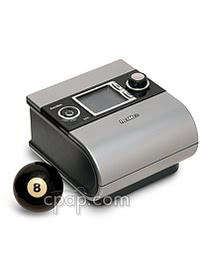
____________
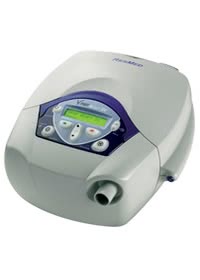
Resmed S9 AutoSet..................................Resmed Adapt SV ...
Okay, I'll play along. After all, you ask some basic ... fundamental questions about the free enterprise system.
rocklin wrote:...
Just some idle musings.
1. Other than the cute plastic housing a slightly different software algorithm, is there any real difference between, say, an $853+ S9 AutoSet and a $7000+Adapt SV ? ...
As you've seen there are some HUGE differences between the ASV unit and an AutoSet (CPAP unit).
- BiLevel instead of one pressure.
- Adaptive Servo-Ventilation instead of one set top pressure.
And that ventilation mode is CRITICAL for those of us, who need it. When I fall asleep, I *STOP* breathing. Oh, I eventually resume once I am fully asleep. But I can (and do) stop breathing for a minute or two at a time. I would be dead by now, if I did not have my ASV unit. I had uncontrolled high blood pressure. It (and the Ibuprofen I took for the headaches) led to permanent kidney damage ... all because some ass of a doctor thought "Oh, Central Sleep Apnea is rare, so you can not have it?" I finally found a doctor who would test for it and found ... that I do have central sleep apnea. My blood pressure is now under control. But I have no doubt I would have died without it.
Just because you don't need it, does not mean that what others go through on a daily basis is not real. Trust me, you would find the experience unpleasant. Ive gone from just needing a CPAP to needing an ASV unit. I would give up everything to go back to just needing CPAP!
rocklin wrote:... 2. What were the approximate developmental costs for ResMed and Respironics to develop their ASV algorithms?
a) Under $500,000 dollars
b) Under $1,000,000 dollars
c) Under $3,000,000 dollars
d) Under $6,000,000 dollars
e) Over $6,000,000 dollars ...
I honestly don't know what the costs were. I suspect it took much more than what you would expect (including the overhead of the corporation ... which like it or not, the projects such as this must cover). There were numerous studies to find how to better treat central sleep apnea and then complex sleep apnea. Those studies require a LOT of man power to monitor, manage and produce the reports. Then the governmental approval process (in many nations) takes a HUGE amount of effort. I've worked in the computer industry side of this and you would be amazed at the amount of data required by governments to obtain the approval for a medical device. While it might seem excessive, it helps protect us from junk that would harm us more than help. These costs typically do mount into the millions of dollars.
rocklin wrote:... 3. What were the approximate manufacturing and marketing costs for ResMed and Respironics to introduce and market their ASVs in the marketplace?
a) Under $500,000 dollars
b) Under $1,000,000 dollars
c) Under $3,000,000 dollars
d) Under $6,000,000 dollars
e) Over $6,000,000 dollars ...
I suspect the marketing and manufacturing costs were much less than you would think. The marketing is very focused toward a small audience (the medical doctors and DMEs that deal with these devices). There are costs for them associated with learning about the technology and how to apply it. Some of that cost is the marketing effort (free seminars, etc). However, compared to many other industries, the market is quite small. So, these companies had less involved in the marketing than a new car launch, as an example.
rocklin wrote:... 4. Why is this priced as a high-tier niche product? ...
Ah, you are assuming this is a "high-tier" niche product. It is a niche product. Most people with sleep apnea find that their problems are solved with a CPAP unit. Some people need to use a BiLevel device to address their needs. A fewer still find they need an ASV (or other) unit to address their needs. In general, if a less complex method will address the problem, that should be used. CPAP is the least complex. If it solves the issue, then use it. If not, add the next level of complexity (BiLevel). Does it fully address the problem? No. Then add more complexity.
Unfortunately, as the size of the market shrinks (the number of people that need an ASV unit is much smaller than CPAP), the economies of scale decrease.
However, even with this, both Respironics and Resmed attempt to leverage the economies of scale for their other products. That is, the ASV units for both manufacturers are built on the same basic shape and design as their CPAP and BiLevel units. This reduces the manufacturing and design costs.
rocklin wrote:... 5. What is the current gross sales, and net income for the ASV "department" of each company? ...
I honestly don't know. However, I would estimate that 60 to 70 percent of the potential market (people with sleep disorders) have their needs met with a CPAP device. Another 20 to 25 percent find an BiLevel unit satisfies their need. The remaining 5 to 10 percent find that an ASV or AVAPS or other "niche" product helps meet their needs.
rocklin wrote:... 6. If ASV's flexibility and responsiveness can be show to be "useful" to the "average" end-user, and thus, a large demand created, will the high-tier cost remain the same? ...
Why did Ford win out over all the other early competitors in the car industry? Because they provided an inexpensive vehicle that met most peoples needs. It was not fancy. It did not do everything. Most people did not need it to do everything.
So, it is with xPAP devices. The larger the market, the more the costs of the device can be spread across market. So, a CPAP device is lower cost than an ASV unit ... simply because the market is large enough for CPAP to spread the cost. There is a smaller markup on CPAP devices.
You are right. If the ASV mode was right for everyone and we did away with CPAP and BiLevel devices it would cost less. But why add complexity to the therapy if it is not needed. And trust me, it takes a LOT to get used to ASV therapy (in comparison to CPAP). If it's not needed, don't build it into the device.
rocklin wrote:... 7. Or, five years from now, will we find them selling on CPAP.com for around $1000? ...
We probably will. That's the natural pressure that comes from increased competition. I bought a used device as a backup device. It cost a LOT less than the original device. It's not the System One device. But who cares? It does the job.
But one final question? Why do you care? If the device meets the need that its market requires, who cares? I know I sure don't. I would have paid for it myself if required. It was cheaper than the inevitable heart attack or stroke would have been for me.
Anyway, that's my two cents ...