


Our recent threads about "what is a leak" set me thinking, and I found I have a number of questions.
1. Is there a normal exahalation volume, and how much does it vary among people?
2. Does the published vent flow rate for a mask include the added exhalation value (I assumed it didn't).
3. How should we compare leak rate at a certain pressure to vent flow rate at that pressure - is there any way of telling whether the difference is too large?
O.
Vent flow, exhalation, Leaks


6 posts
• Page 1 of 1
Vent flow, exhalation, Leaks
_________________
| Mask: AirFit™ P10 Nasal Pillow CPAP Mask with Headgear |
| Additional Comments: Machine: Resmed AirSense10 for Her with Climateline heated hose ; alternating masks. |
And now here is my secret, a very simple secret; it is only with the heart that one can see rightly, what is essential is invisible to the eye.
Antoine de Saint-Exupery
Good advice is compromised by missing data
Forum member Dog Slobber Nov. 2023
Antoine de Saint-Exupery
Good advice is compromised by missing data
Forum member Dog Slobber Nov. 2023

Ozij,
Not sure I have specific answers but from observing flow data from BiLevels, it seems that we all vary the 'tidal flow' quite a lot.
Look at some of the chart data here (my own) and I can point out on different days variations in liters/min http://www.internetage.com/cpapdata/
example1 - 700ml-min to 1350ml-max
example2 - 600ml-min to 2100ml-max
example3 - 450ml-min to 2900ml-max
example4 - 700ml-min to 2000ml-max
example5 - 650ml-min to 3500ml-max
These show a very wide variation of tidal flow over some weeks.
I have seen data from others who breathed even less air. The info here tells me that the variation is a big spread & depends on all sorts of influencing factors (stae-of-health, body weight, food/liquid intake that day etc: )
The fixed venting rate seems to be a formula based on the dead space in the mask & the location of the vent holes, that is sufficient, on average, to clear the excess CO2.
My initial thought is that the variation in tidal-flow for any individual is so great that the masks fixed venting is more than adequate.
The actual venting air-flow is naturally going to vary with the pressure and I guess to some degree, how much pressure the sleeper is exerting when they breathe out. What I am saying here is that panting vs deep breathing may affect venting.
DSM
#2 added missing link
#3 corrected tidal-flow numbers (had entered the 95th% mean in place of the min)
Not sure I have specific answers but from observing flow data from BiLevels, it seems that we all vary the 'tidal flow' quite a lot.
Look at some of the chart data here (my own) and I can point out on different days variations in liters/min http://www.internetage.com/cpapdata/
example1 - 700ml-min to 1350ml-max
example2 - 600ml-min to 2100ml-max
example3 - 450ml-min to 2900ml-max
example4 - 700ml-min to 2000ml-max
example5 - 650ml-min to 3500ml-max
These show a very wide variation of tidal flow over some weeks.
I have seen data from others who breathed even less air. The info here tells me that the variation is a big spread & depends on all sorts of influencing factors (stae-of-health, body weight, food/liquid intake that day etc: )
The fixed venting rate seems to be a formula based on the dead space in the mask & the location of the vent holes, that is sufficient, on average, to clear the excess CO2.
My initial thought is that the variation in tidal-flow for any individual is so great that the masks fixed venting is more than adequate.
The actual venting air-flow is naturally going to vary with the pressure and I guess to some degree, how much pressure the sleeper is exerting when they breathe out. What I am saying here is that panting vs deep breathing may affect venting.
DSM
#2 added missing link
#3 corrected tidal-flow numbers (had entered the 95th% mean in place of the min)
xPAP and Quattro std mask (plus a pad-a-cheek anti-leak strap)
-
StillAnotherGuest

- Posts: 1005
- Joined: Sun Sep 24, 2006 6:43 pm
Is It A Leak or Simply Flow Rate?
I don't think exhaled patient volume has any bearing on "leak", whether it's intentional or not. I mean, since exhaled volume had been procured from machine flow, it's already been accounted for.
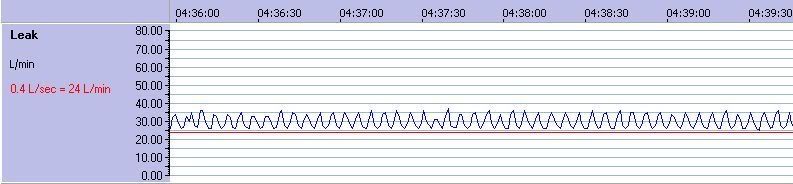
I suppose inhalation and exhalation could cause transient changes in leak rate, if we had software to monitor that and make a graph:
Software To Monitor Leaks and Make A Graph
SAG
I suppose inhalation and exhalation could cause transient changes in leak rate, if we had software to monitor that and make a graph:
Software To Monitor Leaks and Make A Graph
SAG

Aromatherapy may help CPAP compliance. Lavender, Mandarin, Chamomile, and Sweet Marjoram aid in relaxation and sleep. Nature's Gift has these and a blend of all four called SleepEase.
-
DreamStalker
- Posts: 7509
- Joined: Mon Aug 07, 2006 9:58 am
- Location: Nowhere & Everywhere At Once
Yep ... the continuous leak rate will vary with transient of inhale/exhale. However, that is all accounted for because the value at the end of a full session will be the average. The only thing that will affect average leak rate for the session is average pressure (since vent port cross-sectional area remains constant) for said session. Now the average pressure for APAP/BiPAP may vary from night to night. Nevertheless, exhalation volume should have no bearing on published vent flow rate for a mask.
As for what is acceptable leakage ... I would think it is a nonlinear relationship just as is the published vent flow rate for a mask. What that relationship actually is -- who knows? ... a worthwhile study is needed.
As for what is acceptable leakage ... I would think it is a nonlinear relationship just as is the published vent flow rate for a mask. What that relationship actually is -- who knows? ... a worthwhile study is needed.
President-pretender, J. Biden, said "the DNC has built the largest voter fraud organization in US history". Too bad they didn’t build the smartest voter fraud organization and got caught.
Re: Is It A Leak or Simply Flow Rate?
That looks ok to me !StillAnotherGuest wrote:I don't think exhaled patient volume has any bearing on "leak", whether it's intentional or not. I mean, since exhaled volume had been procured from machine flow, it's already been accounted for.
I suppose inhalation and exhalation could cause transient changes in leak rate, if we had software to monitor that and make a graph:
Software To Monitor Leaks and Make A Graph
SAG
Tks
DSM
xPAP and Quattro std mask (plus a pad-a-cheek anti-leak strap)
StillAnotherGuest wrote:I mean, since exhaled volume had been procured from machine flow, it's already been accounted for.
SAG
Thanks for the answers, guys!DreamStalker wrote:Yep ... the continuous leak rate will vary with transient of inhale/exhale. However, that is all accounted for because the value at the end of a full session will be the average. The only thing that will affect average leak rate for the session is average pressure (since vent port cross-sectional area remains constant) for said session. Now the average pressure for APAP/BiPAP may vary from night to night. Nevertheless, exhalation volume should have no bearing on published vent flow rate for a mask.
O.
_________________
| Mask: AirFit™ P10 Nasal Pillow CPAP Mask with Headgear |
| Additional Comments: Machine: Resmed AirSense10 for Her with Climateline heated hose ; alternating masks. |
And now here is my secret, a very simple secret; it is only with the heart that one can see rightly, what is essential is invisible to the eye.
Antoine de Saint-Exupery
Good advice is compromised by missing data
Forum member Dog Slobber Nov. 2023
Antoine de Saint-Exupery
Good advice is compromised by missing data
Forum member Dog Slobber Nov. 2023
6 posts
• Page 1 of 1