




I have recently been diagnosed with some sort of sleep apnea and have my CPAP titration this week. I do not have the final report so I don't know any details of my condition yet.
I am DREADING the 2nd sleep study. I bury my face in my pillow or have my nose barely above the bed. I have a bad back, so I sleep on a solid platform with no mattress and feather pillows. From what I have read, stomach sleepers have to deal with far more discomfort and many more leaks. I fear that even if I can get comfortable (and used to feeling like a flat tire) I will wake up looking like I've been in a car accident from the mask, straps, tubes, etc. I can't go to work (or anywhere else) looking like I just walked out of an ER.
WHat can I do?
Newbie stomach sleeper
-
ChicagoGranny

- Posts: 15516
- Joined: Sun Jan 29, 2012 1:43 pm
- Location: USA
Re: Newbie stomach sleeper
It can be done! And, it is good for your back. I've done it myself on many nights.TooNew wrote:stomach sleeper
WHat can I do?
Here, Dr. Falcon explains the correct positioning and technique - http://www.uarsrelief.com/sleeppositions.html
-
TooNew
Re: Newbie stomach sleeper
What can be done? I can't open the link you posted for some reason.TooNew wrote:
stomach sleeper
WHat can I do?
It can be done! And, it is good for you back. I've done it myself on many nights.
I have always been a stomach sleeper, so if the suggestion is to start sleeping differently, it would be like telling a right handed person to start being left handed - and expecting it to work.
*Sigh*
-
ChicagoGranny
- Posts: 15516
- Joined: Sun Jan 29, 2012 1:43 pm
- Location: USA
Re: Newbie stomach sleeper
WT???TooNew wrote:*Sigh*
You haven't even opened the link, and you become despondent?
The link is legitimate and secure. Just for you, I've tried to open it in three different browsers. It opened quickly in all three.
You stand a much better chance of being successful with CPAP, if you take a positive, problem-solving attitude.
By the time they finally get diagnosed, most people are heavily fatigued from untreated sleep apnea. Time to muster up that inner strength and plow forward.
Forum members can help you with many of the challenges you face. We've been through them ourselves!
Good luck!
-
TooNew
Re: Newbie stomach sleeper
Yep, I've read so many horror stories - getting less sleep than before (which is not good for me driving long distances or for my job), red marks on the face, open sores, bruising, bloating, sinus problems, sore throats, etc. etc.WT???
You haven't even opened the link, and you become despondent?
It's being blocked by our firewall - it's listed as SPAM.The link is legitimate and secure. Just for you, I've tried to open it in three different browsers. It opened quickly in all three.
I was on medication that helped me sleep up until a few months ago and then the doctor didn't want to prescribe anymore. I ended up with insomnia (yeah, little did I know) and was sent for CBT-I, which, was a waste of time. Finally was scheduled for a sleep test and now I'm at this point.You stand a much better chance of being successful with CPAP, if you take a positive, problem-solving attitude.
By the time they finally get diagnosed, most people are heavily fatigued from untreated sleep apnea. Time to muster up that inner strength and plow forward.
Exhausted, fatigued, unable to think straight, etc. I just want to sleep! When I was reading up on insomnia it was made clear that going to bed has to be a comfortable experience - how can wearing a huge mask be comfortable?
I would be happy to hear from any front sleepers that have made it work without changing positions or pillows.Forum members can help you with many of the challenges you face. We've been through them ourselves!
Good luck!
And sorry, I have yet to find anything to be positive regarding CPAP. The positions I sleep in will either crush my face, break the seal, or block the exhaust. Side sleeping is completely out of the question as it screws up my back and back sleeping happens only very seldom if my back hurts for some reason from the front position.
I need all the help and advice I can get.
Re: Newbie stomach sleeper
I sleep alone ('cept for my cat) and so can get away with this - I cut a 3" wide, 4" deep and 1' long 'trench' in my memory foam mattress starting at the head and going towards the foot, with an electric knife, and rounded top edges with scissors. I have a FF mask and when sleeping on my front with my head turned right, the mask dips into the trench diagonally or more vertically, avoiding a very sore neck in the a.m. I've also cut and fiddled with sheets to accommodate things, but have been sleeping like this for years, and so far so good. VERY Important is that my particular mask's vent holes are higher on the mask than most (which are usually at the elbow), so foam or sheet don't block holes but probably would for other masks.
-
TooNew
Re: Newbie stomach sleeper
Not a solution for me, as I stated I have a bad back and sleep on a solid platform (3/4" plywood) with no mattress. When not at home, I sleep on the floor. I even slept on the floor for my sleep study - and will for my titration.I cut a 3" wide, 4" deep and 1' long 'trench' in my memory foam mattress starting at the head and going towards the foot, with an electric knife, and rounded top edges with scissors.

Re: Newbie stomach sleeper
TooNew,
You say you are a dedicated stomach sleeper who uses a lot of pillows, but who sleeps on the floor at home. And the sleep lab was accommodating enough to let you sleep on the floor during your diagnostic sleep test. Hopefully they'll be equally accommodating on the titration test. (I can't see why they wouldn't be.)
The Falcon sleeping position that Granny posted a link to looks like the when the sleeper is wearing a full face CPAP mask:
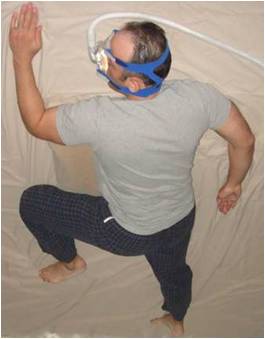
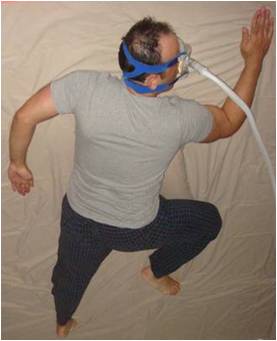
Yes, there is a pillow under this guy's stomach, but that's not necessary for sleeping in this position: If you're comfortable without the support of a pillow under the stomach, don't use one. My husband is by nature a sleeper who spends much of his time on his stomach, and the rest on his back. He has naturally "discovered" this sort of stomach sleep position, although both his legs are often straight and he doesn't add a pillow under his stomach for support.
Since you currently "bury" your nose in your pillow, you may find that you will have to adjust your natural head position when you have the mask on. It could be as simple as arranging the pillows so that your head is at the very edge of the pillows so the mask can hang over the edge of them. Again, that's something my husband does, but then he did that even before he started CPAPing.
Good luck!
You say you are a dedicated stomach sleeper who uses a lot of pillows, but who sleeps on the floor at home. And the sleep lab was accommodating enough to let you sleep on the floor during your diagnostic sleep test. Hopefully they'll be equally accommodating on the titration test. (I can't see why they wouldn't be.)
The Falcon sleeping position that Granny posted a link to looks like the when the sleeper is wearing a full face CPAP mask:
Yes, there is a pillow under this guy's stomach, but that's not necessary for sleeping in this position: If you're comfortable without the support of a pillow under the stomach, don't use one. My husband is by nature a sleeper who spends much of his time on his stomach, and the rest on his back. He has naturally "discovered" this sort of stomach sleep position, although both his legs are often straight and he doesn't add a pillow under his stomach for support.
Since you currently "bury" your nose in your pillow, you may find that you will have to adjust your natural head position when you have the mask on. It could be as simple as arranging the pillows so that your head is at the very edge of the pillows so the mask can hang over the edge of them. Again, that's something my husband does, but then he did that even before he started CPAPing.
Good luck!
_________________
| Machine: DreamStation BiPAP® Auto Machine |
| Mask: Swift™ FX Nasal Pillow CPAP Mask with Headgear |
| Additional Comments: PR System DreamStation and Humidifier. Max IPAP = 9, Min EPAP=4, Rise time setting = 3, minPS = 3, maxPS=5 |

Re: Newbie stomach sleeper
Can you normally breathe through your nose just fine during the day and night or do you have serious nasal congestion issues that pretty much dictates a lot of mouth breathing.
I sleep on my stomach often. Not all the time but I woke up on my stomach just this morning.
I use a nasal pillow mask and have for over 8 years now. So it can be done and isn't all that difficult.
As for marks on the face...there are some wonderful little strap covers if the marks are a problem. Look up padacheek.com for a variety of cpap mask comfort items.
If you can normally breathe through your nose just fine look at the nasal interface masks. Some are totally soft with no hard frame to be an annoyance when on your stomach.
ResMed AirFit P10
Respironics DreamWear Gel Pillows (what I am currently using at the moment)
Respironics DreamWear Cushion (not pillows but a cushion that just rests against the nostrils)
ResMed Swift FX Nasal Pillows
ResMed Swift Nano cushion (covers just the end of the nose)
Should you just have to breathe through your mouth look at the Respironics Amara View full face mask. While it does have a plastic frame it is small and not as annoying as the full face masks with larger frames. I have used it successfully while on my stomach.
I sleep on my stomach often. Not all the time but I woke up on my stomach just this morning.
I use a nasal pillow mask and have for over 8 years now. So it can be done and isn't all that difficult.
As for marks on the face...there are some wonderful little strap covers if the marks are a problem. Look up padacheek.com for a variety of cpap mask comfort items.
If you can normally breathe through your nose just fine look at the nasal interface masks. Some are totally soft with no hard frame to be an annoyance when on your stomach.
ResMed AirFit P10
Respironics DreamWear Gel Pillows (what I am currently using at the moment)
Respironics DreamWear Cushion (not pillows but a cushion that just rests against the nostrils)
ResMed Swift FX Nasal Pillows
ResMed Swift Nano cushion (covers just the end of the nose)
Should you just have to breathe through your mouth look at the Respironics Amara View full face mask. While it does have a plastic frame it is small and not as annoying as the full face masks with larger frames. I have used it successfully while on my stomach.
_________________
| Machine: AirCurve™ 10 VAuto BiLevel Machine with HumidAir™ Heated Humidifier |
| Additional Comments: Mask Bleep Eclipse https://bleepsleep.com/the-eclipse/ |
I may have to RISE but I refuse to SHINE.
-
TooNew
Re: Newbie stomach sleeper
RE: Falcon position
I sleep with one or both arms under the pillow, or one arm under one pillow and over the other pillow. I have probably a 45 degree angle facing down with the pillow firmly supporting my forehead, eyes, and one cheek. My nose is generally very near the bed. I change my facing and pillow positions multiple times while falling alseep and they are different yet again whenever I wake up. I don't think I sleep in any kind of Falcon position, but it depends on how mach variation there can be.
RE: Nasal Pillows/Cushions
Yes, I normally have no trouble breathing through my nose - except about twice a year when I get a bad cold.
The Dreamweaver appears to be the least intrusive device I have seen, but I do have doubts about it staying in place the way I move my head in the pillows. Hopefully it won't leave read marks on my upper lip, nose, and both cheeks - if I can get one that is.
And to anyone who is a stomach sleeper - I don't want to hear about being successful, I want to hear about comfortable sleeping.
And how long has it taken for people to get to the point of sleeping MORE than they were before CPAP?
I sleep with one or both arms under the pillow, or one arm under one pillow and over the other pillow. I have probably a 45 degree angle facing down with the pillow firmly supporting my forehead, eyes, and one cheek. My nose is generally very near the bed. I change my facing and pillow positions multiple times while falling alseep and they are different yet again whenever I wake up. I don't think I sleep in any kind of Falcon position, but it depends on how mach variation there can be.
RE: Nasal Pillows/Cushions
Yes, I normally have no trouble breathing through my nose - except about twice a year when I get a bad cold.
The Dreamweaver appears to be the least intrusive device I have seen, but I do have doubts about it staying in place the way I move my head in the pillows. Hopefully it won't leave read marks on my upper lip, nose, and both cheeks - if I can get one that is.
And to anyone who is a stomach sleeper - I don't want to hear about being successful, I want to hear about comfortable sleeping.
And how long has it taken for people to get to the point of sleeping MORE than they were before CPAP?
Re: Newbie stomach sleeper
Please keep in mind: People who adjust quickly to CPAP (like my husband) are significantly LESS likely to go on-line and post about their experiences than people who have real problems adjusting are. In other words, the on-line information you find about PAPing skews to people posting about their adjustment problems while looking for solutions or looking for "permission to just quit" when they feel like their adjustment problems seem unsurmountable. In other words, people who adjust quickly don't usually bother to come to forums like this just to post: Hey guys, things are great and I don't need you!TooNew wrote:Yep, I've read so many horror stories - getting less sleep than before (which is not good for me driving long distances or for my job), red marks on the face, open sores, bruising, bloating, sinus problems, sore throats, etc. etc.WT???
You haven't even opened the link, and you become despondent?
Forums like this are there to help the people who have serious problems during adjustment, but who also don't want to just throw in the towel.
To illustrate what I mean:
I was diagnosed with moderate OSA back in August of 2010 and starting CPAPing on September 24, 2010. I had an CPAP-adjustment period from hell, and I quickly discovered several CPAP forums dedicated to helping people like me get through tough adjustments. Cpaptalk became my favorite forum, and I spent much of my first 6 months writing at length about all my various adjustment issues. Sometimes I just needed to vent, and people here were willing to listen. Sometimes I posted about my own set of bizarre problems, but no matter how bizarre they sounded, it seemed like someone here knew exactly what I was talking about and could provide useful ideas for me to try. It took me over a year to sort everything out, and quite frankly, my sleep is still fragile because I have a several other sleep problems in addition to OSA. So if someone randomly picked 100-200 of my posts from the first couple of years, they might (incorrectly) assume that my CPAP story has been nothing but a horror story and that I never managed to get to the point where I don't really resent the machine's presence in my life any more.
Contrast that to my hubby's story: He was diagnosed with mild OSA in the summer of 2013 and he hemmed and hawed about whether to get the CPAP for about 9 months. But during that time, he kept falling asleep on the couch every night and feeling lousy during the daytime. Eventually he went ahead and got the machine. And after night one, he told me that he wished he'd gotten it 9 months earlier: He had a good night's sleep and that day he had more energy than usual and he didn't fall asleep on the couch that night. And that's pretty much been the story of his PAPing every since the spring of 2014: He slaps the machine on his nose at the beginning of the night, falls asleep right away, and wakes up feeling pretty decent and has enough engergy to get through his days without any issues. And he's never posted here or anywhere else about his PAP use because he never needed any "help" to make this crazy therapy work for him.
A history of Insomnia prior to starting CPAP can complicate things. But if the insomnia is essentially caused by the OSA and nothing else, then starting CPAP should help.I was on medication that helped me sleep up until a few months ago and then the doctor didn't want to prescribe anymore. I ended up with insomnia (yeah, little did I know) and was sent for CBT-I, which, was a waste of time. Finally was scheduled for a sleep test and now I'm at this point.You stand a much better chance of being successful with CPAP, if you take a positive, problem-solving attitude.
By the time they finally get diagnosed, most people are heavily fatigued from untreated sleep apnea. Time to muster up that inner strength and plow forward.
I want to suggest that you get a copy of Sound Sleep, Sound Mind by Dr. Barry Krakow. It's written in two parts. Much of first part is mainly about self-help for insomniacs, but it also contains some real information about how insomnia "works" and how it adversely affects the body. But it's the second half of the book that I think will be useful to you: In the second half of the book, Krakow writes at length about the connections between intractable insomnia and undiagnosed sleep disordered breathing. He spends quite a bit of time talking about how sleep apnea can cause insomnia---particularly insomnia thatt does NOT respond to the usual self-help stuff and the common CBT-I techniques. He also spends a lot of time carefully explaining how CPAP helps to end insomnia caused by sleep apnea.
Another book that may help you understand how the untreated sleep apnea is adversely affecting your sleep, and hence your quality of life, is Sleep Interrupted by Dr. Stephen Y. Park. It doesn't focus too much on the insomnia stuff, but it is a great read on just what sleep apnea does to your sleep and your body.
I'll be honest: Sleep tests are seldom comfortable, but we've all been there and done that. Many of us would describe the titration study as one of the worst night's sleep we ever got. But it's important to distinguish between the sleep lab experience and the nightly bedtime routine most of us settle into in our own bedrooms at home.Exhausted, fatigued, unable to think straight, etc. I just want to sleep! When I was reading up on insomnia it was made clear that going to bed has to be a comfortable experience - how can wearing a huge mask be comfortable?
Finding a mask that is comfortable can take some work. Figuring out how to deal with the hose can take some work. Learning how to get to sleep with a six foot hose on your nose can take some work. But eventually putting on the CPAP mask takes about as much time and thought as brushing your teeth. How long "eventually" is varies a lot from person to person. Some, like my husband, are genuinely comfortable with the whole set up in less than a week. Others take longer. In reading lots of posts from lots of newbies both here and elsewhere, I'd say that most people solve the comfort issues and start sleeping well with their machine in the first couple of months. And once they're sleeping well with the machine, they start to feel better. And once they feel better, the idea that the mask is awfully uncomfortable or too much trouble goes away.
What I would urge you to do is approach the CPAP study and the need for xPAP with an open mind. You know you're functioning at your best right now because your sleep is bad, but you are (more than a bit) trepidatious about the whole CPAP thing. That's pretty common.
So try to arrange the titration study for the night before a day off work: Most sleep labs do run studies on Friday and Saturday nights. If you have to go to work right after the sleep study, plan on it being a bad day; maybe mention to your boss that you've got a medical test the night before and you don't expect to be at your best. Think of it this way: Other medical tests can be unpleasant and also temporarily disruptive to your job performance as well. Handle the titration study the same way you would handle a colonoscopy (the prep makes you feel awful, but the test is not too bad).
And once you're set up with the machine, be proactive about working through any difficulties you happen to hit: Post here with your problems---someone here is likely to have faced them before you and can help. Rant when you need to, but make it clear whether you just need to blow off some steam or you are looking for ideas to try. Keep the big picture in mind: If you don't deal with the sleep apnea, then you will continue to feel as bad as you do now and through the years your sleep will continue to deteriorate. If you bite the bullet and do the hard work to make PAP therapy work, then at some point the sleep problems will turn around and you will eventually have sleep that is reasonably normal when you use the machine.
Start by sticky thread Newbie would like to hear success stories, please.That thread has success stories going all the way back to 2006 and continuing up through right now. In that 42-page long thread there are plenty of people posting positive things about CPAP and the difference it has made in their lives.And sorry, I have yet to find anything to be positive regarding CPAP.
_________________
| Machine: DreamStation BiPAP® Auto Machine |
| Mask: Swift™ FX Nasal Pillow CPAP Mask with Headgear |
| Additional Comments: PR System DreamStation and Humidifier. Max IPAP = 9, Min EPAP=4, Rise time setting = 3, minPS = 3, maxPS=5 |
-
TooNew
Re: Newbie stomach sleeper
Is he a back sleeper? I can see where a back sleeper has only one issue to deal with - pressure. Side sleepers have more issues and us rare front sleepers (7% apparently) have by far the most issues.
Will check the newbie thread, and thanks for your thoughtful and informative post.
It doesn't help lessen the dread, but I fear nothing short of heavy duty narcotics would do that
I'm sure it's strictly caused by the apnea - I do not spend long periods knowingly awake and fall asleep quickly.A history of Insomnia prior to starting CPAP can complicate things. But if the insomnia is essentially caused by the OSA and nothing else, then starting CPAP should help.
Months? I don't have months. I am barely making it through my days with coffee and caffeine tablets. I won't make it at all if I start getting even less sleep.Finding a mask that is comfortable can take some work. Figuring out how to deal with the hose can take some work. Learning how to get to sleep with a six foot hose on your nose can take some work. But eventually putting on the CPAP mask takes about as much time and thought as brushing your teeth. How long "eventually" is varies a lot from person to person. Some, like my husband, are genuinely comfortable with the whole set up in less than a week. Others take longer. In reading lots of posts from lots of newbies both here and elsewhere, I'd say that most people solve the comfort issues and start sleeping well with their machine in the first couple of months. And once they're sleeping well with the machine, they start to feel better. And once they feel better, the idea that the mask is awfully uncomfortable or too much trouble goes away.
Already did - based on my research. It's this Friday and I plan on having my entire Saturday wasted by being in bed or too tired to do anything.So try to arrange the titration study for the night before a day off work: Most sleep labs do run studies on Friday and Saturday nights.
Colonoscopy prep is a cakewalk compared to being sleep deprived and then knowing there will be little to no sleep for an entire night and knowing half my weekend will just be gone.Handle the titration study the same way you would handle a colonoscopy (the prep makes you feel awful, but the test is not too bad).
Will check the newbie thread, and thanks for your thoughtful and informative post.
It doesn't help lessen the dread, but I fear nothing short of heavy duty narcotics would do that
Re: Newbie stomach sleeper
.
Last edited by Julie on Mon Jul 24, 2017 1:24 pm, edited 2 times in total.
-
Okie bipap

- Posts: 3567
- Joined: Thu Oct 15, 2015 4:14 pm
- Location: Central Oklahoma
Re: Newbie stomach sleeper
For my titration study, my doctor prescribed Ambien for me to take that might. I slept all night without any problem.
_________________
| Machine: AirCurve™ 10 VAuto BiLevel Machine with HumidAir™ Heated Humidifier |
| Mask: Evora Full Face Mask - Fitpack |
| Additional Comments: IPAP 20-25, ps 4, OSCAR software |
Growing old is mandatory, but growing up is optional.
Re: Newbie stomach sleeper
Hubby sleeps on his stomach about 70-75% of the night. He flips over on his back now and then during the night, but doesn't stay on his back very long.TooNew wrote:Is he a back sleeper? I can see where a back sleeper has only one issue to deal with - pressure. Side sleepers have more issues and us rare front sleepers (7% apparently) have by far the most issues.
I am almost exclusively a side sleeper. And I've had many more issues than hubby in any way you want to measure it. And, by the way, one of the problems I had to trouble shoot was the fact that my favorite pre-CPAP sleep position had my nose stuck into hubby's underarm. Took some real time to figure out how to route the hose to where I had my nose next to hubby, but not stuffed into his underarm.
Then once you learn how to sleep with the mask, you should start feeling better pretty quickly. Many of the people who have long, difficult adjustments to xPAP have multiple sleep problems in addition to the sleep apnea. In my case, I've been dealing with some insomnia issues off and on for my whole life; I also have severe TMJ problems, a delayed sleep phase problem, and seasonal affective disorder all of which play havoc with my sleep. CPAP doesn't fix any of those problems, and in my case the difficult adjustment to CPAP aggravated a number of these other sleep related issues.I'm sure it's strictly caused by the apnea - I do not spend long periods knowingly awake and fall asleep quickly.A history of Insomnia prior to starting CPAP can complicate things. But if the insomnia is essentially caused by the OSA and nothing else, then starting CPAP should help.
Hubby? His only sleep problem was that even with mild sleep apnea, he was very symptomatic: He was tired and sleepy all the time and he finally got tired of being tired and sleepy all the time; that's when he finally agreed to get the CPAP. Once he started using his CPAP, his problems with daytime tiredness and daytime sleepiness pretty much resolved within the first week. And again, he sleeps on his stomach for at least 70-75% of the night.
It's your choice:Months? I don't have months. I am barely making it through my days with coffee and caffeine tablets. I won't make it at all if I start getting even less sleep.Finding a mask that is comfortable can take some work. Figuring out how to deal with the hose can take some work. Learning how to get to sleep with a six foot hose on your nose can take some work. But eventually putting on the CPAP mask takes about as much time and thought as brushing your teeth. How long "eventually" is varies a lot from person to person. Some, like my husband, are genuinely comfortable with the whole set up in less than a week. Others take longer. In reading lots of posts from lots of newbies both here and elsewhere, I'd say that most people solve the comfort issues and start sleeping well with their machine in the first couple of months. And once they're sleeping well with the machine, they start to feel better. And once they feel better, the idea that the mask is awfully uncomfortable or too much trouble goes away.
You can give CPAP a real honest trial and most likely be sleeping well and feeling awake and alive again in a couple of months after you start CPAP ... OR ... You can decide up front that there is no way to make CPAP work and just give up and spend the rest of your life barely making it through the day with coffee and caffeine tablets.
Seriously: Believing that it is close to impossible to make CPAP therapy comfortable enough to get a full night's sleep is a good way to guarantee failing at CPAP therapy: Most newbies do have some pretty common problems that have to be resolved before they can sleep all night with the hose on their nose, but those problems are typically relatively easy to address if the CPAP newbie wants to make the therapy work. Too many horror stories are actually from people who just give up at the first sign of difficulty because they've bought into the stereotyping that CPAP therapy is just awful.
The fact is most people who want to make CPAP work CAN make it work, but it is unrealistic to expect that CPAP will magically make everything wonderful after the first night. Some people, like my husband, ARE that lucky. But most people need a week or two to sort out some standard, common and relatively easy to fix newbie problems and then they're able to sleep with the mask without much difficulty. But it also usually takes a month or two of sleeping with the mask all night long before most people notice a real improvement in how they feel in terms of daytime functioning. In other words, for most people, the improvement in terms of how they feel during the daytime is a gradual process that happens over the first couple of months of therapy. It takes some time to undo the damage caused by years of untreated OSA after all.
Having had 5 sleep tests and 3 colonoscopies, I'll take the sleep test any day of the week: I can handle one day of being blurry eyed and in in a brain fog. The two days of clear diet stuff messes me up much more badly, and that's before the laxative stuff starts.Colonoscopy prep is a cakewalk compared to being sleep deprived and then knowing there will be little to no sleep for an entire night and knowing half my weekend will just be gone.
Also, if you are worried about not sleeping during the titration test, you should ask the prescribing doctor if he or she would prescribe one Ambien tablet for you to take just in case you haven't been able to fall asleep within an hour of lights out on the titration test. Most docs and sleep labs are happy to accommodate that.
_________________
| Machine: DreamStation BiPAP® Auto Machine |
| Mask: Swift™ FX Nasal Pillow CPAP Mask with Headgear |
| Additional Comments: PR System DreamStation and Humidifier. Max IPAP = 9, Min EPAP=4, Rise time setting = 3, minPS = 3, maxPS=5 |