




Hello Everyone
Diagnosed in December last year it's only this month that I've got use to wearing all the gear which includes the Dreamwear mask and a chinstrap.
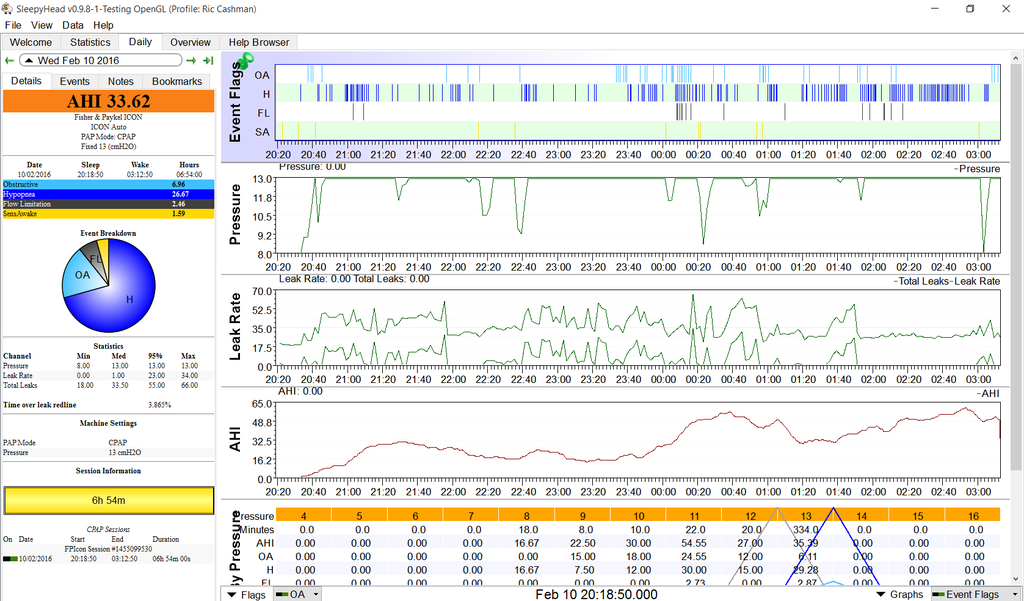
I started off on a fixed pressure of 13 from the titration test. This gave me AHIs in the 20s ansd 30s so at the advice from another forum I switched to APAP with a range from 10-18. This brought my AHIs to just below 10 with one night going down to 6.64. I posted data from the machine and it appears to be the hypopneas that are the main culprit. Advice again said to raise the lower limit to 12. This has given worse results with last night being 20.12
The current theory seems to say that if you are having hypopneas then raising the lower pressure should reduce these. However, it hasn't worked in my case.
I reckon that I only got about 90 minutes sleep in my sleep titration test so the diagnosis and settings must surely be flawed.
I've posted a few nights data to see if anyone here can make any sense of what's happening. I wouldn't have been any better off today if I hadn't used the CPAP.
So what do you make of these?
At FIxed pressure of 13
http://i1108.photobucket.com/albums/h41 ... jrpmdn.png
APAP
http://i1108.photobucket.com/albums/h41 ... odnznk.png
Last night
http://i1108.photobucket.com/albums/h41 ... ayjago.png
Big Variances in AHI
Big Variances in AHI
_________________
| Machine | Mask | |||
 |  | |||
| Additional Comments: Sleepyhead software | ||||
Re: Big Variances in AHI
Hi Holden4th:
I am only about 2 months ahead of you in this process, so I'll just post a couple of observations and comments and leave specific recommendations to the more experienced folks.
1) It is difficult to make an accurate determination based on one night's data at a particular setting. There are so many variables involved in a particular night's sleep that most people are going to want to see trends over several nights.
2) On a couple of your snapshots, your pressure is bumping up against your higher pressure setting. One night was particularly noticeable. This could indicate you need to go even higher. I know my current machine maxes out at 20cm. After that, the next possible step (for me) is a Bipap machine.
3) Glad you are here. My initial study pegged my AHI at 37ish. The titration study determined I needed a fixed rate of 6.0cm. At that pressure, the best I could do was lower the AHI to the lower 20's. With advice here, I tweaked the settings, one at a time, evaluated the changes over several nights, and then tweaked them again. Several times. So it has been a process. Not one change and done. So be prepared for that. I am currently cheating the machine to get a higher pressure than 20cm until I can get back to the doctor in late March and hopefully get prescribed for a Bipap. The good news is my AHI is now reliably below 2.O night after night. So I am getting pretty good rest.
4) I don't know much about the Australian medical system. But if it is anything like what I have experienced in the U. S. you are going to get a lot more knowledge, understanding, and expertise here then from the doctors. They don't seem to understand the intricacies of the condition and/or the treatment. So hopefully some of our fine folks will be along to help you shortly.
Good luck and be prepared to be patient as you learn how to manage your condition properly.
I am only about 2 months ahead of you in this process, so I'll just post a couple of observations and comments and leave specific recommendations to the more experienced folks.
1) It is difficult to make an accurate determination based on one night's data at a particular setting. There are so many variables involved in a particular night's sleep that most people are going to want to see trends over several nights.
2) On a couple of your snapshots, your pressure is bumping up against your higher pressure setting. One night was particularly noticeable. This could indicate you need to go even higher. I know my current machine maxes out at 20cm. After that, the next possible step (for me) is a Bipap machine.
3) Glad you are here. My initial study pegged my AHI at 37ish. The titration study determined I needed a fixed rate of 6.0cm. At that pressure, the best I could do was lower the AHI to the lower 20's. With advice here, I tweaked the settings, one at a time, evaluated the changes over several nights, and then tweaked them again. Several times. So it has been a process. Not one change and done. So be prepared for that. I am currently cheating the machine to get a higher pressure than 20cm until I can get back to the doctor in late March and hopefully get prescribed for a Bipap. The good news is my AHI is now reliably below 2.O night after night. So I am getting pretty good rest.
4) I don't know much about the Australian medical system. But if it is anything like what I have experienced in the U. S. you are going to get a lot more knowledge, understanding, and expertise here then from the doctors. They don't seem to understand the intricacies of the condition and/or the treatment. So hopefully some of our fine folks will be along to help you shortly.
Good luck and be prepared to be patient as you learn how to manage your condition properly.
_________________
| Mask | ||||
 | ||||
| Additional Comments: 560P | ||||
Re: Big Variances in AHI
And one other thing. This is now your thread. So make any posts about your treatment on this thread. That give the board an accurate history of where you started and where you have been. Multiple posts from a single user about their treatment are confusing. Of course feel free to comment on any thread.
_________________
| Mask | ||||
| ||||
| Additional Comments: 560P | ||||
Re: Big Variances in AHI
Australia actually has very up to date medical facilities and knowledgeable doctors, but finding the right help at the right time can be hard given their payer system.
My first thought would be to ask if Holden has tried (while lying down to accommodate facial changes) any full face masks, because there certainly appear to be leakage problems, which can mess with pressures of course. And are you on your back when asleep (it provokes more apneas and hypopneas)? If you raise the pressure to try to compensate for leaks, you only worsen the problem because your mouth opens even more.
My first thought would be to ask if Holden has tried (while lying down to accommodate facial changes) any full face masks, because there certainly appear to be leakage problems, which can mess with pressures of course. And are you on your back when asleep (it provokes more apneas and hypopneas)? If you raise the pressure to try to compensate for leaks, you only worsen the problem because your mouth opens even more.

Re: Big Variances in AHI
I'm certainly not an expert, but my first thoughts were that Holden needs a bipap and higher pressures in addition to getting control of leaks.
_________________
| Machine: ResMed AirSense™ 10 AutoSet™ CPAP Machine with HumidAir™ Heated Humidifier |
| Mask: Fisher & Paykel Vitera Full Face Mask with Headgear (S, M, or L Cushion) |
| Additional Comments: Back up is a new AS10. |

Re: Big Variances in AHI
Holden,
How restless were you on the nights with the worst AHIs? Any chance you're spending significant times awake with the mask on fighting to get to sleep and fighting to stay asleep? That can affect the numbers.
It looks like you have SenseAwake turned on, and there's plenty of SenseAwake evidence on the fixed CPAP@13cm night that you are pretty restless during the night. But it's not clear if SenseAwake was turned off when you switched to APAP mode. But there are no "SenseAwake" events recorded on those nights, and seems a bit unusual to me, given what the AHI looks like.
You write:
You could also try tightening the range---instead of 10-18 or 12-18, you might try 12-14, 13-15, or 14-16. Some people are sensitive to pressure increases in the sense that they get more restless when the pressure starts to bounce around, and sometimes that restlessness results in more events being scored. If you do make further adjustments on the pressure, you need to leave the new settings in place for at least 5-7 days to see what's really happening.
Finally, if you are feeling restless (i.e. you feel like you're tossing and turning a lot fighting to get to sleep and to stay asleep during the night), you might want to think about the comfort settings---i.e. the humidity setting, the exhale relief setting (if there is one), and the SenseAwake setting.
How restless were you on the nights with the worst AHIs? Any chance you're spending significant times awake with the mask on fighting to get to sleep and fighting to stay asleep? That can affect the numbers.
It looks like you have SenseAwake turned on, and there's plenty of SenseAwake evidence on the fixed CPAP@13cm night that you are pretty restless during the night. But it's not clear if SenseAwake was turned off when you switched to APAP mode. But there are no "SenseAwake" events recorded on those nights, and seems a bit unusual to me, given what the AHI looks like.
You write:
Can you put the treated numbers in perspective for us: What was your diagnostic AHI? And has there been a change in the type of events recorded since starting CPAP? In other words, on your diagnostic sleep test, was the problem mainly OAs or Hs? And were central apneas mentioned on either the diagnostic or titration sleep tests?Holden4th wrote: I started off on a fixed pressure of 13 from the titration test. This gave me AHIs in the 20s ansd 30s so at the advice from another forum I switched to APAP with a range from 10-18. This brought my AHIs to just below 10 with one night going down to 6.64. I posted data from the machine and it appears to be the hypopneas that are the main culprit.
How many times in the last month have you changed the settings on your machine? It's tempting to dial wing after every single bad night, but sometimes you do have to use a particular setting for 5-7 days so that your body can acclimate to the new settings and to get enough data for the data to be meaningful.Advice again said to raise the lower limit to 12. This has given worse results with last night being 20.12
You could try leaving the settings where they are for at least 5-7 more days to see if things start to settle down.The current theory seems to say that if you are having hypopneas then raising the lower pressure should reduce these. However, it hasn't worked in my case.
You could also try tightening the range---instead of 10-18 or 12-18, you might try 12-14, 13-15, or 14-16. Some people are sensitive to pressure increases in the sense that they get more restless when the pressure starts to bounce around, and sometimes that restlessness results in more events being scored. If you do make further adjustments on the pressure, you need to leave the new settings in place for at least 5-7 days to see what's really happening.
Finally, if you are feeling restless (i.e. you feel like you're tossing and turning a lot fighting to get to sleep and to stay asleep during the night), you might want to think about the comfort settings---i.e. the humidity setting, the exhale relief setting (if there is one), and the SenseAwake setting.
_________________
| Machine: DreamStation BiPAP® Auto Machine |
| Mask: Swift™ FX Nasal Pillow CPAP Mask with Headgear |
| Additional Comments: PR System DreamStation and Humidifier. Max IPAP = 9, Min EPAP=4, Rise time setting = 3, minPS = 3, maxPS=5 |
Re: Big Variances in AHI
Thank you for all the replies so far, very interesting and have given me plenty to think about.
My diagnosed AHI was 57
My best results so far have come from the 10-18 settings. Yes I did turn Sensawake off when I switched to APAP as it doesn't seem to be needed for automatic pressure. I also have doubts about its accuracy but am happy to give it another try.
I seem to sleep well, only woke once last night but feel like crap today. I'll bet my AHIs are near the 20s!
Given the results from some earlier graphs I am taking the advice from Robysue., to whit, I'll run off a tighter APAP range. As I was titrated for 13cm fixed (but only on about 90 minutes sleep so not sure how accurate that was) I will reset the machine for 10-15 auto and see what happens over the next 7 days. I'll also turn Sensawake back on again.
One trend that you probably can't see in the few graphs I have provided is that I seem to need lower pressures and have fewer events in the first part of the night. It's only after I wake and then go back to sleep (usually only once a night for a toilet stop or because my nose starts to block up) that the events increase and the pressure goes up.
I've also noticed events recorded in this second 'sleep' when I know that I was fully awake. False readings as it where.
Finally BiPAP, why do you folks think I might need it? Given enough evidence I can take this info to a doctor for a change of prescription.
I might talk about mask types in the next post after I've given this seven days.
Once again, thanks to everyone so far for their help, it is truly appreciated as I strive towards that ultimate night's sleep
My diagnosed AHI was 57
My best results so far have come from the 10-18 settings. Yes I did turn Sensawake off when I switched to APAP as it doesn't seem to be needed for automatic pressure. I also have doubts about its accuracy but am happy to give it another try.
I seem to sleep well, only woke once last night but feel like crap today. I'll bet my AHIs are near the 20s!
Given the results from some earlier graphs I am taking the advice from Robysue., to whit, I'll run off a tighter APAP range. As I was titrated for 13cm fixed (but only on about 90 minutes sleep so not sure how accurate that was) I will reset the machine for 10-15 auto and see what happens over the next 7 days. I'll also turn Sensawake back on again.
One trend that you probably can't see in the few graphs I have provided is that I seem to need lower pressures and have fewer events in the first part of the night. It's only after I wake and then go back to sleep (usually only once a night for a toilet stop or because my nose starts to block up) that the events increase and the pressure goes up.
I've also noticed events recorded in this second 'sleep' when I know that I was fully awake. False readings as it where.
Finally BiPAP, why do you folks think I might need it? Given enough evidence I can take this info to a doctor for a change of prescription.
I might talk about mask types in the next post after I've given this seven days.
Once again, thanks to everyone so far for their help, it is truly appreciated as I strive towards that ultimate night's sleep
_________________
| Machine | Mask | |||
| | |||
| Additional Comments: Sleepyhead software | ||||

Re: Big Variances in AHI
What was the break down of your AHI? OA, HA, CAHolden4th wrote:My diagnosed AHI was 57
Do you have a copy of your Sleep Study?
_________________
| Machine: AirCurve™ 10 VAuto BiLevel Machine with HumidAir™ Heated Humidifier |
| Mask: AirFit™ P10 Nasal Pillow CPAP Mask with Headgear |
| Additional Comments: Sleepyhead Software |
ResMed Aircurve 10 VAUTO EPAP 11 IPAP 15 / P10 pillows mask / Sleepyhead Software / Back up & travel machine Respironics 760
Re: Big Variances in AHI
Being awake can cause faulty readings, but REM can also be the worst time for apneas. I know in my case the first part of the night is not too bad, then the AHI tends to rise in waves that correspond to the deeper sleep part of the cycle later in the night. I also get excellent readings when I nap, I suspect because I probably never get to that deep sleep level.
_________________
| Mask | ||||
| ||||
| Additional Comments: 560P | ||||
Re: Big Variances in AHI
My understanding is that REM sleep happens reasonably soon after falling asleep but I might be wrong. My big events usually happen after about 5 hours sleep and also after I've woken up then gone back to sleep. This is the part that puzzles me.Mudrock63 wrote:Being awake can cause faulty readings, but REM can also be the worst time for apneas. I know in my case the first part of the night is not too bad, then the AHI tends to rise in waves that correspond to the deeper sleep part of the cycle later in the night. I also get excellent readings when I nap, I suspect because I probably never get to that deep sleep level.
I do mouth breathe but with a chinstrap this is after air is forced out of my mouth.
_________________
| Machine | Mask | |||
| | |||
| Additional Comments: Sleepyhead software | ||||



Re: Big Variances in AHI
standard sleep cycle chart:Holden4th wrote:My understanding is that REM sleep happens reasonably soon after falling asleep but I might be wrong. My big events usually happen after about 5 hours sleep and also after I've woken up then gone back to sleep. This is the part that puzzles me.Mudrock63 wrote:Being awake can cause faulty readings, but REM can also be the worst time for apneas. I know in my case the first part of the night is not too bad, then the AHI tends to rise in waves that correspond to the deeper sleep part of the cycle later in the night. I also get excellent readings when I nap, I suspect because I probably never get to that deep sleep level.
I do mouth breathe but with a chinstrap this is after air is forced out of my mouth.
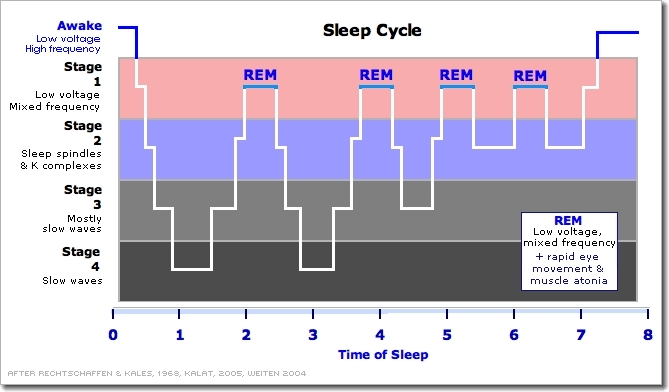
so, I guess it depends on your definition of "reasonably". rem cycles come closer together the longer you sleep, normally.
it's easy to mouth breath with a chinstrap, since your teeth aren't airtight, the only thing that keeps the air in is your lips, which is why some people tape, or use a sweatband over their lips, I've also heard people having luck with athletic mouthpieces that don't have a breathing hole in the middle... or they've plugged it with something.
Get OSCAR
Accounts to put on the foe list: dataq1, clownbell, gearchange, lynninnj, mper!?, DreamDiver, Geer1, almostadoctor, sleepgeek, ajack, stom, mogy, D.H., They often post misleading, timewasting stuff.
Accounts to put on the foe list: dataq1, clownbell, gearchange, lynninnj, mper!?, DreamDiver, Geer1, almostadoctor, sleepgeek, ajack, stom, mogy, D.H., They often post misleading, timewasting stuff.
Re: Big Variances in AHI
Great chart, PaleRider. I thought the longer you slept, the deeper the cycles. Apparently the reverse is true. So my worst AHI periods seem to happen later in the night, in REM and shallower sleep. Still learn things here every day.
I guess I am one of the lucky ones where mouth breathing is concerned. I'm using a nasal-only mask at the moment, at high pressure, and it makes my mouth snap shut like a trap.
I guess I am one of the lucky ones where mouth breathing is concerned. I'm using a nasal-only mask at the moment, at high pressure, and it makes my mouth snap shut like a trap.
_________________
| Mask | ||||
| ||||
| Additional Comments: 560P | ||||
Re: Big Variances in AHI
OK, it's been 7 days and time to report back on progress. Recommendation from most here was to set pressure APAP 10-14 cms.
My AHIs have gone up into the low teens and one or two at 20.
I have woken up feeling starved for air some nights and this is getting more frequent. It s a horrible feeling and I now realise that I had similar experiences before CPAP but didn't realise what they were.
My OAs air in clusters and my hypopneas a bit more spread out.
Mask leak does not appear to be an issue.
I have hit and maintained the top pressure of 14 on quite a few occasions. As I fall asleep I notice the pressure slowly rises from 10. Conversely I also have times where the pressure sits comfortably at 10
Time for some changes
I am almost positive that my head falls forward when I relax, even in my side and that this might be causing flow limitations, hypopneas etc. so I'm going to try a cervical collar. I bought one today and will use it tonight. I will not use my chinstrap.
A couple of thoughts have arisen as I read other posts. I notice that some machines have some sort of auto trial setting to help determine the optimum APAP setting based on 30 days readings. I don't think the F&P Icon has this feature. So if I now reset my machine to APAP 4-20 and leave it like this will I achieve the same result after I look at all the data or is this a bad idea?
I am going to ask the hire company to change my machine. The best they can do is a Resmed S9. They are reluctant to give me this because I don't have a prescription for auto. Can I get my GP ( he's very obliging) to write a prescription or does it have to be a sleep specialist. I feel I need the relief that EPR provides.
Thanks in advance for your advice
My AHIs have gone up into the low teens and one or two at 20.
I have woken up feeling starved for air some nights and this is getting more frequent. It s a horrible feeling and I now realise that I had similar experiences before CPAP but didn't realise what they were.
My OAs air in clusters and my hypopneas a bit more spread out.
Mask leak does not appear to be an issue.
I have hit and maintained the top pressure of 14 on quite a few occasions. As I fall asleep I notice the pressure slowly rises from 10. Conversely I also have times where the pressure sits comfortably at 10
Time for some changes
I am almost positive that my head falls forward when I relax, even in my side and that this might be causing flow limitations, hypopneas etc. so I'm going to try a cervical collar. I bought one today and will use it tonight. I will not use my chinstrap.
A couple of thoughts have arisen as I read other posts. I notice that some machines have some sort of auto trial setting to help determine the optimum APAP setting based on 30 days readings. I don't think the F&P Icon has this feature. So if I now reset my machine to APAP 4-20 and leave it like this will I achieve the same result after I look at all the data or is this a bad idea?
I am going to ask the hire company to change my machine. The best they can do is a Resmed S9. They are reluctant to give me this because I don't have a prescription for auto. Can I get my GP ( he's very obliging) to write a prescription or does it have to be a sleep specialist. I feel I need the relief that EPR provides.
Thanks in advance for your advice
_________________
| Machine | Mask | |||
| | |||
| Additional Comments: Sleepyhead software | ||||
Re: Big Variances in AHI
lower pressure = more apneas and hypopneas until the machine climbs back up to the higher pressure needed.Holden4th wrote:OK, it's been 7 days and time to report back on progress. Recommendation from most here was to set pressure APAP 10-14 cms.... So if I now reset my machine to APAP 4-20 and leave it like this will I achieve the same result after I look at all the data or is this a bad idea?
Get OSCAR
Accounts to put on the foe list: dataq1, clownbell, gearchange, lynninnj, mper!?, DreamDiver, Geer1, almostadoctor, sleepgeek, ajack, stom, mogy, D.H., They often post misleading, timewasting stuff.
Accounts to put on the foe list: dataq1, clownbell, gearchange, lynninnj, mper!?, DreamDiver, Geer1, almostadoctor, sleepgeek, ajack, stom, mogy, D.H., They often post misleading, timewasting stuff.
Re: Big Variances in AHI
My GP wrote my Rx, but I am in the US. Where you live, I don't know.
I hope someone comes along that knows more than I do, but if not, I would use the collar and see how much it helps. I might raise the Max some but I think I would just use the collar first. Good Luck
I hope someone comes along that knows more than I do, but if not, I would use the collar and see how much it helps. I might raise the Max some but I think I would just use the collar first. Good Luck
_________________
| Machine: AirCurve™ 10 VAuto BiLevel Machine with HumidAir™ Heated Humidifier |
| Mask: Brevida™ Nasal Pillow CPAP Mask with Headgear |
| Humidifier: S9™ Series H5i™ Heated Humidifier with Climate Control |
| Additional Comments: S9 VPAP Auto Bilevel Machine |