Do leaks cause OAs - or do OAs cause leaks?

General Discussion on any topic relating to CPAP and/or Sleep Apnea.
sparky2
Posts: 78
Joined: Sat Feb 16, 2008 10:13 pm
Location: Washington State

Do leaks cause OAs - or do OAs cause leaks?

Post by sparky2 » Wed Apr 09, 2008 10:54 pm

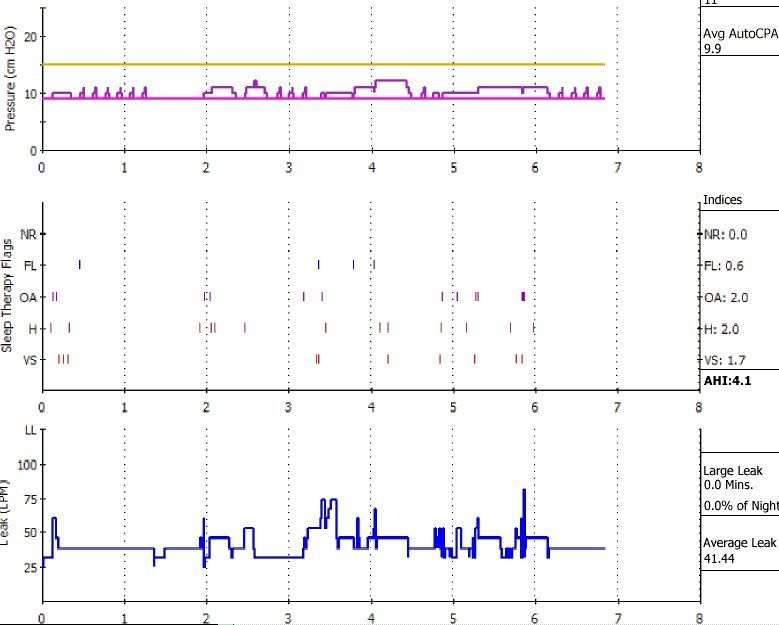
The graph below is typical for me (except that the AHI is about half of my normal value). When I look at the OAs or Hs, I see a very strong correlation with jumps in the Leak chart. These jumps indicate flows of more than 60 LPM. This is always the pattern for me.

The question is - do I have an apnea which causes me to stir which then causes a leak, or do I move around and develop a leak which either causes an apnea/hypopnea or something that is registered as one?

Image


Sparky2


_________________
Machine: PR System One REMStar 60 Series Auto CPAP Machine
Additional Comments: CMS50E Pulse Oximeter

jules
Posts: 3304
Joined: Mon Nov 27, 2006 10:51 pm

Post by jules » Wed Apr 09, 2008 11:16 pm

This is an example where I think some of the output from the software is "fishy" - events and leak changes coinciding. For example, at around 5 h 50 min into the night there are a series of leak changes and there are two "apneas" recorded then. The persons whose data I looked and commented on last night had more of this with a larger group of leak spikes and cluster of "apneas".

It is my opinion that once the software can't recognize what is going on exactly, the machine responds with more air which can be a leak instead of a pressure raise. Apneas can be occurring at a higher rate than the software detects or it might be there was a leak that caused the machine to record an apnea falsely.

I don't trust the programming enough myself. The basic math in Encore Pro sucks so why should I trust more sophisticated algorithms to have been programmed correctly?

I don't trust the way that a few dots a minute or so apart are connected to make these graphs as so much could have happened in that time frame My standard example is the person who graphs the function f(x) = 1/x by plotting the two points (1,1) and (-1,-1) and then draw the line through them. They lost the whole picture of what the function really is.

You don't have to have a big black LL bar on the top of the leak graph to have leaks screwing up recording of events.

It appears I may be in the minority based on comments from last night, but my professional life involved trying to teach college students mathematical critical thinking skills.


User avatar
Goofproof
Posts: 16087
Joined: Mon Dec 05, 2005 3:16 pm
Location: Central Indiana, USA

Post by Goofproof » Wed Apr 09, 2008 11:51 pm

You need some tape or a FF mask... Jim
Use data to optimize your xPAP treatment!

"The art of medicine consists in amusing the patient while nature cures the disease." Voltaire

User avatar
dsm
Posts: 6996
Joined: Mon Jun 20, 2005 6:53 am
Location: Near the coast.

Post by dsm » Thu Apr 10, 2008 12:00 am

OSAs can cause leaks - quite common for them to do so on APAPS & Bilevels.

This is because the mask fit is best when these machines are at their optimum pressure settings but for both Apaps & Bipaps if the user stops breathing & the pressure is increased, it is more likely to seek an escape route.

For Apaps, an event will raise the pressure & the increased pressure creates the problem - same for Bipaps, if your Bipap goes to ipap (breath-in ) pressure & you don't breathe in, there is an increased chance the air will try to escape elsewhere.

Most of us set our masks for optimal conditions.

Conversely, If the mask starts to leak & the machine cannot make up for the leak, then the pressure holding the airway open gets reduced and can allow an OSA event to occur that may not have occurred had the leak not happened.

DSM

_________________

CPAPopedia Keywords Contained In This Post (Click For Definition): bipap

xPAP and Quattro std mask (plus a pad-a-cheek anti-leak strap)

User avatar
Snoredog
Posts: 6399
Joined: Sun Mar 19, 2006 5:09 pm

Post by Snoredog » Thu Apr 10, 2008 2:45 am

Leaks make it more difficult for the machine to maintain pressure, when the ideal pressure is lost (pressure needed to keep your airway splinted open) more OSA events will show up on the report.

Looking at your report; once that leak gets to 75L/m that machine will begin to drop pressure and stop responding to events (while it may continue to record such events).

So if you see a Large Leak (indicated by solid black line at the "top" of the leak chart, that tells you the machine is no longer responding to events due to leaks.

It is best to keep your total maximum leak under 50L/m (about what you will get using a typical FF mask).

Keep in mind in the presence of external leak, the machine has to rev higher to compensate and keep the pressure up, when it does that it becomes more noisy (for your partner) and it makes it harder for the machine to detect those events (it has to compensate for higher flow from the machine or listen over itself). Best to keep leak to a minimum, your therapy will be better if you do.

But there is a fine line between allowable leak and comfort, does no good to cinch up on the straps so tight that it becomes uncomfortable to where you no longer want to use the machine. In that case a little leak is okay.

That is why I like my Soyala so much, it seals great, doesn't need a lot of strap pressure and it has the quietest exhaust of any mask on the market without a doubt.
someday science will catch up to what I'm saying...

sleepie
Posts: 169
Joined: Mon Aug 27, 2007 11:28 am
Location: Elmira,New York

Post by sleepie » Thu Apr 10, 2008 3:06 am

looks like mouth leaks to me------pat

ozij
Posts: 10491
Joined: Fri Mar 18, 2005 11:52 pm

Post by ozij » Thu Apr 10, 2008 3:15 am

Auto Algorithm
Respironics wrote: Leak Management
Patient leak rate depends upon device pressure. For any given pressure level, the REMstar Auto algorithm compares the measured patient leak rate to an expected amount of leak from the exhalation device in the mask. The robust REMstar Auto algorithm tolerates a wide range of leak fluctuations. If the measured patient leak rate significantly increases above the expected leak for an extended period of time, the enhanced Encore report indicates this large leak by displaying a black bar.

Instead of falsely increasing pressure when a large leak is detected, our novel technology compensates by decreasing pressure in an attempt to re-seal the mask on the patient’s face. It’s safer for the patient and helps to provide uninterrupted sleep.
Added emphasis mine.

I do trust the machine to distiguish a leak from added pressure. Look at what happens between hour 3-4 where you have leaks, but no added pressure, to what happens at 5:50.

Edit April 11: I no longer think what I wrote in the following prapgraph - I was wrong about that. See my next post.
I don't like the way the pressure meanders from just about 9.x (the bottom)to a little bit higher - see the first hour, and at just before hour 3 and into it - its going up and down about every 10 minutes, without visible causes. To me this indicates that the bottom is too low and can't really keep you eventless for any reasonable amount of time - the machine is probably responding to changes in the flow characteristics, resolving them satisfactorilyt with that little nudge, and the going back down, and up again because they've returned.
Taking all the data together, I'd guess you're getting too many events that the auto isn't pre-epmting, opening your mouth in response, getting leaks because of that, and moving about restlessly.

I would try to raise the bottom a tiny bit to 10 or 10.5 (not sure if the decimal is possible on a Respironics) and would then concentrate on the leaks - FFM or mouth taping being possible solutions.

O.

_________________

CPAPopedia Keywords Contained In This Post (Click For Definition): respironics, auto

_________________
Mask: AirFit™ P10 Nasal Pillow CPAP Mask with Headgear
Additional Comments: Machine: Resmed AirSense10 for Her with Climateline heated hose ; alternating masks.
Last edited by ozij on Fri Apr 11, 2008 6:12 am, edited 1 time in total.
And now here is my secret, a very simple secret; it is only with the heart that one can see rightly, what is essential is invisible to the eye.
Antoine de Saint-Exupery

Good advice is compromised by missing data
Forum member Dog Slobber Nov. 2023

sparky2
Posts: 78
Joined: Sat Feb 16, 2008 10:13 pm
Location: Washington State

Post by sparky2 » Thu Apr 10, 2008 10:23 pm

I would like to thank you all for your comments so far. I got a smile on my face the other night reading comments to jules' remarks. I am an EE and I don't know everything either . I also realize that control systems can be fooled. I see how it would be difficult for the system's sensors and logic to distinguish between a brief lowering in the leak rate and an OA.

I got really excited a couple of weeks ago when I finally decided that I could be doing some mouth breathing after all. I had strongly suspected that I was not because I had none of the other symptoms. I found some Fixodent the first night and then got some Polygrip and tried this for about a week. No change .

I understand dsm and Snoredog and suspect that some of this is happening - the machine's response is not helping due to the leaks and so I still get events. This is "leaks cause OSAs." The only thing that may have helped my leak situation so far is the Velcro on the headgear trick. I have been adjusting the thing so tight my nose hurts in the middle of the night. I read where someone suggested that being too tight can ruin the seal, so I loosened it - things got worse.

I worry that my moving around may be bumping the mask from my nose a bit. I bought a "CPAP pillow," but that has only helped a little so far. I am just not sure if I start moving because I am having difficulty breathing. If that is the case, things will not get any better until I dial in my pressure correctly (if I/we can).

ozij, thanks for the blurb on "Leak Management." It looks as though there is one of those short dips in pressure at 5:50 in response to a leak. Also, thanks for the pressure recommendation. I will bump up the bottom to 10.5 starting tonight. I have been on 9 to 15 for 9 nights now, so it is time for a change anyway. I haven't started a thread yet asking for specific help in setting my machine up because, by reading the comments to others, I see that I really should give each different pressure setting a try for a week or 10 days. I have an Excel spreadsheet with over 2,000 cells filled in from my first 62 nights of data so, if I finally do start to give up, I can answer the questions I get here with some hard facts.

I would just feel a lot better if I knew one way or another what my AHI would be if I had no leaks. Maybe I should put the mask on with RTV . I am willing to try anything now. Do you think the leaks would get better with a FF mask given that I am not mouth breathing? I sleep best on my side (and I think my events go down) but every time I try that the leaks go up again.


_________________
Machine: PR System One REMStar 60 Series Auto CPAP Machine
Additional Comments: CMS50E Pulse Oximeter

ozij
Posts: 10491
Joined: Fri Mar 18, 2005 11:52 pm

Post by ozij » Fri Apr 11, 2008 6:09 am

ozij wrote:Auto Algorithm
Respironics wrote: Leak Management
Patient leak rate depends upon device pressure. For any given pressure level, the REMstar Auto algorithm compares the measured patient leak rate to an expected amount of leak from the exhalation device in the mask. The robust REMstar Auto algorithm tolerates a wide range of leak fluctuations. If the measured patient leak rate significantly increases above the expected leak for an extended period of time, the enhanced Encore report indicates this large leak by displaying a black bar.

Instead of falsely increasing pressure when a large leak is detected, our novel technology compensates by decreasing pressure in an attempt to re-seal the mask on the patient’s face. It’s safer for the patient and helps to provide uninterrupted sleep.
Added emphasis mine.

I do trust the machine to distiguish a leak from added pressure. Look at what happens between hour 3-4 where you have leaks, but no added pressure, to what happens at 5:50.

I don't like the way the pressure meanders from just about 9.x (the bottom)to a little bit higher - see the first hour, and at just before hour 3 and into it - its going up and down about every 10 minutes, without visible causes. To me this indicates that the bottom is too low and can't really keep you eventless for any reasonable amount of time - the machine is probably responding to changes in the flow characteristics, resolving them satisfactorilyt with that little nudge, and the going back down, and up again because they've returned.
Taking all the data together, I'd guess you're getting too many events that the auto isn't pre-epmting, opening your mouth in response, getting leaks because of that, and moving about restlessly.

I would try to raise the bottom a tiny bit to 10 or 10.5 (not sure if the decimal is possible on a Respironics) and would then concentrate on the leaks - FFM or mouth taping being possible solutions.

O.

_________________
Mask: AirFit™ P10 Nasal Pillow CPAP Mask with Headgear
Additional Comments: Machine: Resmed AirSense10 for Her with Climateline heated hose ; alternating masks.
And now here is my secret, a very simple secret; it is only with the heart that one can see rightly, what is essential is invisible to the eye.
Antoine de Saint-Exupery

Good advice is compromised by missing data
Forum member Dog Slobber Nov. 2023

sparky2
Posts: 78
Joined: Sat Feb 16, 2008 10:13 pm
Location: Washington State

Post by sparky2 » Fri Apr 11, 2008 9:03 pm

Thanks, ozij. It is really nice of you to have given that a second look and then passed that update along. I am going to collect more data about response to various pressures before I give up and ask for more intensive assistance here to get my AHI down. Last night with the low end set to 10.5 I recorded a 6.5 AHI. The night before I had a 7, so I don't expect to get much of a change. I'll give it another week and see what happens.

Sparky2


_________________
Machine: PR System One REMStar 60 Series Auto CPAP Machine
Additional Comments: CMS50E Pulse Oximeter