




After some discussions here this past week I was prompted to again try the BiPAP-Auto. The prospect of using a BiPAP to help minimize aerophagia while allowing me to increase my minimum pressure enough to prevent residual apneas was too tempting to resist. I'd had troubles with the BiPAP-Auto running away with pressure earlier, but since I'd also experienced that same problem with the Remstar-Auto and more less controlled it by minimizing leaks, it seemed likely that the same solution might work for the BiPAP-Auto as well.
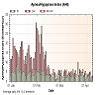
Sure enough it did. With few leaks, my first night with the BiPAP-Auto again went well, and I had no instances of run-away pressure. The worst problem was with a couple of desaturations five minutes apart late in the night. These coincided with blank time in the Encore Pro data which can be seen a little past the 5th hour below:

With a little experimenting I was able to duplicate what caused the blank time. When mouth breathing, the machine stops recording data. Now, if I'd had the machine set to auto-OFF, it would have turned OFF as well (as some users have reported their machines doing recently), however, since I did not have auto-OFF enabled the machine continued blowing air, and as soon as I started nasal breathing again the machine returned to normal operation. I spent an hour or so testing the machine yesterday and determined that this is the way it operates.
Thinking that this sequence of events left a little to be desired, I enabled the alarm function which I had previously disabled and went to bed last night feeling everything was going great for the second night with the BiPAP-Auto knowing that I wouldn't be able to hear the high-frequency alarm if I started to mouth-breathe, but confident that it would wake my wife, who would then probably punch me to shut the #$%& noise off.
One other thing I did was to increase the minimum pressure a tad on the theory that preventing an apnea was better than allowing one to occur which might trigger mouth breathing. Anyway, last night, there were no unexplained blank sequences in the Encore Pro data which can be seen below. There was a large leak, but that was not mouth breathing. I caught that at the time and it was caused by my CL2 nasal pillow shifting on one side.

Just for the sake of completeness I'll mention that the oximeter data looked good too, except for a couple of minor desats which coincide with the two recorded apneas which occurred just prior to the third hour in the Encore Pro data. The machine had reached the upper limit of 12 cm at that time and so couldn't respond to those particular apneas.
Finally to the Point!
Apologies for the length, but I couldn't make the point without providing the background info.
Bad Design Decisions:
1.) Alarm tone at such a high frequency that many typical middle age men with high frequency hearing loss can't hear it. What sense does that make? Who is the typical apnea customer, anyway - the same middle age men, many of whom have high frequency hearing loss. Did Respironics bother to get feedback from any of their customers?
2.) Alarm enabled, automatically turns machine OFF. No kidding! I couldn't believe it. Even though I had Auto-OFF disabled, as soon as I turned the alarm ON, the machine automatically enabled the auto-OFF. This may seem like a minor point, but consider the effect it would have if you used a mask which didn't trigger auto-ON (and many here have recently attested to using such masks). Once you started mouth breathing, the machine would leave you not only without CPAP for the rest of the night, but you'd have an excess of CO2 for the rest of the night as well. Now, if you had good hearing, the alarm would wake you, but not if your hearing is at all like mine. (I simply can't hear the alarm at all!)
To further make the point that the machine manufacturers are not listening to the users of the equipment, I'll point out a couple of bad design decisions involving the CL2 mask which I am just now evaluating also.
1) No way to snug nasal pillows up against base of nose. Sure, you can get it as tight as you want at the tip of the nose, but as soon as you do the nose tip just acts as a pivot point and the mask loosens even more at the base.
2.) The pillows design of the CL2 has the pillows bellows essentially horizontal from the center of the nose to the side edges. C'mon now, most noses tilt up toward the edges. The Swift design builds in about a 30 degree angle.
3.) There is NO way to clean the CL2 nasal pillows. I repeat, there is no way to clean these pillows. Sure, you can wash the outside all you want, but you can't get inside to clean it out. C'mon now, where do the designers think excess snot is going to go, if not down into the inside of the pillows chamber. About all I can see doing is running some water through the assembly and then blowing air through it to dry it off so that mold and mildew don't take hold inside of it.
My apologies for offending any Respironics fans, but these are just what I've observed in the past two nights while checking out the BiPAP-Auto and the CL2. If I'd used other manufacturer's stuff I'd be blunt about it too.
Regards,
Bill