


This is my first post, so I'll begin by thanking those who have been contributing to this forum. I've found this place very valuable over the past few weeks.
As background, I'll add that I'm 53 now and have had sleep problems for 27 years due to heart arrhythmias, bradycardia, hypothermia, leg cramps, chest pain, edema, etc. The episodes were always transient though. I've lost count of exactly how many trips were made to the emergency room in the middle of the night, but it's in the six to ten range, mostly in an ambulance. Always the same result, although the diagnoses varied greatly. Sometimes I even got a stress test. Heart was always just fine. Sometimes I left the hospital after a few hours feeling better than I'd felt in weeks.
Had a sleep study done about a dozen years ago which found some mixed central and obstructive apneas but the docs declared these didn't happen often enough to warrant further consideration despite the severity of the symptoms.
This year, after getting hacked at my GP, and after having fulfilled my deductible for the year as the result of eye surgery. I decided to pursue my problem yet again with another sleep study (and to try to run it fully to ground this time). Interestingly enough, the new sleep study results were consistent with those obtained years ago. My AHI was only about 2.7. What was different now though was my attitude and the fact that earlier in the month I'd obtained a pulse oximeter and analysis software for home use to keep tabs on oxygen desaturation at night. The results showed desaturations which coincided with the arrhythmias, or more precisely, preceded the arrhythmic events just slightly.
Desaturations occurred pretty much non-stop on the few occasions when I was able to fall asleep while lying on my back. (Naturally, at the sleep lab I hadn't been able to fall asleep on my back, even though I tried.) I shared the oximeter reports with my sleep doc who then obligingly provided me a prescription for a BiPAP machine of my choice with pressure levels set initially to 4/4. I guess the data pretty much spoke for itself. The only question he asked me was if I was prepared to pay for the machine myself.
Armed with the prescription and loads of user comments from this forum I ordered the Respironics Auto BiPAP (with heated humidifier) and the Ultra Mirage Full Face Mask. (I even ordered a Smart Card Reader to use with Encore Pro software, but this is a story I'll save for another post.)
The machine arrived overnight express yesterday. I set it up and practiced using it a couple of times for 10-20 minutes during the day. Interestingly, the machine came not with the 4/4 setting prescribed but for auto-titration up to 20/4. I was a little uncomfortable with the auto setting though; seemed like I was hyperventilating on it, and so I decided to follow the docs advice and reset the machine to 4/4, (i.e., straight CPAP). This seemed like a good safe level to get used to things.
I used the machine all night without problems. Because of the low titration settings, I didn't have great expectations. I figured that over a period of a week or so it might be possible to come up with a titration level which provided some benefit. What I didn't expect was to see much immediate relief, but I got it. After being asleep for a few hours, I awoke at the end of a pleasant dream and was so warm under the covers that I had to toss the covers off.
This may not sound like much, but I almost never have pleasant dreams anymore. My dreams often start out pleasant enough but always end in a crisis as I awaken with hypoxia/arrhythmia/cramps/etc. Last night was definitely not the routine night for me, but the sort I'd like to get used to.
I also tend toward hypothermia at night with a basal temperature 2-3 degrees below normal. I was diagnosed with hypothyroid years ago but supplements have never made much difference in body temperature although I continue to take them (and every year I get a thyroid test and am told everything is "normal"). Many nights I've awakened to uncontrollable shivering. (Believe it or not, I'm actually relieved when I get a fever, because I'll be warmer at night; I'll sleep well without having to worry about waking up in a crisis.)
Last night was definitely different. I took my temperature several times to make sure it wasn't a fluke, but it stayed above 97 all night. Again, I think I could get used to this. I'm hoping it's not just the result of being sick (but, I don't feel sick).
When I downloaded the oximeter data this morning it correlated with what I was feeling. It showed the smallest amount of time with a pulse rate below 50 bpm in the several weeks I've been collecting data and had only three desaturations all night compared with the ten to twenty or more I've been seeing.
All in all, I'm very encouraged; more so than at any time in the past 27 years since I first went to an emergency room in an ambulance thinking that I'd just had a stroke.
Sorry for the rambling post. Guess I just needed to talk. What I'm really hoping is that the first night's trend continues.
Regards,
Bill
A Surprising First Night


15 posts
• Page 1 of 1

Getting it off your chest
Bill,
I find that it helps to write it down, to tell someone. Seems to help me get focused.
You are not set up to read any AHI's reported by the machine, so you don't know what they might be. (That's another story, huh?) I gather you are hoping that PAP is going to help your other conditions? It seems your were encouraged by last night? You are pioneering. Most of the folks on this forum talk in terms of classical SDB and AHI's. But, your AHI's are very low.
Keep us posted,
Jerry
I find that it helps to write it down, to tell someone. Seems to help me get focused.
You are not set up to read any AHI's reported by the machine, so you don't know what they might be. (That's another story, huh?) I gather you are hoping that PAP is going to help your other conditions? It seems your were encouraged by last night? You are pioneering. Most of the folks on this forum talk in terms of classical SDB and AHI's. But, your AHI's are very low.
Keep us posted,
Jerry
_________________
| Machine | Mask | |
 |  |
Un-treated AHI = 9.5
Titrated prssure: 6 cm
Ave. AHI after therapy = 0.5
Ave. Snore Index = <10
Current pressure = 9 cm
Titrated prssure: 6 cm
Ave. AHI after therapy = 0.5
Ave. Snore Index = <10
Current pressure = 9 cm
-
NightHawkeye
- Posts: 2431
- Joined: Thu Dec 29, 2005 11:55 am
- Location: Iowa - The Hawkeye State
My Smart Card reader is supposed to arrive tomorrow. One of the reasons I ordered the Respironics machine is its ability to collect data. I'm an engineer so, naturally, I love data. I'm real interested in seeing what the machine collects.You are not set up to read any AHI's reported by the machine, so you don't know what they might be. (That's another story, huh?)
See my other thread about Securetech Peripherals.
Well, Jerry, sometimes one just has to go with the best info available and draw conclusions from that. The info I've managed to gather over the past month forces me to form a different conclusion than I've held for years. I used to think I had some kind of heart problem or systemic problem which the docs couldn't fully diagnose and kinda made the best of that. I controlled symptoms with diet and "moderate" exercise.I gather you are hoping that PAP is going to help your other conditions? It seems your were encouraged by last night? You are pioneering. Most of the folks on this forum talk in terms of classical SDB and AHI's. But, your AHI's are very low.
Actually, in one sense my AHI is within the well documented range of sleep apnea. While sleeping on my back, desaturations increase greatly. I believe it's the Medicare guidelines which state that AHI of greater than 5 (with significant symptoms) must be measured over at least a 2 hour interval of sleep. I've recorded desaturations while sleeping on my back a couple of times for 2 to 3 hours each and gotten AHI's of between 5 and 10 per hour. I went through this line of reasoning with my sleep doc and, like I said, he didn't argue with the data. Instead, he wrote the prescription for me.
Anyway, for better or worse, I own the equipment now, regardless of whether insurance reimburses me for any of it or not. I'm sure I'll have more questions as I begin to look at the data collected by the machine.
Regards,
Bill
-
NightHawkeye
- Posts: 2431
- Joined: Thu Dec 29, 2005 11:55 am
- Location: Iowa - The Hawkeye State
OK, here's what I've learned since the original post. It looks like the pieces of the puzzle are coming together for me now. The Encore Pro software is scoring my AHI much higher than the sleep lab did. (Even though Encore Pro didn't print an AHI from last night, it's obvious from the long-term trend data that the software did in fact score last night. The long-term trend data shows an AHI of 9.2 for both nights. This is higher than the AHI of 7.6 from the first night's data and since last night was just over 5 hours rather than the 8 hours of the first night, this means that last night's AHI = 12.)
So, which am I to believe, the sleep lab calculation or Encore Pro? I think I'll go with the Encore Pro data; it's a relatively simple, direct measurement based on airflow. Oximeter data on the other hand, which figures heavily in the sleep lab calculations, is indirect, complex and subject to large errors. (I expect I'll bring this up with the sleep doc when I go back in three weeks.) My sleep has been much better the last two nights than is the norm, making me think I'm going in the right direction. (Oximeter results from the first night were the best in a month of collecting data, suggesting that the therapy is helping.)
Well, so this is why I bought an auto titrating machine Jerry. And why I got a machine which collects data. I got an auto titrating BiPAP because I remembered from my first sleep study years ago that I had a mix of obstructive and central apneas (just not enough to classify as serious enough for treatment).
I'm feeling better already and mighty glad I decided to take personal charge of this matter rather than depending solely on a physician's diagnosis. It appears now that what's been ailing me is not so different from what some of you folks here have endured for years as well. (Still have to resolve the discrepancy with the oximeter data, but that may be a longer term project.)
Regards,
Bill
So, which am I to believe, the sleep lab calculation or Encore Pro? I think I'll go with the Encore Pro data; it's a relatively simple, direct measurement based on airflow. Oximeter data on the other hand, which figures heavily in the sleep lab calculations, is indirect, complex and subject to large errors. (I expect I'll bring this up with the sleep doc when I go back in three weeks.) My sleep has been much better the last two nights than is the norm, making me think I'm going in the right direction. (Oximeter results from the first night were the best in a month of collecting data, suggesting that the therapy is helping.)
Well, so this is why I bought an auto titrating machine Jerry. And why I got a machine which collects data. I got an auto titrating BiPAP because I remembered from my first sleep study years ago that I had a mix of obstructive and central apneas (just not enough to classify as serious enough for treatment).
I'm feeling better already and mighty glad I decided to take personal charge of this matter rather than depending solely on a physician's diagnosis. It appears now that what's been ailing me is not so different from what some of you folks here have endured for years as well. (Still have to resolve the discrepancy with the oximeter data, but that may be a longer term project.)
Regards,
Bill

Nighthawkeye,
The sleep study is exactly that... a study. It's one night, and usually the conditions are not something most folks deal with real well for the duration (all the wires, people coming into the room, position of sleep, etc). By using a machne that collects data and by getting used to using it, I think your sleep pattern "stabilizes" into whatever is more normal for YOU. So the data has to be looked at over time. Collecting sufficiaent data to formulate conclusions will take a little time, but if you've got a month's worth of data and you're fairly comfortable using the machine, then you're already probably starting to see some trends.
Your observation that your sleep is better is important. A LOT of this is about..."how do you FEEL?". And so is somewhat subjective. IMPORTANT...but subjective. Keep also in mind that the machine interprets criteria, but makes no observations, therefore it reports only what it knows to interpret. It doesn't make subjective calls (unless that's in its programming... heheh).
All that being said...
If you FEEL better, then you're on to something.
The sleep study is exactly that... a study. It's one night, and usually the conditions are not something most folks deal with real well for the duration (all the wires, people coming into the room, position of sleep, etc). By using a machne that collects data and by getting used to using it, I think your sleep pattern "stabilizes" into whatever is more normal for YOU. So the data has to be looked at over time. Collecting sufficiaent data to formulate conclusions will take a little time, but if you've got a month's worth of data and you're fairly comfortable using the machine, then you're already probably starting to see some trends.
Your observation that your sleep is better is important. A LOT of this is about..."how do you FEEL?". And so is somewhat subjective. IMPORTANT...but subjective. Keep also in mind that the machine interprets criteria, but makes no observations, therefore it reports only what it knows to interpret. It doesn't make subjective calls (unless that's in its programming... heheh).
All that being said...
If you FEEL better, then you're on to something.
_________________
| Mask: Swift™ FX Nasal Pillow CPAP Mask with Headgear |
| Humidifier: S9™ Series H5i™ Heated Humidifier with Climate Control |
| Additional Comments: original pressure 8cm - auto 8-12 |
-
Guest
Bill, just wanted to say "Congratulations" both because you are feeling better, and for your tenacity in following up on your symptoms and causes thereof! That is really impressive!
Just shows how really important it is for us to take charge of our own situations and health as much as is feasible.
Will look forward to hearing how you are doing as you continue to use your bi-pap.
Sleepy Gal (Nan)
Just shows how really important it is for us to take charge of our own situations and health as much as is feasible.
Will look forward to hearing how you are doing as you continue to use your bi-pap.
Sleepy Gal (Nan)
-
NightHawkeye
- Posts: 2431
- Joined: Thu Dec 29, 2005 11:55 am
- Location: Iowa - The Hawkeye State
Thanks Sleepy Gal, Nan. After four days, some significant trends are starting to emerge for me, not the least of which is getting up feeling pretty good; a far cry from most mornings before I started xPAP, when I'd emerge every morning feeling unrested, but thankful to have survived the night."Congratulations" both because you are feeling better, and for your tenacity in following up on your symptoms and causes thereof! . . .
Will look forward to hearing how you are doing as you continue to use your bi-pap.
Here's some of the data from the past four nights with my machine running as a straight CPAP at 4 cm pressure.
AHI: 7.6, 12.0, 12.1, 11.7
Number of Oxygen De-saturations: 3, 13, 8, 3
Longest Time of Desaturation: 20, 70, 50, 30
Number of Snores: 1, 0, 0, 1
And just for comparison - the prior four nights of Oximeter data prior to starting xPAP.
Number of Oxygen De-saturations: 14, 15, 15, 22
Longest Time of Desaturation: 50, 150, 70, 50
The prior four nights data is reasonably representative of the entire month of data, although the 150 sec desaturation time was the longest recorded. The fewest desaturations in any one night prior to xPAP was 7.
It appears that CPAP therapy has affected the length and duration of the oxygen desaturations. I'd guess that's why I feel better in the morning now - less stress from hypoxia during the night.
Also, I've continued to wake up feeling warmer every morning. When I've checked my temperature the past four mornings, it has run a little over 97. This itself is unusual for me. Prior to xPAP, it was normally running in the 95 to 96 range.
I got a few important answers from the data so far but, really, lots more questions. I'd like to hear other people's interpretations. I'm ready to make an adjustment to the settings but I'm not quite sure how much yet and in what mode. I'm not ready for full auto-BiPAP mode yet. When I practiced with the unit a little on the day it arrived, it was in auto-BiPAP mode and I think I was hyperventilating on it, so I'd like to avoid having that happen.
The choice seems to between merely raising CPAP pressure or going to Bi-Flex mode and just raising the IPAP slightly. (C-flex is not an option with this machine.) Suggestions appreciated.
Regards,
Bill
P.S. I still don't have MyEncore working. There's a problem accessing the database, although I think I've followed Derek's directions to the letter. For some reason the data is in the MSSQL$ENCOREPRO directory rather than the one it's supposed to be and I can't figure out how to move it.
-
NightHawkeye
- Posts: 2431
- Joined: Thu Dec 29, 2005 11:55 am
- Location: Iowa - The Hawkeye State
What I really meant to say was: "It appears that CPAP therapy has affected both the number and duration of the oxygen desaturations. I'd guess that's why I feel better in the morning now - less stress from hypoxia during the night.It appears that CPAP therapy has affected the length and duration of the oxygen desaturations. I'd guess that's why I feel better in the morning now - less stress from hypoxia during the night.
Please excuse the nonsensical first writing.
Regards,
Bill
-
Colorado Jan
Am I reading you correctly at all?
Your first post said you had a sleep study which showed AHI of 2.7? And now with CPAP at 4 cfm, you are having AHI's in the teens? Which is worse, of course, although I saw your oxygen desats were down....
I'm not sure why you have a Bipap either. I thought Bipaps were most useful for people who had high pressures or unrelated lung issues that made exhalation against the pressure difficult.
Just trying to understand what is going on here and trying to learn from it...glad you are feeling better! Defnitely that is the most important thing!
Jan in Colo.
Your first post said you had a sleep study which showed AHI of 2.7? And now with CPAP at 4 cfm, you are having AHI's in the teens? Which is worse, of course, although I saw your oxygen desats were down....
I'm not sure why you have a Bipap either. I thought Bipaps were most useful for people who had high pressures or unrelated lung issues that made exhalation against the pressure difficult.
Just trying to understand what is going on here and trying to learn from it...glad you are feeling better! Defnitely that is the most important thing!
Jan in Colo.
-
rested gal

- Posts: 12880
- Joined: Thu Sep 09, 2004 10:14 pm
- Location: Tennessee
I'm not a doctor or anything to do with the health care professions. But I'll offer a suggestion anyway. If it were me, I'd set the machine for auto mode - minimum pressure of 5 (or 6), maximum pressure 10. Use it as an autopap until you've gathered 4 or 5 days of data to see how things look using that range of pressure. If you see that you are spending a lot of time up at 10, change the range to 6 (or 7) as the low, 12 as the high.NightHawkeye wrote: I'm ready to make an adjustment to the settings but I'm not quite sure how much yet and in what mode.
---snipped---
Suggestions appreciated.
There is no point in trying to use BiPAP mode, imho, until you know what a good "single" pressure is for you. By running it in auto mode to give the machine an opportunity to come up with a "90th" percentile pressure, you'll have an idea what your "prescribed" single pressure really should be. Almost as if you had had a sleep study titration to find a good pressure for you.
-
NightHawkeye
- Posts: 2431
- Joined: Thu Dec 29, 2005 11:55 am
- Location: Iowa - The Hawkeye State
Jan,Am I reading you correctly at all?
Your first post said you had a sleep study which showed AHI of 2.7? And now with CPAP at 4 cfm, you are having AHI's in the teens? Which is worse, of course, although I saw your oxygen desats were down....
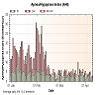
Yes, you are understanding me perfectly. I'll refrain from speculating on the reasons for the big difference between the sleep study AHI and the Encore Pro AHI, although I've been considering several possibilities, but instead of speculating for now I'll just post the data and you can see for yourself. (I've been putting it together for my next discussion with the sleep doc.) Pardon the imperfections in the oximeter data which I had to do some cut and pasting on to align it with the Encore Pro data. Even with the imperfections, the correlation between Desats and Apneas is apparent.
Here's the first night's data. Note that I have a large leak problem for a good part of the night, probably because of facial hair.

Here's the second night's data.

Encore Pro divided the third night's data into two parts (I guess because I was out of bed for over an hour in the middle of the night.) The large leak problem appears to be corrected here and the AHI goes up somewhat as a result.


Here's last night's data. Note that the large leak problem was not totally vanquished.

Two factors played into my decision for a BiPAP.I'm not sure why you have a Bipap either. I thought Bipaps were most useful for people who had high pressures or unrelated lung issues that made exhalation against the pressure difficult.
1) I'm concerned a little about the possibility of Central Apnea. Apparently, BiPAP's, for reasons no one fully understand, help folks with Central Apnea. From my first sleep study years ago, I seem to remember some central apneas being present.
2) I really just wanted to go through the hassle one time as opposed to upgrading later at additional expense, etc. Besides, being an engineer, using a BiPAP just seemed like the better way to perform my own sleep study analysis.
Regards,
Bill
-
NightHawkeye
- Posts: 2431
- Joined: Thu Dec 29, 2005 11:55 am
- Location: Iowa - The Hawkeye State
Rested Gal, I would use it as an APAP if I could; unfortunately, that's one of the limitations of my machine it will run auto-BiPAP but not auto-PAP. (The difference in the two being the difference in inhalation and exhalation pressures, of course.) From a final use perspective, I'm hard pressed to think there's any real reason to need APAP rather than auto-BiPAP; both seem to accomplish the same result. From a data collection perspective, though, it introduces an additional complicating variable.There is no point in trying to use BiPAP mode, imho, until you know what a good "single" pressure is for you. By running it in auto mode to give the machine an opportunity to come up with a "90th" percentile pressure, you'll have an idea what your "prescribed" single pressure really should be.
At this point I'm inclined to keep things simple. I think that I'll probably just increase the pressure to 6 or 7 cm for the next few days and see what the results look like.
Regards,
Bill
-
sapphireskye
- Posts: 121
- Joined: Fri Dec 23, 2005 2:22 pm
- Location: Colorado
- Contact:
Hey there
Bill, as a newbie to all of this, I must say I am proud that you are embarking on this journey to help yourself and it is wonderful your doctor worked with you.
I do not believe my sleep study in the lab was a completely accurate diagnostic for how serious I can get sometimes. It was a one night split study, and I still don't have the results. Yes, I qualified for treatment, but I do believe at times I am much worse than others. For instance, I used to live with a friend (whom we have grown apart), who had been to medical school until she got restrictive cardiomyopathy. I would freak her out as much as I stopped breathing, far more than the short 1st half of the night that I slept and was monitored at the hospital. Not to mention, I didn't fall asleep for what seemed like forever with that mask on my face. To me, longer term studies would be more accurate. I am hoping that with your machine and software you will be able to find a correct setting that will greatly decrease your problems. And again, so long as it is helping, it surely cannot hurt.
HAPPY NEW YEAR
CHelle
I do not believe my sleep study in the lab was a completely accurate diagnostic for how serious I can get sometimes. It was a one night split study, and I still don't have the results. Yes, I qualified for treatment, but I do believe at times I am much worse than others. For instance, I used to live with a friend (whom we have grown apart), who had been to medical school until she got restrictive cardiomyopathy. I would freak her out as much as I stopped breathing, far more than the short 1st half of the night that I slept and was monitored at the hospital. Not to mention, I didn't fall asleep for what seemed like forever with that mask on my face. To me, longer term studies would be more accurate. I am hoping that with your machine and software you will be able to find a correct setting that will greatly decrease your problems. And again, so long as it is helping, it surely cannot hurt.
HAPPY NEW YEAR
CHelle

It appears to me that your machine set at 4/4 would be too low, I think I wouldn't get enought air at all. I was started at 14 and it worked pretty good but last night I set it up to 15 and my readings were much better. If I was in your shoes I would try it a little higher for a couple of nights to see it the AHI comes down. Maybe a change of 6/6 to 8/8. I would worry about low air.
Use data to optimize your xPAP treatment!
"The art of medicine consists in amusing the patient while nature cures the disease." Voltaire
"The art of medicine consists in amusing the patient while nature cures the disease." Voltaire
-
NightHawkeye
- Posts: 2431
- Joined: Thu Dec 29, 2005 11:55 am
- Location: Iowa - The Hawkeye State
Day 5:
Lots went wrong last night, but even so I got up feeling pretty darned good this morning; learned a few more things too. Seems like do-it-yourself anything always involves a lot more trial and error than it seems like it should.
Specifics are that I started out with CPAP at 6 cm pressure for three hours before getting up in the middle of the night. Then, about ten minutes after going back to bed I was so uncomfortable that I got up again; this time as I got up stomach cramps hit me - from air in my stomach no doubt. Wow, my first encounter with aerophagia! Man, did that hurt; took me about an hour to walk it off before going back to bed.
Thinking maybe a change was in order, I switched the machine to auto-BiPAP mode with max IPAP set to 8 cm and EPAP set to 4 cm. I decided I like BiPAP mode better than CPAP mode, although the Darth Vader like sound effects kept me awake much more than I would have been otherwise for the rest of the night.
Oximeter results from the night at higher pressure were as good as any of the previous four nights; only 3 desaturations with a max duration of 40 sec.
Encore Pro didn't provide much meaningful info though because of a "large leak" for most of the night. It appears that auto-BiPAP mode requires less leakage than straight BiPAP before it will declare apneas and hypopneas.
The good news is that I think I've now finally resolved the source of the large leak. At first I thought it was the result of facial hair, so I've attempted to minimize this each of the past five nights, with limited success. After investingating a little bit this morning though, I've concluded that I must have gotten one of the defective ResMed Ultra Mirage FF masks which has been written about on this board recently. I've been aware of air exhausting at the inlet port for the prior nights but without thinking too much about it, and without the experience to know exactly how things were supposed to work, I just assumed that it was part of the normal exhaust system.
After considering this possibility this morning, I hooked up the mask, turned the machine on and sure enough air poured through the exhaust valve at the inlet port. After playing with the seal flap for a minute or so, when I put the mask back on, amazingly, no air was vented through it.
I'll continue to monitor the flap. If it continues to give problems, I'll call CPAP.com for a replacement.
I'm really looking forward to using the machine again in auto-BiPAP mode.
Regards,
Bill
Lots went wrong last night, but even so I got up feeling pretty darned good this morning; learned a few more things too. Seems like do-it-yourself anything always involves a lot more trial and error than it seems like it should.
Specifics are that I started out with CPAP at 6 cm pressure for three hours before getting up in the middle of the night. Then, about ten minutes after going back to bed I was so uncomfortable that I got up again; this time as I got up stomach cramps hit me - from air in my stomach no doubt. Wow, my first encounter with aerophagia! Man, did that hurt; took me about an hour to walk it off before going back to bed.
Thinking maybe a change was in order, I switched the machine to auto-BiPAP mode with max IPAP set to 8 cm and EPAP set to 4 cm. I decided I like BiPAP mode better than CPAP mode, although the Darth Vader like sound effects kept me awake much more than I would have been otherwise for the rest of the night.
Oximeter results from the night at higher pressure were as good as any of the previous four nights; only 3 desaturations with a max duration of 40 sec.
Encore Pro didn't provide much meaningful info though because of a "large leak" for most of the night. It appears that auto-BiPAP mode requires less leakage than straight BiPAP before it will declare apneas and hypopneas.
The good news is that I think I've now finally resolved the source of the large leak. At first I thought it was the result of facial hair, so I've attempted to minimize this each of the past five nights, with limited success. After investingating a little bit this morning though, I've concluded that I must have gotten one of the defective ResMed Ultra Mirage FF masks which has been written about on this board recently. I've been aware of air exhausting at the inlet port for the prior nights but without thinking too much about it, and without the experience to know exactly how things were supposed to work, I just assumed that it was part of the normal exhaust system.
After considering this possibility this morning, I hooked up the mask, turned the machine on and sure enough air poured through the exhaust valve at the inlet port. After playing with the seal flap for a minute or so, when I put the mask back on, amazingly, no air was vented through it.
I'll continue to monitor the flap. If it continues to give problems, I'll call CPAP.com for a replacement.
I'm really looking forward to using the machine again in auto-BiPAP mode.
Regards,
Bill
15 posts
• Page 1 of 1