Africassie wrote:
SleepyToo2: Since I have had no instruction on how to operate my machine, I am flying blind. How am I supposed to find out which settings are best? Is there a guide somewhere that could tell me what settings to use or suggested combinations of settings? I am sometimes not even sure what impact my changes really have.
You need to get into the clinical menu. You can go to
http://www.apneaboard.com and request a copy of the clinical menu for your machine. You'll have to register as a user over there.
One more question: As I understand it, the machine I have, the C-Flex Plus machine, has variable air pressure. When one exhales, the machine's air pressure drops to allow for proper breathing. When does the positive air pressure start again? Do I have to inhale for the pressure to ramp up?
You are using the PR REMstar System One
Pro with C-Flex Plus (model 450 or 460), which is a fixed pressure machine that records full efficacy data and has an exhalation relief system called C-Flex Plus.
Now to answer your questions:
The way C-Flex Plus work is this: At the beginning of each exhalation, the pressure is reduced to a lower, but still positive air pressure. Exactly how much the pressure drops at the beginning of the exhalation depends on both the Flex setting and the force of the exhalation. The more forceful the exhalation, the greater the drop in pressure. But the exhale pressure will never drop more than 1-3cm below your pressure setting AND the exhalation pressure will never drop below 4cm. So throughout the exhalation you are still dealing with an airway that has positive air pressure being added by the machine. To give you a couple of working examples:
If your pressure setting is 8cm and Flex is set to 3, at the beginning of an exhalation the pressure will be dropped to somewhere between 5 and 7.5cm.
If your pressure setting is 6 cm and Flex is set to 3, at the beginning of an exhalation the pressure will be dropped to somewhere between 4 and 5.5 cm.
And under the C-Flex Plus system, the pressure is increased about half-way back up about halfway into the exhalation and the pressure is increased all the way back up at the beginning of the next inhalation.
When does the positive air pressure start again? Do I have to inhale for the pressure to ramp up? Is this not counter intuitive for apnea? I thought the purpose of the positive air pressure was to force open the airway to prevent/alleviate obstruction?
Your CPAP does NOT try to force open a collapsed airway to "alleviate obstruction." That would require the machine to act as a non-invasive ventilator. Rather the machine provides positive air pressure
even during the exhalation to make it more difficult for your airway to collapse. The system is very good at preventing apneas and hypopneas from occurring, but it is not perfect: A few events will likely occur each night, but the overall number of events will be low enough to keep your
treated AHI under 5.0, and probably well under 5.0, each night you use the machine.
Because your machine is a
fixed pressure machine it will not respond to the events that get through the CPAP defenses. Since your machine is the PR System One
Pro with C-Flex Plus (moded 450 or 460), the machine will record when each of the events that get by the CPAP happen. In fact, the machine will record a record of each and every breath you take all night long. But because the machine is programed to run with a fixed pressure setting, it will not respond to those events by increasing the pressure.
In order to get a machine that can increase the pressure in response to the events that get by the PAP defenses, you need to have a PR System One Auto CPAP (model 550 or 560). But even the PR System One Auto will NOT increase the pressure
during an apnea or a hypopnea (that would make it a non-invasive ventilator). Rather the Auto PAP will increase the pressure
after the apnea or hypopnea is over and you restart breathing on your own. The idea is to prevent
additional events from happening rather than trying to "fix" the event in progress.
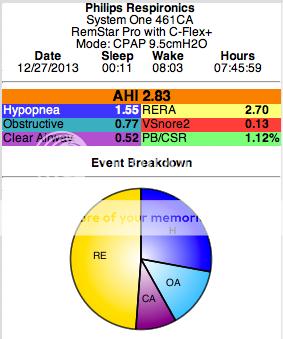
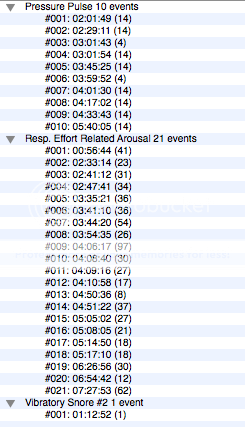
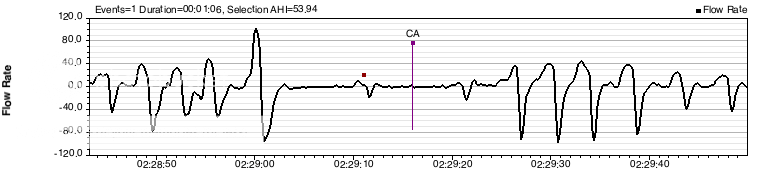
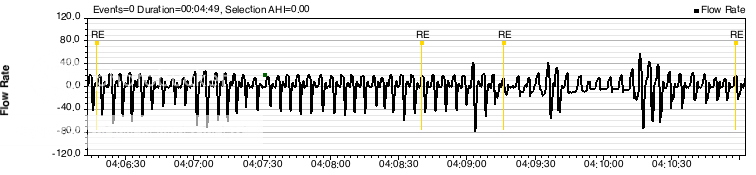
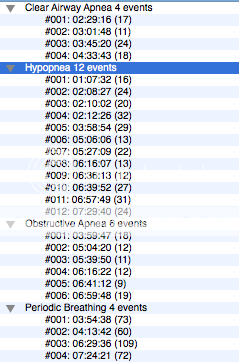
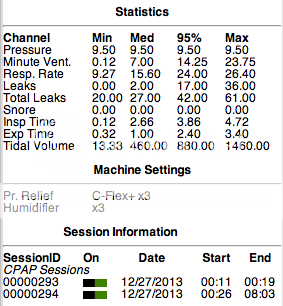
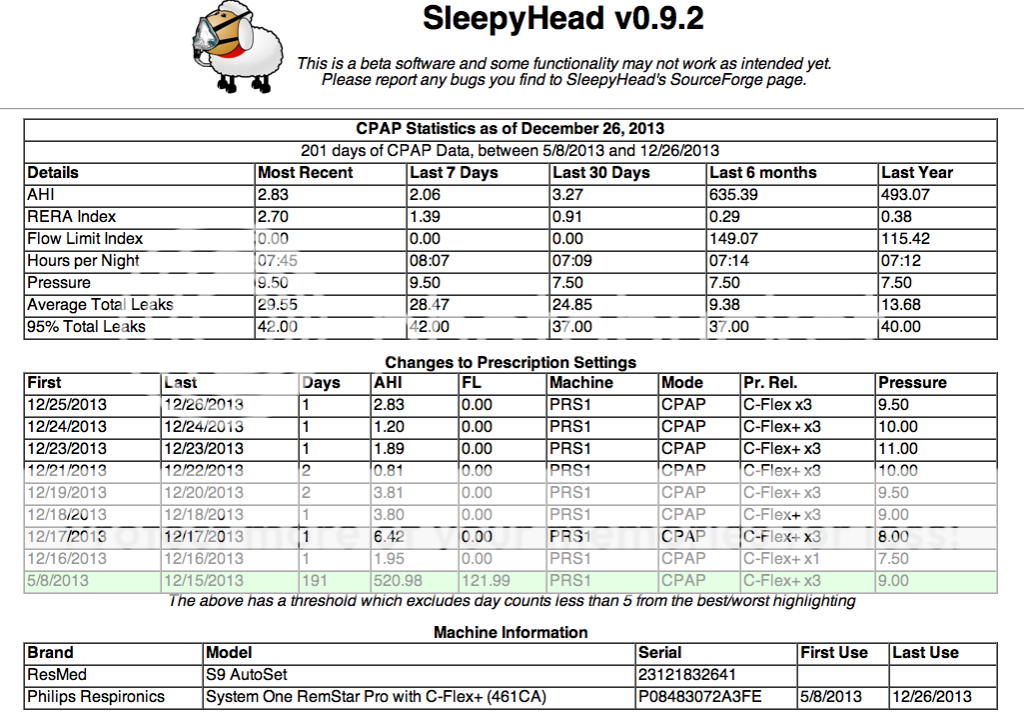
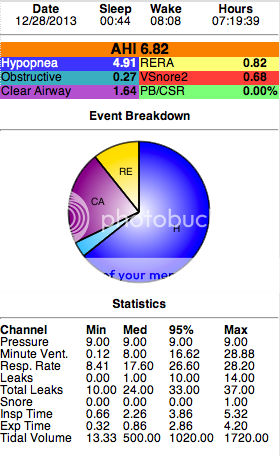
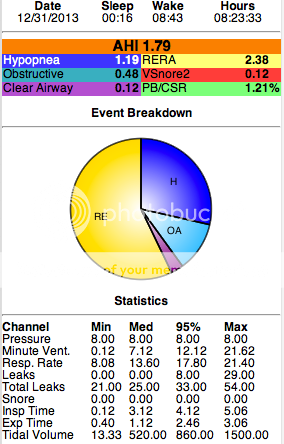
ere is the screen capture of the pie chart and the stats. Apart from my leak rate that went down, it seems the other things all took a turn for the worse. Any insights would be appreciated!
Data from one night is not long enough to really say much of anything. But: On this night your treated AHI is a bit higher than desired since it is above 5.0. But it's not that much above 5.0. Sometimes the treated AHI takes a few days or a couple of weeks to drop down to where it becomes more or less stable.
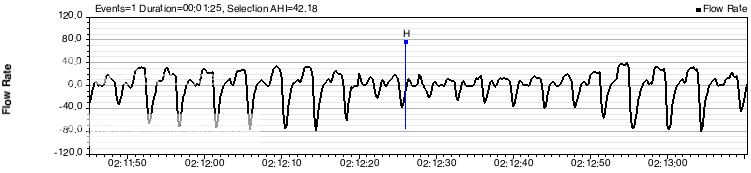
Next, most of the events that the machine was not able to prevent were Hypopneas. A hypopnea is scored when the air flow decreases by at least 50% from the running baseline and the reduction lasts for at least 10 seconds. Loosely a hypopnea occurs when the airway is partially blocked, but not fully obstructed. It is kind of like breathing through a very narrow straw and too many hypopneas can lead to the same problems that too many apneas lead to: Arousals (to kick start the breathing) and (potentially) O2 desaturations.
From the numerical data the leaks appear to be under control. On the PR System Ones, the official Encore software tends to score official Large Leaks only when the
total leak rate gets up above 70-90 L/min. (The line seems to be dependent on the pressure setting and PR has not published what the criteria are for scoring an official Large Leak.)