


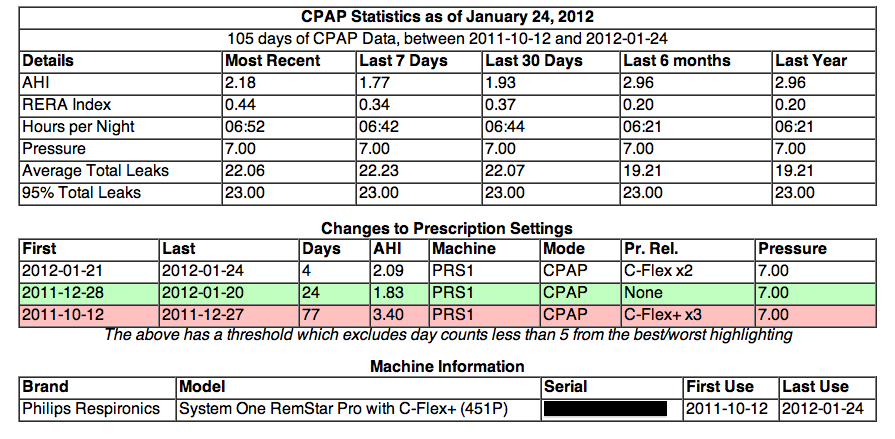
This morning, SleepyHead displayed a day count of 105, or fifteen weeks. Has it really been that long since I returned the brick (that I used for five nights) and 110 days since I last had a night without wearing a mask?
Most of what I had hoped for with this machine hasn't happened. My doctor still chases me out of her office at the end of appointments with comments on how tired I look; I still have the colouration of Uncle Fester; I have an even harder time staying awake during my commute home and in class. As for the more positive changes, when I'm awake, it's easier to stay focused on tasks than before, and it's easier to stay awake at work. But I'm perfectly willing to trade staying awake times. What's work good for, anyway? Rent? Groceries? Tuition? Well, okay, tuition is kind of important.
Hopefully my follow-up at the end of week eighteen has some answers, and if not, hopefully I will have caught myself snoring by then.
15 weeks on my machine


8 posts
• Page 1 of 1
15 weeks on my machine
_________________
| Mask: AirFit™ P10 For Her Nasal Pillow CPAP Mask with Headgear |
| Additional Comments: Software: SleepyHead, loosely following HEAD |

Re: 15 weeks on my machine
Congratulations on 15 weeks!
Hang in there, and always remember that you probably suffered with apnea for years. The human body is wonderfully adaptable, and it adapted to your lack of sleep over that time, now it has to adapt back.
Now, I'm not saying that everything is ok. You need to keep monitoring, talking with your doc, etc. Absolutely! But, keep in mind that it could take a little time for your body to set a new baseline. Then the real fun begins.
I've been on CPAP for nearly a year now. I still feel sluggish and tired and all that. But:
I eat like crap.
I don't exercise.
So, I know that now, after I've had some time to adjust to actually sleeping, I need to change my diet and start moving. Until I do I'll keep feeling like crap and my health will not dramatically improve. But now, I sleep at night, so I can actually not be crashing at 3pm, I can go and do things like find good recipes and exercises.
Hang in there, I can't stress that enough. CPAP doesn't work for everyone, but it does help most of the folks who use it. Keep in touch with your doctor, see what other changes you'll be able to start in your life that might help you feel better and better over time.
And keep talking! Your posts over the next months may help the next visitor who's in the same boat you are right now =)
Hang in there, and always remember that you probably suffered with apnea for years. The human body is wonderfully adaptable, and it adapted to your lack of sleep over that time, now it has to adapt back.
Now, I'm not saying that everything is ok. You need to keep monitoring, talking with your doc, etc. Absolutely! But, keep in mind that it could take a little time for your body to set a new baseline. Then the real fun begins.
I've been on CPAP for nearly a year now. I still feel sluggish and tired and all that. But:
I eat like crap.
I don't exercise.
So, I know that now, after I've had some time to adjust to actually sleeping, I need to change my diet and start moving. Until I do I'll keep feeling like crap and my health will not dramatically improve. But now, I sleep at night, so I can actually not be crashing at 3pm, I can go and do things like find good recipes and exercises.
Hang in there, I can't stress that enough. CPAP doesn't work for everyone, but it does help most of the folks who use it. Keep in touch with your doctor, see what other changes you'll be able to start in your life that might help you feel better and better over time.
And keep talking! Your posts over the next months may help the next visitor who's in the same boat you are right now =)
_________________
| Machine: ResMed AirSense™ 10 AutoSet™ CPAP Machine with HumidAir™ Heated Humidifier |
| Mask: Simplus Full Face CPAP Mask with Headgear |
Mike Talon
http://www.miketalon.com
http://www.miketalon.com
-
soul_power

- Posts: 22
- Joined: Sat Jul 16, 2011 5:32 pm
- Location: Texas
Re: 15 weeks on my machine
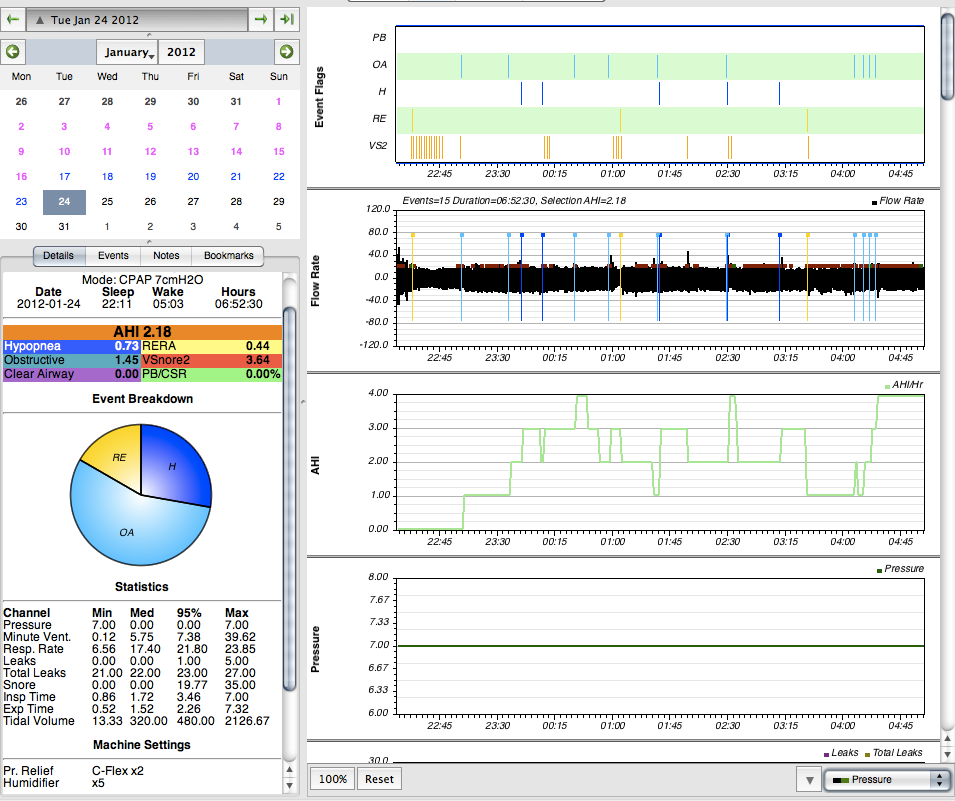
How have your numbers been? If you post an image of your data for one night I'm sure somebody could help you identify any problems.
Re: 15 weeks on my machine
My AHI has floated around 2 for the past few days. Any problems won't be that obvious, and ever since jedimark changed the colour used for pressure pulses, I don't even have my band of crimson garlanding the flow graph (for a mere 200ish pulses) (it's now a barely discernible dark red).soul_power wrote:How have your numbers been? If you post an image of your data for one night I'm sure somebody could help you identify any problems.
_________________
| Mask: AirFit™ P10 For Her Nasal Pillow CPAP Mask with Headgear |
| Additional Comments: Software: SleepyHead, loosely following HEAD |
Re: 15 weeks on my machine
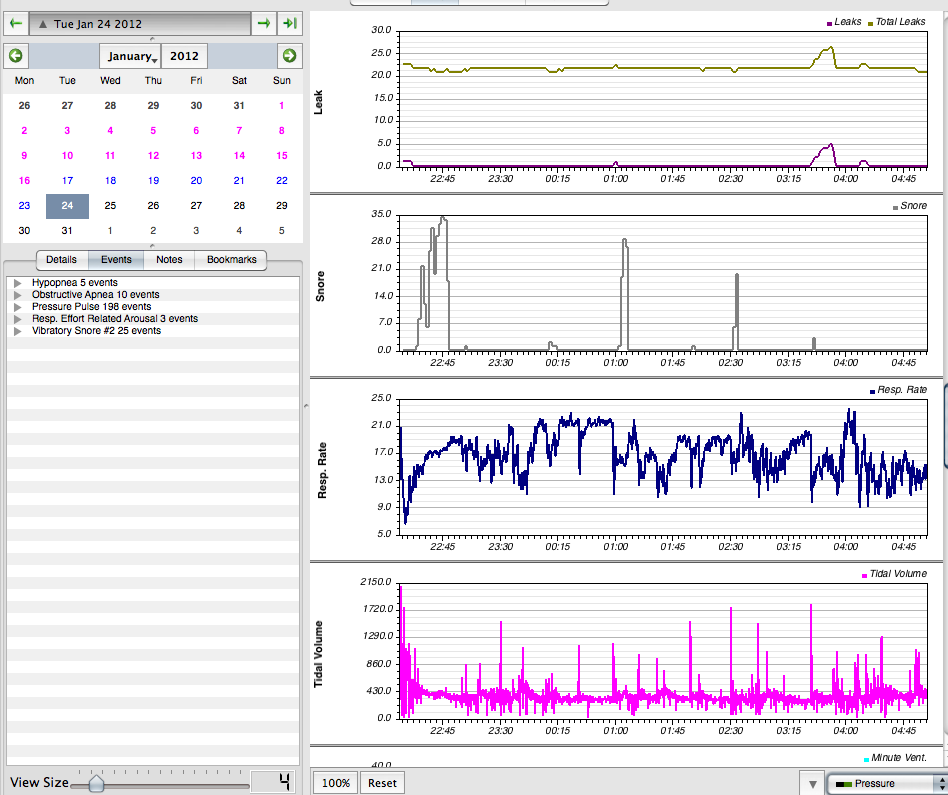
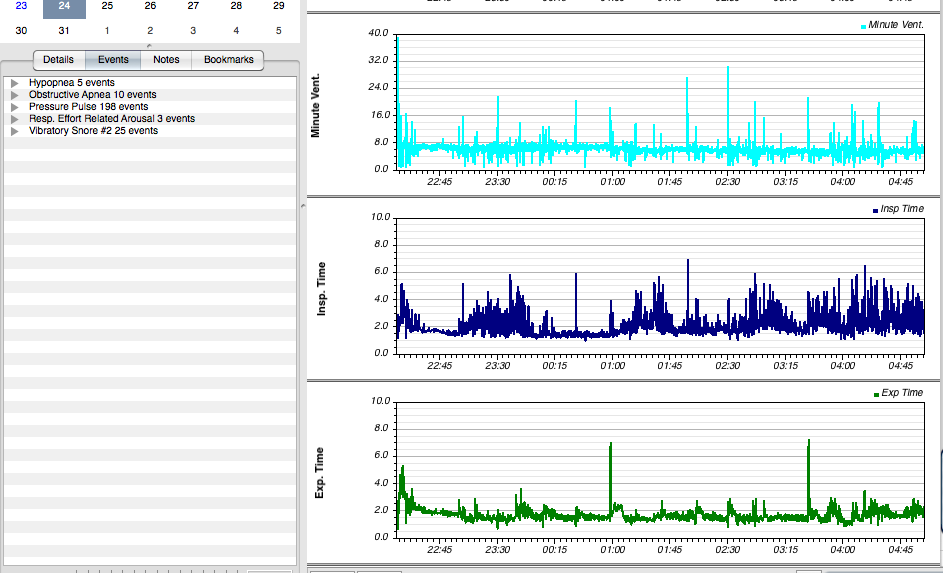
But, because I can (and someone specifically asked), and SleepyHead won't always say 105 days (under the assumption that I continue loading fresh data, and that I don't subsequently delete older session).
_________________
| Mask: AirFit™ P10 For Her Nasal Pillow CPAP Mask with Headgear |
| Additional Comments: Software: SleepyHead, loosely following HEAD |

Re: 15 weeks on my machine
tetragon,
First, congratulations for making it this far without giving up.
Second, my sympathies for the struggles you are continuing to have. You may just be one of the unlucky ones (like me) who takes a very long time to fully adjust and start to feel better.
In my case, I didn't start to feel any better until after four or five months on the machine---which was about a month or two after declaring war on the insomnia monster. And I started to finally feel better on a consistent basis only after the worst of the insomnia was reined in.
I bring this up because I'm wondering if there's something else going on that is fragmenting your sleep. The CPAP is clearly doing its job of preventing most of the apneas and hypopneas, but I'm wondering if the overall quality of your sleep architecture is still poor. The reason I'm wondering this is that your respiratory rate graph is really very ragged: When we are sleeping well, our respiration usually becomes very, very regular and as part of that regularity, our respiration rate becomes almost constant. A near constant respiratory rate makes the respiratory rate graph's shape resemble a mostly flat line with small bumps or a "wavy flat" line where the waves are rather small in the full view of the whole night. But your respiratory rate curve is going up and down all night long in middle-sized bumps instead of small bumps.
You respiratory rate curve looks rather like mine did during the worst of the insomnia. So the question is: How fragmented does your sleep feel to you? In other words, do you feel like you're tossing and turning much of the night? How often do you wake up? How long does it take you to get back to sleep? Do you subjectively feel like you might not be getting enough REM or deep sleep?
The answers to these questions are significant because if your sleep is still highly fragmented, that would explain why you're still having trouble staying awake in class, why you're still tired, and why you "still have the colouration of Uncle Fester". And then the question becomes: Since the apneas and hypopneas are no longer happening and causing mini-arousals, what is causing the continued poor quality sleep?
So where to go from here may be as simple (or hard) as starting to think about non-OSA conditions that are affecting your sleep and what to do about them.
Ideas include:
Sleep hygiene and daytime behavior. As useful as it is for getting through the day, too much daytime caffeine can play havoc on some folks ability to sleep well. Alcohol can cause sleep problems. Eating too late in the evening can lead to restlessness. For some folks, having an irregular sleep schedule makes it difficult to fully relax into deep, restorative sleep. Daytime naps can be an issue as well.
Stress and worrying. Let's face it, we're all under stress. But some of us are more sensitive to it than others. And some of us don't handle being under stress as graciously as others. Worrying about things when you're trying to get to sleep can trigger a pattern of dozing rather than sleeping. And unfortunately worrying about sleep can make the quality of sleep worse too. So actively working on de-stressing yourself and allowing yourself to have "closure" at the end of the day can help. Even if you don't think insomnia is a problem, you might still want to pick up Dr. Krakow's Sound Sleep, Sound Mind and read through the chapter on closure.
Rule out other obvious medical causes for the poor sleep and daytime fatigue. If they haven't been checked recently, request the following blood work: A full thyroid panel, vitamin D level, and vitamin B12 level tests. The standard basic metabolic panel and a complete blood count are probably worth doing as well.
Known medical conditions AND their treatments. Any existing medical conditions? Pain of all sorts can fragment sleep. And daytime fatigue is a symptom for a whole host of medical conditions. If you take any medication, it's important to remember that many, many medicines (both OTC and prescription) can lead to a host of problems with sleep: It's possible for the same drug to cause both daytime sleepiness and fatigue AND nighttime restlessness.
Getting enough physical activity during the day? Yes, it's tough to force yourself to go do some exercise when you're tired and cranky and feel exhausted. But if you can push through the tiredness and increase the activity even marginally that can sometimes help with getting over the hump of "not great sleep with no apparent cause." You can start by looking for simple things: Take the stairs instead of the elevator if your class is on the second or third floor of the building. Park at the far side of the parking lot when you're grocery shopping. Park in one of the more remote parking lots when you're commuting to campus. Try to take a 15 minute walk during the day if possible.
Hang in there and best of luck!
First, congratulations for making it this far without giving up.
Second, my sympathies for the struggles you are continuing to have. You may just be one of the unlucky ones (like me) who takes a very long time to fully adjust and start to feel better.
In my case, I didn't start to feel any better until after four or five months on the machine---which was about a month or two after declaring war on the insomnia monster. And I started to finally feel better on a consistent basis only after the worst of the insomnia was reined in.
I bring this up because I'm wondering if there's something else going on that is fragmenting your sleep. The CPAP is clearly doing its job of preventing most of the apneas and hypopneas, but I'm wondering if the overall quality of your sleep architecture is still poor. The reason I'm wondering this is that your respiratory rate graph is really very ragged: When we are sleeping well, our respiration usually becomes very, very regular and as part of that regularity, our respiration rate becomes almost constant. A near constant respiratory rate makes the respiratory rate graph's shape resemble a mostly flat line with small bumps or a "wavy flat" line where the waves are rather small in the full view of the whole night. But your respiratory rate curve is going up and down all night long in middle-sized bumps instead of small bumps.
You respiratory rate curve looks rather like mine did during the worst of the insomnia. So the question is: How fragmented does your sleep feel to you? In other words, do you feel like you're tossing and turning much of the night? How often do you wake up? How long does it take you to get back to sleep? Do you subjectively feel like you might not be getting enough REM or deep sleep?
The answers to these questions are significant because if your sleep is still highly fragmented, that would explain why you're still having trouble staying awake in class, why you're still tired, and why you "still have the colouration of Uncle Fester". And then the question becomes: Since the apneas and hypopneas are no longer happening and causing mini-arousals, what is causing the continued poor quality sleep?
So where to go from here may be as simple (or hard) as starting to think about non-OSA conditions that are affecting your sleep and what to do about them.
Ideas include:
Sleep hygiene and daytime behavior. As useful as it is for getting through the day, too much daytime caffeine can play havoc on some folks ability to sleep well. Alcohol can cause sleep problems. Eating too late in the evening can lead to restlessness. For some folks, having an irregular sleep schedule makes it difficult to fully relax into deep, restorative sleep. Daytime naps can be an issue as well.
Stress and worrying. Let's face it, we're all under stress. But some of us are more sensitive to it than others. And some of us don't handle being under stress as graciously as others. Worrying about things when you're trying to get to sleep can trigger a pattern of dozing rather than sleeping. And unfortunately worrying about sleep can make the quality of sleep worse too. So actively working on de-stressing yourself and allowing yourself to have "closure" at the end of the day can help. Even if you don't think insomnia is a problem, you might still want to pick up Dr. Krakow's Sound Sleep, Sound Mind and read through the chapter on closure.
Rule out other obvious medical causes for the poor sleep and daytime fatigue. If they haven't been checked recently, request the following blood work: A full thyroid panel, vitamin D level, and vitamin B12 level tests. The standard basic metabolic panel and a complete blood count are probably worth doing as well.
Known medical conditions AND their treatments. Any existing medical conditions? Pain of all sorts can fragment sleep. And daytime fatigue is a symptom for a whole host of medical conditions. If you take any medication, it's important to remember that many, many medicines (both OTC and prescription) can lead to a host of problems with sleep: It's possible for the same drug to cause both daytime sleepiness and fatigue AND nighttime restlessness.
Getting enough physical activity during the day? Yes, it's tough to force yourself to go do some exercise when you're tired and cranky and feel exhausted. But if you can push through the tiredness and increase the activity even marginally that can sometimes help with getting over the hump of "not great sleep with no apparent cause." You can start by looking for simple things: Take the stairs instead of the elevator if your class is on the second or third floor of the building. Park at the far side of the parking lot when you're grocery shopping. Park in one of the more remote parking lots when you're commuting to campus. Try to take a 15 minute walk during the day if possible.
Hang in there and best of luck!
_________________
| Machine: DreamStation BiPAP® Auto Machine |
| Mask: Swift™ FX Nasal Pillow CPAP Mask with Headgear |
| Additional Comments: PR System DreamStation and Humidifier. Max IPAP = 9, Min EPAP=4, Rise time setting = 3, minPS = 3, maxPS=5 |
Re: 15 weeks on my machine
Argh, my browser ate my initial reply.
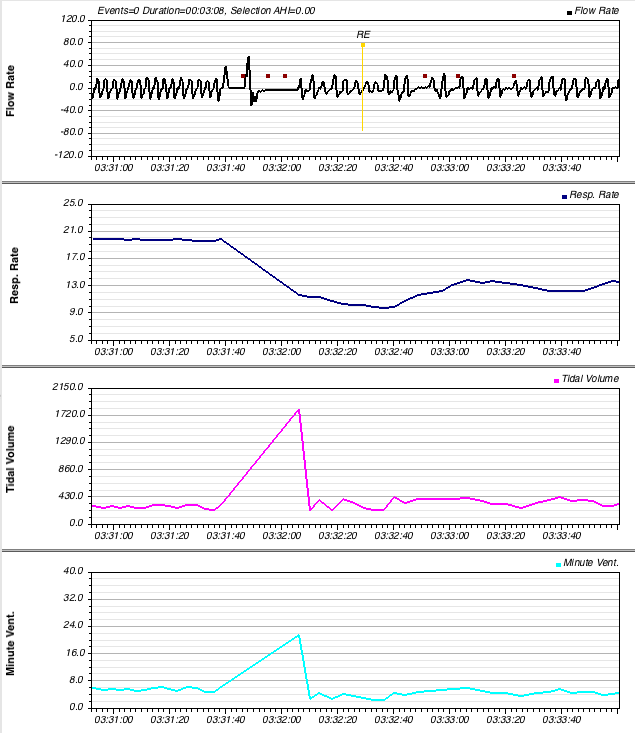
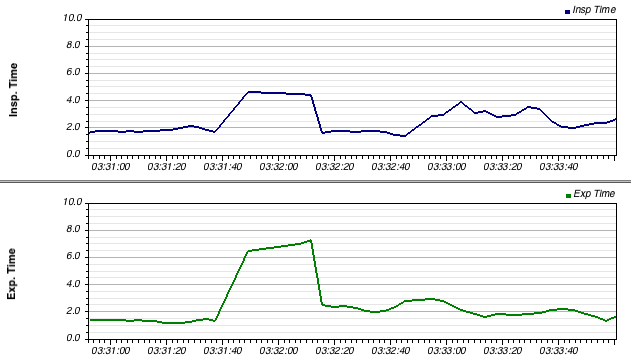
I think that much of the bumpiness is due to the interaction of jedimark's calculations with all my not quite apneas, where after a normal breath, I just don't take another for a few seconds. But not for a long enough time for the machine to log it as an apnea. The fat, dark red bar on the flow graph is really made up of red boxes indicating all the pressure pulses of the night, most of which don't result in a logged event.robysue wrote:I bring this up because I'm wondering if there's something else going on that is fragmenting your sleep. The CPAP is clearly doing its job of preventing most of the apneas and hypopneas, but I'm wondering if the overall quality of your sleep architecture is still poor. The reason I'm wondering this is that your respiratory rate graph is really very ragged: When we are sleeping well, our respiration usually becomes very, very regular and as part of that regularity, our respiration rate becomes almost constant. A near constant respiratory rate makes the respiratory rate graph's shape resemble a mostly flat line with small bumps or a "wavy flat" line where the waves are rather small in the full view of the whole night. But your respiratory rate curve is going up and down all night long in middle-sized bumps instead of small bumps.
I started dealing with the insomnia that had me sent for a sleep study shortly after I got this machine. Most recent nights have been the best sleep that I've had in quite some time, although I will admit that that isn't saying much, and that it still doesn't compare to the handful of good nights I remember. I remember dreaming three times over the course of night 105. I typically wake up only five or six times over the course of a night, and that's only for a couple of minutes at a time. Those times are mostly to change position or rearrange blankets. I'm down to taking less than fifteen minutes to get to sleep. I don't spend time tossing and turning anymore, just an initial pillow and blanket arrangement.robysue wrote: You respiratory rate curve looks rather like mine did during the worst of the insomnia. So the question is: How fragmented does your sleep feel to you? In other words, do you feel like you're tossing and turning much of the night? How often do you wake up? How long does it take you to get back to sleep? Do you subjectively feel like you might not be getting enough REM or deep sleep?
The answers to these questions are significant because if your sleep is still highly fragmented, that would explain why you're still having trouble staying awake in class, why you're still tired, and why you "still have the colouration of Uncle Fester". And then the question becomes: Since the apneas and hypopneas are no longer happening and causing mini-arousals, what is causing the continued poor quality sleep?
I have been improving on this for almost a year so far, although the initial changes weren't made with sleep hygiene in mind. The initial changes were stopping most caffeine (a matter of convenience, and I don't have it every day anymore, closer to once a week, and in the morning) and moving to a more regular sleep schedule (I had to take iron three times a day, and with working out when to take it, I got a more regular sleep schedule and an earlier dinner time).robysue wrote: So where to go from here may be as simple (or hard) as starting to think about non-OSA conditions that are affecting your sleep and what to do about them.
Ideas include:
Sleep hygiene and daytime behavior. As useful as it is for getting through the day, too much daytime caffeine can play havoc on some folks ability to sleep well. Alcohol can cause sleep problems. Eating too late in the evening can lead to restlessness. For some folks, having an irregular sleep schedule makes it difficult to fully relax into deep, restorative sleep. Daytime naps can be an issue as well.
This sort of thing is why the last part of my usual routine is: "curl up for an hour of light reading". The apartment cools as I stop considering the matters of the day. I really should find my copy of "Night of the Living Trekkies", that book was fun.robysue wrote: Stress and worrying. Let's face it, we're all under stress. But some of us are more sensitive to it than others. And some of us don't handle being under stress as graciously as others. Worrying about things when you're trying to get to sleep can trigger a pattern of dozing rather than sleeping. And unfortunately worrying about sleep can make the quality of sleep worse too. So actively working on de-stressing yourself and allowing yourself to have "closure" at the end of the day can help. Even if you don't think insomnia is a problem, you might still want to pick up Dr. Krakow's Sound Sleep, Sound Mind and read through the chapter on closure.
A few vials of blood were taken last week, I'll hear more in three weeks. I do wonder how my sleep doctor will respond to the values the complete blood count that I know will most likely be out of range.robysue wrote: Rule out other obvious medical causes for the poor sleep and daytime fatigue. If they haven't been checked recently, request the following blood work: A full thyroid panel, vitamin D level, and vitamin B12 level tests. The standard basic metabolic panel and a complete blood count are probably worth doing as well.
At this point, it looks like the iron supplements I take can result in me having a fidgety, aerophagic night if I take them in the evening. Thankfully, my latest results got my dose lowered to only once a day. And that, I take in the morning.robysue wrote: Known medical conditions AND their treatments. Any existing medical conditions? Pain of all sorts can fragment sleep. And daytime fatigue is a symptom for a whole host of medical conditions. If you take any medication, it's important to remember that many, many medicines (both OTC and prescription) can lead to a host of problems with sleep: It's possible for the same drug to cause both daytime sleepiness and fatigue AND nighttime restlessness.
I live in a part of the city where doing almost everything by foot is doable, and having a car is more trouble than it's worth. I take the stairs to my apartment (building has no elevator) and to work (that building has scary elevators that screech and shake for a few seconds before opening at my floor, and I spent some time trapped in one in the summer), but not class (ground floor). I typically walk if the destination is within a couple kilometres, and use my Metropass for longer trips.robysue wrote: Getting enough physical activity during the day? Yes, it's tough to force yourself to go do some exercise when you're tired and cranky and feel exhausted. But if you can push through the tiredness and increase the activity even marginally that can sometimes help with getting over the hump of "not great sleep with no apparent cause." You can start by looking for simple things: Take the stairs instead of the elevator if your class is on the second or third floor of the building. Park at the far side of the parking lot when you're grocery shopping. Park in one of the more remote parking lots when you're commuting to campus. Try to take a 15 minute walk during the day if possible.
Hang in there and best of luck!
_________________
| Mask: AirFit™ P10 For Her Nasal Pillow CPAP Mask with Headgear |
| Additional Comments: Software: SleepyHead, loosely following HEAD |
Re: 15 weeks on my machine
I went looking at some of the bump edges on that night. I think jedimark's simple calculations need some refinement. I have an example of where they don't match what I would expect from the flow graph.
_________________
| Mask: AirFit™ P10 For Her Nasal Pillow CPAP Mask with Headgear |
| Additional Comments: Software: SleepyHead, loosely following HEAD |
8 posts
• Page 1 of 1