So, why haven't you pursued CO2 re-breathing?

General Discussion on any topic relating to CPAP and/or Sleep Apnea.
User avatar
mollete
Posts: 1001
Joined: Thu Jan 10, 2013 5:45 am

Re: So, why haven't you pursued CO2 re-breathing?

Post by mollete » Mon Jun 24, 2013 5:49 am

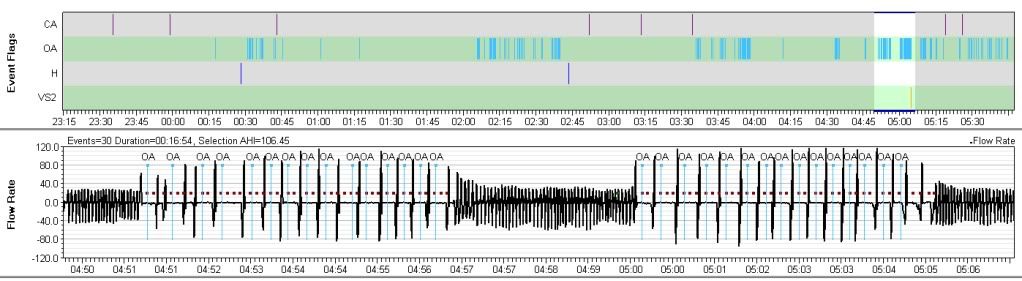
Tom W wrote:my flow patterns indicate that I experience some type of breath holding and/or VCD.
If your hypothesis is that hypocapnia is inducing VCD, why not just go down the pulmonary lab, hyperventilate like crazy and then do some tests (there is a protocol for this, and one would be looking at Flow-Volume Loops, among other things).

Hypocapnia-induced VCD is not dependent on sleep, and would certainly be reproducible (and probably occurs at a much lower pCO2 than you see transiently in your sleep).

User avatar
mollete
Posts: 1001
Joined: Thu Jan 10, 2013 5:45 am

Re: So, why haven't you pursued CO2 re-breathing?

Post by mollete » Mon Jun 24, 2013 6:12 am

archangle wrote:I would not be surprised to see some degree off CO2 rebreathing becoming a standard part of CPAP and mask design in the future.
I would tend to doubt it. If you look at the study group, the patients were placed on therapy between 2004 and 2006. At that point the first ASV technology became available, and EERS became EERSosaurus.

If I were going to crystal ball the next development in hypocapnia-induced central/complex sleep apnea, it will be a pharmacological approach to increasing arousal threshold (that doesn't create more problems than it corrects).

Tom W
Posts: 223
Joined: Thu Sep 01, 2011 4:59 am
Location: West Central Florida

Re: So, why haven't you pursued CO2 re-breathing?

Post by Tom W » Mon Jun 24, 2013 8:03 am

mollete wrote:
Tom W wrote:my flow patterns indicate that I experience some type of breath holding and/or VCD.
If your hypothesis is that hypocapnia is inducing VCD, why not just go down the pulmonary lab, hyperventilate like crazy and then do some tests (there is a protocol for this, and one would be looking at Flow-Volume Loops, among other things).

Hypocapnia-induced VCD is not dependent on sleep, and would certainly be reproducible (and probably occurs at a much lower pCO2 than you see transiently in your sleep).
I'm just trying to eliminate this nightly pattern, whatever may be causing it, as I'm thinking it's the major contributor of my excessive daytime sleepiness.

Image

My latest doctor wants to determine the extent of my heart damage before he decides which avenue he wants to pursue first.

I find EERS interesting as I often slept better with the covers over my head as a child - not sure if that counts as re-breathing or not.

User avatar
Somnolence
Posts: 37
Joined: Sat Dec 29, 2012 10:07 pm
Location: Dallas, TX

Re: So, why haven't you pursued CO2 re-breathing?

Post by Somnolence » Mon Jun 24, 2013 9:03 am

Where did you have your calibration done?
Right at the source. I heard there are more opportunities, but they still seemed centralized in MA. Several of the lead researcher's fellows are graduating and moving to other parts of the country, however.
I would tend to doubt it. If you look at the study group, the patients were placed on therapy between 2004 and 2006. At that point the first ASV technology became available, and EERS became EERSosaurus.

If I were going to crystal ball the next development in hypocapnia-induced central/complex sleep apnea, it will be a pharmacological approach to increasing arousal threshold (that doesn't create more problems than it corrects).
The irony in this post is you implicitly acknowledge ASV's shortcomings. It's a reactive therapy that allows sleep fragmenting arousals (clinical and sub-clinical) to continue.

I wish any researcher luck on the pharmacological front, but I see only one interesting avenue (albeit a potential blockbuster) on the horizon. Histamine, GABA, Seratonin, and Melatonin have been explored pretty robustly.
I'm just trying to eliminate this nightly pattern, whatever may be causing it, as I'm thinking it's the major contributor of my excessive daytime sleepiness.
That sounds like a reasonable hypothesis to me. I should mention that our cases are different; my obstructive events were largely controlled by treatment, but left a high number of arousals.

Obviously, you should explore this with your doctor before anyone else. What other things have you done, though? What else have you considered?

For me, EERS seemed like the safest and least intrusive next step.

Tom W
Posts: 223
Joined: Thu Sep 01, 2011 4:59 am
Location: West Central Florida

Re: So, why haven't you pursued CO2 re-breathing?

Post by Tom W » Mon Jun 24, 2013 9:31 am

Obviously, you should explore this with your doctor before anyone else. What other things have you done, though? What else have you considered?

For me, EERS seemed like the safest and least intrusive next step.
The PR machines that I've used record these patterns as CA (30%) and OA (70% roughly) with the only significant difference in the flow pattern being that the pressure pulse has a slightly higher amplitude in the events recorded as CA's.

I'm using an PR ASV machine at the moment and have considered purchasing a Res Med ASV out of pocket.

I was recently taken on as a patient by a research doctor at one of the state universities (which seems promising).

I've taken sleeping pills and anti-anxiety medication for RLS without any benefit.

I exercise, eat healthy, meditate, practice yoga, eliminated caffeine (just to name a few).

When the EDS is at its worse I've considered getting a tracheotomy.

User avatar
Somnolence
Posts: 37
Joined: Sat Dec 29, 2012 10:07 pm
Location: Dallas, TX

Re: So, why haven't you pursued CO2 re-breathing?

Post by Somnolence » Mon Jun 24, 2013 11:10 am

I'm using an PR ASV machine at the moment and have considered purchasing a Res Med ASV out of pocket.
My S9 ASV was very effective at eliminating both my OA and CA events. However, I still had the respiratory instability which preceded the CA's. Based on my sleep studies, I could tell the clinical arousals began with the instability, yet before an identifiable event presented itself.
I was recently taken on as a patient by a research doctor at one of the state universities (which seems promising).
It's well and good to call one a "research doctor," but is the level of care better? Would he/she be interested in consulting with one of the EERS familiar doctors?
I've taken sleeping pills and anti-anxiety medication for RLS without any benefit.

I exercise, eat healthy, meditate, practice yoga, eliminated caffeine (just to name a few).
I've been there and am sorry that our diligence isn't more rewarded.
When the EDS is at its worse I've considered getting a tracheotomy.
I can't really sound off on this idea. I haven't seriously considered it, but that's because I wanted more conservative treatment possibilities.

User avatar
kteague
Posts: 7783
Joined: Tue May 16, 2006 8:30 pm
Location: West and Midwest

Re: So, why haven't you pursued CO2 re-breathing?

Post by kteague » Mon Jun 24, 2013 12:50 pm

Tom W wrote: I was recently taken on as a patient by a research doctor at one of the state universities (which seems promising). I've taken sleeping pills and anti-anxiety medication for RLS without any benefit.
Hi Tom. I've seen your past posts about your RLS. Did you ever get your ferritin level up over 50? What is the status on your RLS/PLM(D/S)? Not trying to muddy the waters on the breathing/arousals discussion. Just want to throw out there that when my limb movements were at their worst my sleep studies showed lots of spontaneous arousals. While I can't say for certain and speak strictly from a patient experience perspective, I believe that people with this disorder will benefit greatly from first resolving their limb movements as much as possible, then see what irregularities remain in their sleep breathing and arousals. This has been discussed on here before, but in the moments preceding a leg jerk from periodic limb movement disorder, there is sometimes a sensation that I think is responsible for some of what is seen as spontaneous arousals even if that arousal is not followed by a limb movement. I say that because where sleep apnea and PLMD coexist, one could have been approaching a limb movement when the apnea event interferred, thus making the source of the arousal unclear. Also, I tended to hold my breath during movements and have to wonder if that muddied the picture even more. Don't want to derail the thread topic. Just something to add to your thoughts as you sort through things.

_________________
Mask: TAP PAP Nasal Pillow CPAP Mask with Improved Stability Mouthpiece
Humidifier: S9™ Series H5i™ Heated Humidifier with Climate Control
Additional Comments: Bleep/DreamPort for full nights, Tap Pap for shorter sessions

patrissimo
Posts: 186
Joined: Tue Dec 11, 2012 3:07 pm

Re: So, why haven't you pursued CO2 re-breathing?

Post by patrissimo » Mon Jun 24, 2013 1:04 pm

archangle wrote:I think it's very promising. Especially when combined with CPAP use. It should be possible to cause a considerable increase in CO2 in the inhaled air without significantly decreasing O2, since O2 is so much higher than CO concentration in air.

I would not be surprised to see some degree off CO2 rebreathing becoming a standard part of CPAP and mask design in the future.

However, I don't think it's a do it yourself thing for right now. Trying to set it up yourself could easily end you up with too little O2. I'm afraid some dummy will cover up the vent holes on his mask and not provide adequate alternate ventilation and harm himself. Or someone will simply screw up his CPAP therapy.
+1. Nice to see a balanced response, finally, I think it's sad what an instant opposing reaction most of the other people here seem to have. If you are happy & cured by your xPAP, awesome, but the compliance data shows very clearly that a ton of people are not as lucky as you. For starters, anyone who has more centrals than they would like to have (even if not enough to make xPAP not work) should care about CO2, since CO2 controls respiration and centrals, and thus ultimately how much O2 you get (along with your airway resistance, of course).

It's not like the fact that breathing is driven much more by CO2 levels than O2 levels is a weird controversial thing, here's Wikipedia on Breathing, Section "Control of breathing" http://en.wikipedia.org/wiki/Breathing (emphasis added)
Unconscious control
Unconsciously, breathing is controlled by specialized centers in the brainstem, which automatically regulate the rate and depth of breathing depending on the body’s needs at any time. When carbon dioxide levels increase in the blood, it reacts with the water in blood, producing carbonic acid. Lactic acid produced by fermentation during exercise also lowers pH. The drop in the blood's pH stimulates chemoreceptors in the carotid and aortic bodies as well as those inside the respiratory center in the medulla oblongata. Chemoreceptors send more nerve impulses to the respiration centre in the medulla oblongata and pons in the brain. These, in turn send nerve impulses through the phrenic and thoracic nerves to the diaphragm.

Examples
For instance, while exercising, the level of carbon dioxide in the blood increases due to increased cellular respiration by the muscles, which activates carotid and aortic bodies and the respiration center, which ultimately cause a higher rate of respiration.

During rest, the level of carbon dioxide is lower, so breathing rate is lower. This ensures an appropriate amount of oxygen is delivered to the muscles and other organs. It is important to reiterate that it is the buildup of carbon dioxide making the blood acidic that elicits the desperation for a breath much more than lack of oxygen.
Anyway, I think archangle nails it, it's a no-brainer for the future, but it seems dangerous to DIY. I consider myself very open to risk in self-experimenting, but I would be worried to add an experimental CO2 rebreather without being monitored in a lab, with someone watching my O2 sat & respiration rate, and ready to rip off my mask if needed. And I wouldn't want to add a commercial CO2 rebreather until it had been tested in tons of sleep studies. That said, I'm open to there being safe ways of slightly increasing CO2, like simply slightly increasing your mask volume.

Somnolence, thanks for sharing, I really appreciate hearing about your experiments.

_________________
MaskHumidifier
Additional Comments: Surgeries: MMA, tonsils/adenoids, septoplasty/turbinate

patrissimo
Posts: 186
Joined: Tue Dec 11, 2012 3:07 pm

Re: So, why haven't you pursued CO2 re-breathing?

Post by patrissimo » Mon Jun 24, 2013 1:11 pm

mollete wrote:If I were going to crystal ball the next development in hypocapnia-induced central/complex sleep apnea, it will be a pharmacological approach to increasing arousal threshold (that doesn't create more problems than it corrects).
I would love it if "pop a pill" was the solution, but I'm deeply skeptical. It's not an accident that there are no good sleeping pills, our brain does not seem to work in a way where medication tweaks are very effective, both in general and for sleep. I think better airway expansion methods (like the DNA/Homeoblock, more personalized airway surgery especially noninvasive stuff like RF), better xPAP (more ASV adoption, EERS, more spread of comfy masks), and much more widespread diagnosis of SDB due to cheap home studies (your doc will send you home with a pulse oximeter that uploads data via wifi or 3G, you wear it a few nights, drop it in the mail) which drives greater research interest, more sleep labs (which still do your confirmation & titration after the home pre-screening), and general increase in volume of SDB treatment which lowers price and increases variety.

_________________
MaskHumidifier
Additional Comments: Surgeries: MMA, tonsils/adenoids, septoplasty/turbinate

User avatar
DreamDiver
Posts: 3082
Joined: Thu Oct 04, 2007 11:19 am

Re: So, why haven't you pursued CO2 re-breathing?

Post by DreamDiver » Mon Jun 24, 2013 1:52 pm

I have to agree with Den on one thing. Without proper supervision, CO2 re-breathing currently has no place in the CPAP environment. Even with supervision, only those with Cheynes Stokes and Centrals are likely to benefit.

However, it might be interesting if a peer-reviewed study were done on the benefit of CO2 rebreathing for those of us with open-airway apnea that is well-controlled by standard CPAP/APAP therapy.

Consider: A mask with a rebreather column might not need CPAP. The mask could be worn alone. That means no bulky machine.

However:
1. There might have to be some digitization incorporated into the mask or a wrist band attached to electronically to the mask. For instance, we would need a pulseC02/ox meter to measure both 02 and CO2 in the blood. The mask could collapse or extend the CO2 column to select the most appropriate CO2 volume in an attempt to reach peak efficiency. An emergency valve would eject the CO2 column altogether when or if CO2 levels approach critical levels.

2. If such a device could be made safe, a whole host of people who have nothing but open-airway apnea might be able to do things like extended backpacking without large machines or huge batteries.

The concept has merit for a study at the very least, but again the study should be peer-reviewed and involve huge amounts of monitored testing of any device before being offered to the public.

_________________
Mask: ResMed AirFit™ F20 Mask with Headgear + 2 Replacement Cushions
Additional Comments: Pressure: APAP 10.4 | 11.8 | Also Quattro FX FF, Simplus FF

Tom W
Posts: 223
Joined: Thu Sep 01, 2011 4:59 am
Location: West Central Florida

Re: So, why haven't you pursued CO2 re-breathing?

Post by Tom W » Mon Jun 24, 2013 2:05 pm

kteague wrote:
Tom W wrote: I was recently taken on as a patient by a research doctor at one of the state universities (which seems promising). I've taken sleeping pills and anti-anxiety medication for RLS without any benefit.
Hi Tom. I've seen your past posts about your RLS. Did you ever get your ferritin level up over 50? What is the status on your RLS/PLM(D/S)?
The doctor ordered ferritin and vitamin D tests at my first visit but my follow up appointment isn't for another few weeks so I don't know what my current levels are.

My RLS symptoms show up about once a week but aren't as bad as they once were.

User avatar
Todzo
Posts: 2014
Joined: Tue Apr 24, 2012 8:51 pm
Location: Washington State U.S.A.

Re: So, why haven't you pursued CO2 re-breathing?

Post by Todzo » Mon Jun 24, 2013 5:44 pm

Somnolence wrote:I'm considering making an FAQ of sorts now that I am using this treatment, and I hope to become more familiar with the community's concerns. I have learned quite a bit about the research and feel it would be helpful to share.

The CO2 re-breathing research citations have made the rounds on this board, which begs the question of why more of you haven't considered it further... I'd like to know those reasons.

Here is a link to one such study:
http://www.sleepmedicineusa.com/UserFil ... (EERS).pdf
I use this and have found it very useful, indeed, in my case a life saver.

I believe it is under used for several reasons:

Almost everyone who uses or administers CPAP therapy is unaware of the issues involved with the pressure induced ventilatory instability and how it is related to stress and carbon dioxide maintenance. So they do not understand how maintaining carbon dioxide can help stabilize the issue. They do not see how the ventilatory instability steals their sleep with it's associated respiratory related arousals. They do not understand how carbon dioxide works as an essential circulation regulating element which if lacking drastically reduces circulation, especially in the brain[1] where many of the breathing related chemoreceptors are. They do not understand how the lack of carbon dioxide also further frustrates metabolism. They do not understand how the repeated arousals caused by the resultant unstable breathing ratchet up the stress hormones making the cycles (hypoxic/hyperoxic – hypercapnic/Hypocapnic) deeper and likely resulting in inflammation and/or rostral fluid shift bringing about apnea or hypopneas and more cycles. In other words they are simply ignorant of the physiology issues which are directly related to normal CPAP use.

While they worry about their cells starving from too little oxygen in the blood they remain unaware of the cells which starve from the very low circulation and oxygen transport resulting from too little carbon dioxide in the blood. In the brain circulation resorts to a “rob Peter to keep Paul going” mode[1]. So what happens to Peter?

Since this is a simple and very economical fix, those who would produce very expensive “fixes” - well – they do not want to see this. They will suppress dollars and support for further research. They will attack those who support it. I would not be surprised to see this thread attacked by industry Internet shills.

I look forward to seeing you FAQ!

[1]: Integration of cerebrovascular CO2 reactivity and chemoreflex control of breathing: mechanisms of regulation, measurement, and interpretation
- Philip N. Ainslie and James Duffin
Am J Physiol Regul Integr Comp Physiol 296:R1473-R1495, 2009. First published 11 February 2009; doi:10.1152/ajpregu.91008.2008
link: Integration of cerebrovascular CO2 reactivity and chemoreflex control of breathing: mechanisms of regulation, measurement, and interpretation
Philip N. Ainslie and James Duffin
Am J Physiol Regul Integr Comp Physiol 296:R1473-R1495, 2009. First published 11 February 2009; doi:10.1152/ajpregu.91008.2008
link: http://www.ncbi.nlm.nih.gov/pubmed/?ter ... reactivity

May any shills trolls sockpuppets or astroturfers at cpaptalk.com be like chaff before the wind!

User avatar
Drowsy Dancer
Posts: 1271
Joined: Mon Feb 28, 2011 9:35 am
Location: here

Re: So, why haven't you pursued CO2 re-breathing?

Post by Drowsy Dancer » Mon Jun 24, 2013 11:25 pm

patrissimo wrote:I think it's sad what an instant opposing reaction most of the other people here seem to have.
The question was phrased to elicit negative responses: "why haven't you pursued this?"

Those responding to question are mostly saying, in effect, "if it ain't broke don't fix it." That is certainly a summary of my answer.

You might just well ask me, "So, why haven't you pursued getting an ASV?" Well, because I don't need one.

My impression is that this concept is (1) potentially helpful to a fairly narrow range of people and (2) not ready for DIY.

_________________
Machine: PR System One REMStar 60 Series Auto CPAP Machine
Mask: Swift™ FX Bella Nasal Pillow CPAP Mask with Headgears
Additional Comments: Software: SleepyHead. Pressure: APAP 9.5 min/11 max, A-Flex x2
How we squander our hours of pain. -- Rilke

User avatar
mollete
Posts: 1001
Joined: Thu Jan 10, 2013 5:45 am

Re: So, why haven't you pursued CO2 re-breathing?

Post by mollete » Tue Jun 25, 2013 4:22 am

Tom W wrote:I'm just trying to eliminate this nightly pattern, whatever may be causing it, as I'm thinking it's the major contributor of my excessive daytime sleepiness.

Image
Well, I still think the cause of your EDS is a running sleep debt, but that was a subject for another thread.

In re: above, I think you need to know 3 things:
  • What position you're in when they occur;
  • What stage of sleep you're in (including Wake) when they occur; and
  • What type of event they are (obstructive, mixed, clear-airway central or closed-airway central)
Without all 3 pieces of information you're destined to remain in DWing Hell.

Looking at the previously submitted information, the idea of Catathrenia was tossed around, and I think that remains a strong possibility.
  • The event locations loosely follow a REM pattern (which Catathrenia is);
  • The events appear to be breath-holding (full inspiration) in nature:
  • They have the appearance of 4+ closed-airway central events (so are basically pressure unresponsive);
  • They apparently did not occur during ASV titration, but appeared after you got out of the strange place and back into the comfort of you own home (which is suggestive of a parasomnia - put a parasomniac in new surroundings and they don't parasomniate).
So, "IMHO", IIWY I would get another study/series of home studies, preferably with EEG. At bare minimum, you might be able to get away with a good quality SDB unit like the Nox T3 (whose snoring microphone might pick up the Catathrenia). You may need several nights in row for the phenomenon to reveal itself.

User avatar
Somnolence
Posts: 37
Joined: Sat Dec 29, 2012 10:07 pm
Location: Dallas, TX

Re: So, why haven't you pursued CO2 re-breathing?

Post by Somnolence » Tue Jun 25, 2013 7:28 am

The question was phrased to elicit negative responses: "why haven't you pursued this?"
The tone wasn't accusatory. Don't blame me for overly zealous responses.