Do all machines recognize central apneas...

General Discussion on any topic relating to CPAP and/or Sleep Apnea.
SleepySandy
Posts: 330
Joined: Sat Jan 13, 2007 5:25 pm
Location: Seattle, WA

Do all machines recognize central apneas...

Post by SleepySandy » Sun Apr 08, 2007 2:29 pm

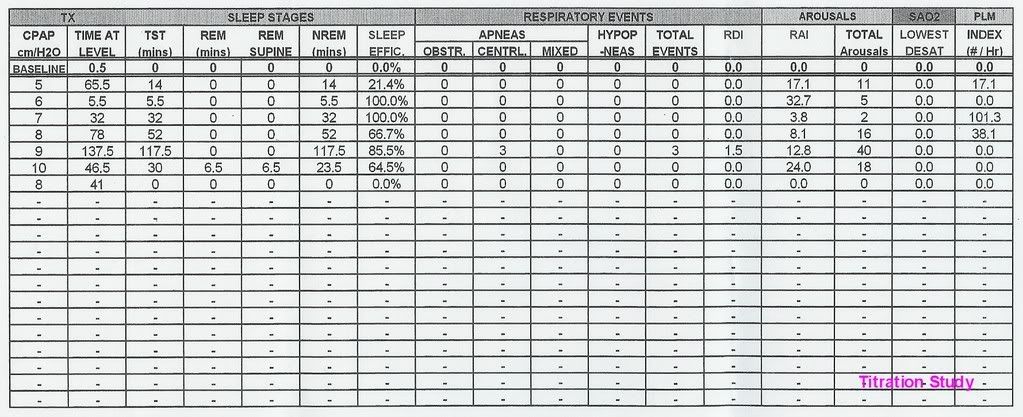
...and do the 3 I had during my titration study matter?

I'm not even sure if this is something to worry about but on Friday I finally received additional information about my first sleep studies - posted below. It showed that I had 3 centrals during my titration study when the pressure was 9. I didn't know about this until Friday. My prescribed pressure has been 10. I didn't have any centrals at 10 during my titration study but I wasn't at 10 for very long compared to the length of time I was at 9.

I just saw the post by Daffney_Gillfin about Silverlining and I saw how Silverlining shows central apneas.

I'm wondering if the Respironics and Resmed machines recognize centrals. I have had a Respironics M Series Pro for a few months and I have EncorePro. It shows apneas but I don't know if that includes centrals.

My new sleep doc just prescribed a new machine for me - a Resmed S8 Vantage Auto. I'm going to the DME tomorrow.

The prescription form is preprinted and has the M-Series Auto and the Resmed Auto listed. My sleep doc has been certified since 1985 and one of the C-Flex studies was done at his clinic. So, I'm hoping he knows more about the machines than the average sleep doc. I didn't notice that he specified a brand until I got home - I was too shocked that he recommended an Auto (I hadn't brought it up). I'm going to be calling tomorrow to find out why he chose the Resmed machine for me. But, I'm wondering about the centrals and if I need to consider the Puritan Bennett machine if the Resmed or Respironics machines don't recognize centrals. If the central events during my titration study matter...

I'm so confused

My current sleep doc hasn't seen this information since I just got it on Friday (he has seen the summary reports). The studies were under my former sleep doc. The info I got on Friday also included graphs. If seeing the graphs would be helpful, they're here: viewtopic/t18905/Help-Interpreting-Slee ... -mean.html

Thanks in advance for your help.
Image


User avatar
dsm
Posts: 6996
Joined: Mon Jun 20, 2005 6:53 am
Location: Near the coast.

Post by dsm » Sun Apr 08, 2007 3:18 pm

As best as I understand, they can't all be certain that a central has occured. They only know there was a significant flow limitation that failed to respond to the normal treatment.

Am sure some of our other erstwhile xPAPers will have good thoughts on this

DSM.
xPAP and Quattro std mask (plus a pad-a-cheek anti-leak strap)

User avatar
Snoredog
Posts: 6399
Joined: Sun Mar 19, 2006 5:09 pm

Re: Do all machines recognize central apneas...

Post by Snoredog » Sun Apr 08, 2007 4:13 pm

SleepySandy wrote:...and do the 3 I had during my titration study matter?

I'm not even sure if this is something to worry about but on Friday I finally received additional information about my first sleep studies - posted below. It showed that I had 3 centrals during my titration study when the pressure was 9. I didn't know about this until Friday. My prescribed pressure has been 10. I didn't have any centrals at 10 during my titration study but I wasn't at 10 for very long compared to the length of time I was at 9.

I just saw the post by Daffney_Gillfin about Silverlining and I saw how Silverlining shows central apneas.

I'm wondering if the Respironics and Resmed machines recognize centrals. I have had a Respironics M Series Pro for a few months and I have EncorePro. It shows apneas but I don't know if that includes centrals.

My new sleep doc just prescribed a new machine for me - a Resmed S8 Vantage Auto. I'm going to the DME tomorrow.

The prescription form is preprinted and has the M-Series Auto and the Resmed Auto listed. My sleep doc has been certified since 1985 and one of the C-Flex studies was done at his clinic. So, I'm hoping he knows more about the machines than the average sleep doc. I didn't notice that he specified a brand until I got home - I was too shocked that he recommended an Auto (I hadn't brought it up). I'm going to be calling tomorrow to find out why he chose the Resmed machine for me. But, I'm wondering about the centrals and if I need to consider the Puritan Bennett machine if the Resmed or Respironics machines don't recognize centrals. If the central events during my titration study matter...

I'm so confused

My current sleep doc hasn't seen this information since I just got it on Friday (he has seen the summary reports). The studies were under my former sleep doc. The info I got on Friday also included graphs. If seeing the graphs would be helpful, they're here: viewtopic/t18905/Help-Interpreting-Slee ... -mean.html

Thanks in advance for your help.

Image

Based upon your titration table, the Resmed S8 Vantage is about the worst machine your doctor could possibly prescribe.

It does a lousy job at avoiding central apnea. Then if you snore it will increase pressure for as long as that snore exists all along ignoring pressures that trigger central. A Remstar will increase pressure by .5cm then monitor, if event still there increase again, then monitor. On the Resmed snore detection mic is on the pressure transducer circuit. Next it has a A10 algorithm, which basically says it won't respond to any apnea whenever the pressure is at 10cm or above.

Look at your titration table, you had 3 Centrals at only 9cm pressure, what do you think setting that threshold to 10cm will do? Yep you guess it, the Vantage command on apnea is already 1cm above your threshold. Look again at your titration table, they went from 9cm (where the 3 centrals where seen) back DOWN to the prior 8cm pressure where sleep was again stable, that was 8cm which is listed in the last line of the titration table. Based upon that data, your pressure is 8cm not 10cm.

Respirionics NRAH response: It is more an error report that the machine screwed up vs being any kind of Central Apnea detection. The reason is the machine has to see an apnea event remain after 3 prior pressure increases (that is a LONG time when you think about it) before it finally decides that the event did NOT respond to a pressure increase. Very rare if it logs one at all.

I can go from my m series (or classic it doesn't matter which) to the 420e and I can see Centrals show up the very next night and EncorePro reported ZERO "NR" events weeks prior. So is it I didn't have any Centrals or is it the Remstars didn't detect any? My money is on the latter, the Remstar didn't detect any. It is also why I cannot allow a Remstar to run higher than 9cm, if I do it will only climb up to the maximum set pressure.

You would think if I was having regular CA's almost every night detected on a 420e only detecting 6 out of 10 possible centrals seen that I would at least have 1 "NR" event show up. By the time "NR" shows up on a EncorePro report your sleep is already a train wreck.

While Respironics technically classified it correctly as Non-Responsive (an event that didn't respond to prior pressure increases). This ALSO means that if the event went away after only 1 or 2 pressure increases that it would never be scored as a "NR". Even if that event was actually a central event.

What NR really says is: "well that one didn't respond after 3 consequtive pressure increases so ooops! it must have been a central, but we cannot admit we screwed up and applied pressure to a central event so we'll call it Non-Responsive.

You need to address those other PLMD arousals seen on your PSG, those are going to cause you more interruptions to your sleep than the 3 centrals seen. But it seems if you get the right therapy all of those events settle down. I would try the 420e over any other machine. At least you will be able to see more than what you have now.

I bet if you set your current machine down to 8cm pressure you would do better than you did the night before.

someday science will catch up to what I'm saying...

User avatar
rested gal
Posts: 12880
Joined: Thu Sep 09, 2004 10:14 pm
Location: Tennessee

Post by rested gal » Sun Apr 08, 2007 4:25 pm

I'm not a doctor, but first of all I'd say that having 3 centrals show up in your titration was nothing to worry about at all.
Here's a link to info and discussions about central apneas:
Links to Central Apnea discussions
viewtopic.php?p=22702

I'm not any kind of expert about the machines. This is simply my understanding of how the major manufacturers' autopaps deal with centrals. Autopaps do not try to "treat" centrals. They try to avoid raising pressure unnecessarily when faced with an apnea that might be a central. That's because with a central apnea, the throat is already open. The brain simply hasn't yet sent a signal "Breathe now." Since the throat is already open, no additional pressure is needed.

When faced with an apnea:

Respironics' autopap gives three small increasing pressure nudges to see if more pressure improves the airflow. If the airflow does not show any signs of improving after the third nudge, the machine assumes "that might be a central with a throat already open" since more pressure has not resulted in better air flow from the person. It stops trying more pressure. It marks that event as "NR" (Non-Responsive, meaning the "apnea" didn't respond with improved air flow after three pressure nudges.) It might or might not have been a central. There's no way to know for sure, but I'd usually regard an "NR" on Encore Pro data as probably having been a central.

Puritan Bennett's autopap tries to sense "cardiac oscillations"...heartbeat airflow vibrations in an open throat. If the machine senses cardiac oscillations in the airflow, the machine assumes the throat is open. There's no reason to increase the pressure if the person is having an apnea but the throat is already open. It marks that event as a "Ca" -- apnea with cardiac oscillations present. I regard a "Ca" on the Silverlining data as having been a central apnea.

How accurate is the PB machine at identifying centrals?
-SWS, who I regard as a person who understands better than anyone on the message boards (and better than doctors and DMEs) how all these machines work, wrote:
I just now reviewed the 420e central apnea specs and here they are:
420e Central Apnea Specificity=100%
420e Central Apnea Sensitivity= 62%


Math always throws me for a loop, but I take 100% specificity to mean that if the 420E marks a "Ca" on the data, it really was a central.
I take 62% sensitivity to mean that centrals, if they are present at all, will be caught 62% of the time; but that some centrals can slip by the machine undetected 38% of the time. In other words, it will catch over half the centrals that might occur. It won't catch all of them. But when it does catch one, it's correct about it being a central.

ResMed's autopap makes no attempt at all to distinguish between obstructive/central apneas. It relies on what it calls the A-10 algorithm. When airflow from the person diminishes to the point that the machine thinks there's an "apnea", it will increase the pressure to as much as 10 cm (but no more) to try to open the throat. If the pressure being used was already above 10 at the time the apnea event started, I suppose the machine will not increase the pressure at all.
ResMed S9 VPAP Auto (ASV)
Humidifier: Integrated + Climate Control hose
Mask: Aeiomed Headrest (deconstructed, with homemade straps
3M painters tape over mouth
ALL LINKS by rested gal:
viewtopic.php?t=17435

User avatar
Snoredog
Posts: 6399
Joined: Sun Mar 19, 2006 5:09 pm

Post by Snoredog » Sun Apr 08, 2007 4:38 pm

Rested gal quoted:
How accurate is the PB machine at identifying centrals?
-SWS, who I regard as a person who understands better than anyone on the message boards (and better than doctors and DMEs) how all these machines work, wrote:
I just now reviewed the 420e central apnea specs and here they are:
420e Central Apnea Specificity=100%
420e Central Apnea Sensitivity= 62%

Math always throws me for a loop, but I take 100% specificity to mean that if the 420E marks a "Ca" on the data, it really was a central.
I take 62% sensitivity to mean that centrals, if they are present at all, will be caught 62% of the time; but that some centrals can slip by the machine undetected 38% of the time. In other words, it will catch over half the centrals that might occur. It won't catch all of them. But when it does catch one, it's correct about it being a central.
The only part missing from SWS's past quote from the help screens is this additional critical statement:
Independent published research has documented that cardiac oscillations on the airflow signal accompany only 60% of all central apnea events.
That means only 60% of central apnea has an associated cardiac oscillation. Or 6 out of 10 centrals. Now if the 420e uses "cardiac oscillations" as its detection criteria for detecting centrals then its ability to detect centrals may even be less than 60%. It is 100% specific/accurate at detecting them IF they have an associated cardiac oscillation, but as the study demonstrated only 6 out of 10 do sooo.....

I do give Puritian Bennett credit, they did put that disclaimer right in the Help screen for Central Apnea. So with the additional detection the 420 may have, it actually does a bit better than the 60%.

My opinion the little 420 does a better job at differentiating the difference between a central and obstructive event.

And yes it is true most try to avoid any response to centrals, but some have more difficulty at doing that then others.

I know those 3 centrals mean nothing, but if I was awakened 3 times per night, I'd be even more grumpy than I am now.

someday science will catch up to what I'm saying...

SleepySandy
Posts: 330
Joined: Sat Jan 13, 2007 5:25 pm
Location: Seattle, WA

Post by SleepySandy » Sun Apr 08, 2007 5:20 pm

Thanks to everyone for the information. I am really trying to sort this out before tomorrow.

As I said my current sleep doc hasn't seen this table and the graphs because they were done by my former sleep doc's clinic. My current sleep doc went off the summary reports. But, he didn't prescribe a pressure - I'm taking all of my study reports as well as my EncorePro data with me to the DME. My current sleep doc has said he will want me to get into his sleep lab but first wants me to lose weight and to get my antidepressant meds straightened out. The weight loss is the reason for the Auto.
Snoredog wrote:I bet if you set your current machine down to 8cm pressure you would do better than you did the night before.
I would like to try but I don't have a machine right now. It was from my old sleep clinic and I returned it Friday to avoid overlap with insurance billing. Going without it has again shown that while CPAP hasn't made me "not tired" I definitely feel worse without it.

I'm very bothered about the fact that my prescribed pressure was 10.
Snoredog wrote:You need to address those other PLMD arousals seen on your PSG, those are going to cause you more interruptions to your sleep than the 3 centrals seen. But it seems if you get the right therapy all of those events settle down. I would try the 420e over any other machine. At least you will be able to see more than what you have now.
My titration study listed 6 arousals due to PLMs. When I look at the graph, I can't tell what's a PLM and what's Limb Movement. How do you stop arousals due to PLMs without medication? Also, I have a lot of arousals due to snoring during my titration study but my snore index is usually zero in EncorePro. This is the link to my summary reports if it would help: viewtopic.php?p=151256

I know I'm obsessing a lot over this - I can't help it. I'll appreciate any additional help.


User avatar
dsm
Posts: 6996
Joined: Mon Jun 20, 2005 6:53 am
Location: Near the coast.

Post by dsm » Sun Apr 08, 2007 5:43 pm

Snoredog,

Do you have any link to official data that explains the S8 snore detection circuits ?

I was wondering if you may be confusing this with the older S7 ?

Thanks

D
xPAP and Quattro std mask (plus a pad-a-cheek anti-leak strap)

User avatar
Snoredog
Posts: 6399
Joined: Sun Mar 19, 2006 5:09 pm

Post by Snoredog » Sun Apr 08, 2007 6:04 pm

I was looking at your other PSG reports and titration found here:

http://tinyurl.com/2k6uus

If you compare your initial study to your titration study, you had fewer apnea/hypopnea events but you also had much less REM sleep during the titration study. In fact it wasn't until you reached 4AM did you get any REM sleep at all. THEN I counted no less that 33 other times you went back to the "WAKE" state during that titration. Even during REM you had some arousals from snore and unknown below.

compare the AROUSALS seen in the initial study to the titration study, sure there is improvement but nothing I'd write home about, you still have arousals which can impact your sleep.

There can be many causes of the arousals, if you look at your snore graph you will see it correlates to an arousal above. So some of your arousals are from snore, some from leg movement (PLM's), some from OSA and others can be unknown (medications can be another cause).

The typical problem with sleep medicine is:

They address all your obstructive sleep apnea events with CPAP and the rest of the arousals seen on the PSG which may also "interrupt" your sleep go completely untreated.

The result is the SAME, you are left fatigued during the day.

someday science will catch up to what I'm saying...

User avatar
dsm
Posts: 6996
Joined: Mon Jun 20, 2005 6:53 am
Location: Near the coast.

Post by dsm » Sun Apr 08, 2007 6:38 pm

"Based upon your titration table, the Resmed S8 Vantage is about the worst machine your doctor could possibly prescribe.

It does a lousy job at avoiding central apnea. Then if you snore it will increase pressure for as long as that snore exists all along ignoring pressures that trigger central. A Remstar will increase pressure by .5cm then monitor, if event still there increase again, then monitor. On the Resmed snore detection mic is on the pressure transducer circuit. Next it has a A10 algorithm, which basically says it won't respond to any apnea whenever the pressure is at 10cm or above.

Look at your titration table, you had 3 Centrals at only 9cm pressure, what do you think setting that threshold to 10cm will do? Yep you guess it, the Vantage command on apnea is already 1cm above your threshold. Look again at your titration table, they went from 9cm (where the 3 centrals where seen) back DOWN to the prior 8cm pressure where sleep was again stable, that was 8cm which is listed in the last line of the titration table. Based upon that data, your pressure is 8cm not 10cm. "


The above is mostly just Snoredog's questionable opinion. Others don't share it.


DSM

_________________

CPAPopedia Keywords Contained In This Post (Click For Definition): resmed, Titration

xPAP and Quattro std mask (plus a pad-a-cheek anti-leak strap)

-SWS
Posts: 5301
Joined: Tue Jan 11, 2005 7:06 pm

Post by -SWS » Sun Apr 08, 2007 6:55 pm

Snoredog wrote:
Independent published research has documented that cardiac oscillations on the airflow signal accompany only 60% of all central apnea events.
That means only 60% of central apnea has an associated cardiac oscillation. Or 6 out of 10 centrals. Now if the 420e uses "cardiac oscillations" as its detection criteria for detecting centrals then its ability to detect centrals may even be less than 60%. It is 100% specific/accurate at detecting them IF they have an associated cardiac oscillation, but as the study demonstrated only 6 out of 10 do sooo.....
Those 60% and 62% scores support each other with a 2% discrepancy. If I recall correctly that 420e 62% sensitivity score was also independently sourced (could be wrong about that last part).

Anyway, my understanding is that it's very common to find one or more small-percentage discrepancies in independent medical studies. But there's a very interesting flip side to that statement as well. How often do we find large-percentage discrepancies in separate medical studies? Surprisingly often. So I think PB/Tyco is actually citing that 60% finding as pretty much corroborating their own published sensitivity score of 62%. As a side note, if 420e designers elected to employ additional basic analysis techniques (such as basic temporal analysis), that alone might account for a slight 2% boost in central-apnea sensitivity over a basic or unaccompanied cardiac-oscillation detection method.

More importantly, the published sensitivity score is really a population-wide statistical result. Unfortunately that means that 62% score cannot be interpreted as if it were a "detection guarantee" of sorts for any given patient. Two hypothetical examples come to mind. One would be an atypical patient with vocal chords defensively closed throughout each central apnea (not meeting the temporal definition of mixed apnea). That hypothetical patient would achieve central-apnea sensitivity that would be significantly less than 62%. Another hypothetical case would be a central apnea patient who never experienced concomitant airway closures and always presented strong pulse signals through the open airway. That second hypothetical patient would theoretically achieve a much better sensitivity score than 62%.


User avatar
Snoredog
Posts: 6399
Joined: Sun Mar 19, 2006 5:09 pm

Post by Snoredog » Sun Apr 08, 2007 7:53 pm

dsm wrote:"Based upon your titration table, the Resmed S8 Vantage is about the worst machine your doctor could possibly prescribe.

It does a lousy job at avoiding central apnea. Then if you snore it will increase pressure for as long as that snore exists all along ignoring pressures that trigger central. A Remstar will increase pressure by .5cm then monitor, if event still there increase again, then monitor. On the Resmed snore detection mic is on the pressure transducer circuit. Next it has a A10 algorithm, which basically says it won't respond to any apnea whenever the pressure is at 10cm or above.

Look at your titration table, you had 3 Centrals at only 9cm pressure, what do you think setting that threshold to 10cm will do? Yep you guess it, the Vantage command on apnea is already 1cm above your threshold. Look again at your titration table, they went from 9cm (where the 3 centrals where seen) back DOWN to the prior 8cm pressure where sleep was again stable, that was 8cm which is listed in the last line of the titration table. Based upon that data, your pressure is 8cm not 10cm. "


The above is mostly just Snoredog's questionable opinion. Others don't share it.


DSM
You are just mad because your boss wins so many awards:
Image

someday science will catch up to what I'm saying...

SleepySandy
Posts: 330
Joined: Sat Jan 13, 2007 5:25 pm
Location: Seattle, WA

Post by SleepySandy » Sun Apr 08, 2007 8:25 pm

rested gal wrote:ResMed's autopap makes no attempt at all to distinguish between obstructive/central apneas. It relies on what it calls the A-10 algorithm. When airflow from the person diminishes to the point that the machine thinks there's an "apnea", it will increase the pressure to as much as 10 cm (but no more) to try to open the throat. If the pressure being used was already above 10 at the time the apnea event started, I suppose the machine will not increase the pressure at all.
I read this on another forum and I was hoping the poster was mistaken. It said when the pressure is above 10 the machine responds to snores but not apneas.

If I'm understanding this correctly, if an apnea happens at a pressure of 12 then the Auto won't raise the pressure. How is that considered effective therapy?

Based on my study results I doubt I need to go to a pressure higher than 10 but you never know.

Still confused

_________________

CPAPopedia Keywords Contained In This Post (Click For Definition): auto


User avatar
Snoredog
Posts: 6399
Joined: Sun Mar 19, 2006 5:09 pm

Post by Snoredog » Sun Apr 08, 2007 8:47 pm

SleepySandy wrote:
rested gal wrote:ResMed's autopap makes no attempt at all to distinguish between obstructive/central apneas. It relies on what it calls the A-10 algorithm. When airflow from the person diminishes to the point that the machine thinks there's an "apnea", it will increase the pressure to as much as 10 cm (but no more) to try to open the throat. If the pressure being used was already above 10 at the time the apnea event started, I suppose the machine will not increase the pressure at all.
I read this on another forum and I was hoping the poster was mistaken. It said when the pressure is above 10 the machine responds to snores but not apneas.

If I'm understanding this correctly, if an apnea happens at a pressure of 12 then the Auto won't raise the pressure. How is that considered effective therapy?

Based on my study results I doubt I need to go to a pressure higher than 10 but you never know.

Still confused
That is correct, if your pressure is at 10cm or higher the Resmed A10 algorithm will NOT respond to any apnea seen. It will continue to respond to snore (which is why I say it is the worst machine you could have gotten).

Respironics uses a different algorithm but it starts at 8cm instead of 10cm. By default the Puritian Bennett machine responds also at 10cm but the parameter is changable on the machine, it is the ONLY machine you can change that parameter on.

So if your threshold is 9cm, you cannot use most autopaps unless you limit any response. The problem with that is you can snore, you can have hypopnea, flow limitations above 10cm pressure so the machine still needs to increase to address those.

Here is what the Respironics uses, it uses NRAH which is Non-Responsive Apnea/Hypopnea. It responds differently depending on the type of event seen, for apnea (most of it self explanatory):

Image
Image
Image
Image
Image
Image
and here is an example of what the double-hypopnea NR shows up on EncorePro. You can see the 3cm stair step of pressure increase, machine determines event did not respond, then drops pressure by -2cm:
Image

someday science will catch up to what I'm saying...

User avatar
Snoredog
Posts: 6399
Joined: Sun Mar 19, 2006 5:09 pm

Post by Snoredog » Sun Apr 08, 2007 8:58 pm

Now the question becomes:

From the EncorePro report above where I highlighted the events in RED boxes, how many of those OA's scored "as Obstructive Apnea" are actually Central Apnea? and scored incorrectly by the Remstar? They have a "NR" tic scored within the same event, sure looks to match the criteria from the Remstar algorithm above to me.

So are we to then flip a coin and call them vocal cord dysfunctions?, GERD related? or what? What says they are even that?

While it is true that those events could very well be "non-responsive" apnea, if your PSG shows Central Apnea the chances of those being central vs (VCD, Gerd, or scarred GI tissue are extremely remote).
someday science will catch up to what I'm saying...

User avatar
christinequilts
Posts: 489
Joined: Sun Jan 23, 2005 12:06 pm

Post by christinequilts » Sun Apr 08, 2007 9:15 pm

Looking at the data you posted, its hard to tell if those central apneas are post arousal or not, but they sure look like it to me. IMHO, 3 centrals is not that many, and even if we look even just the time you were at a pressure of 9, when they occurred, which would still be a central AHI of 1.5. Not much at all when under 5 is considered normal. Look at the charts and do others see the arousal before the centrals? And the considerable snore before the first central apneas? I wouldn't focus so much on the centrals, at worst they could be a symptom of something else, but more then likely they are a normal part of variation in your breathing while you sleep. I would be more concerned about the arousals, snores and leg movements. If centrals were an issue, they would be much more frequent.

As to xPAPs detecting centrals? Let's not forget that even in the lab, its not 100% with all the data they have available. To be safe, they would rather label an obstructive as a central then the other way around. Can xPAPs tell the difference? they can try their best, but its based on limited information and so a machine may report NR or even 'central', it only a 'best guess' based on its alogorhythm and data it has collected. All autoPAPs use various methods to avoid causing central events, but for most people, using a proper range of pressures, it shouldn't be as big of an issue as some make it out to be. Even the most complex xPAP available, VPAP Adapt SV, isn't going to try to distinguish between the two- it deals with obstructives by having an EEP (base pressure) set high enough to eliminate them and then works on treating central events by doing its 'magic'.

Centrals are not the only thing that goes bump in the night that may make us more tired and grumpy the next day, I'd wager they are pretty far down the list of possible culprits. And even if your machine accurately reports a central event, you have to ask yourself if that central is a problem on its own, normal sleep 'burps', or a symptom of something else?