Re: Numbers Ain't Everything
Posted: Fri Jan 20, 2012 3:37 pm
WOW Max, that sounds interesting, but not something that I would be capable of.
Processing the eye channels in an attempt to grossly isolate REMs, it does seem possible to find an example where there may be some reliability:deltadave wrote:Clearly, they must be creating an eye channel. More fiddlement to follow...
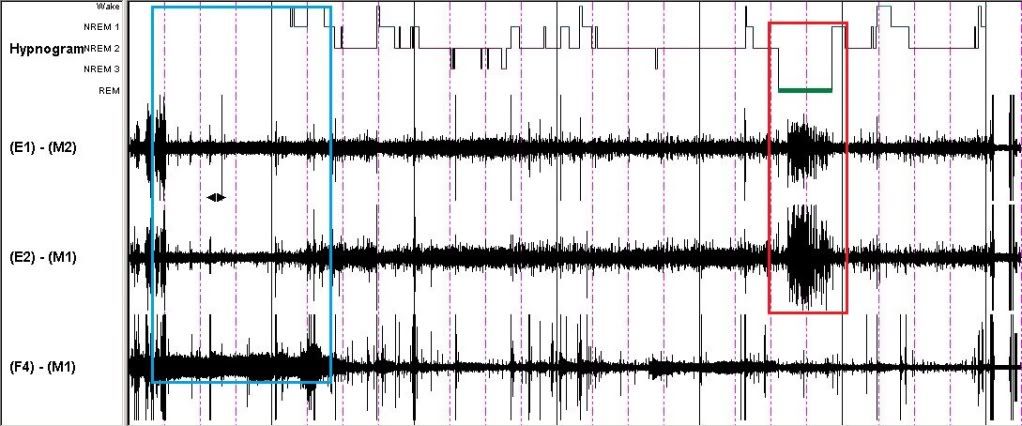
Zero.deltadave wrote:... reproducibility is nearly zero...
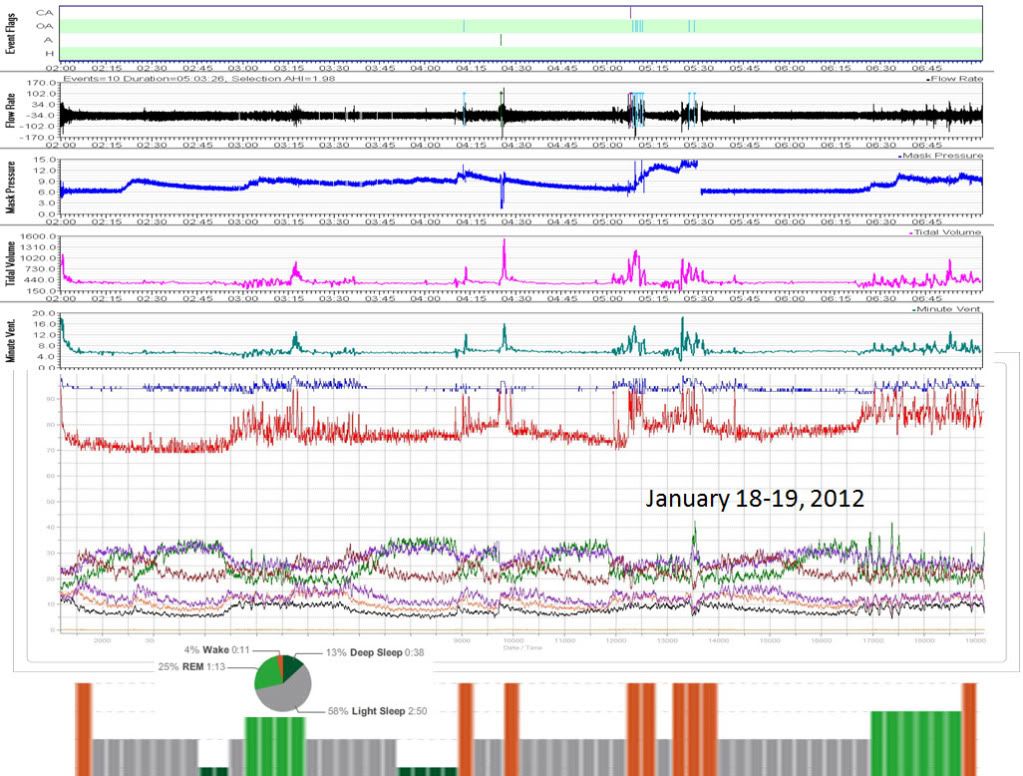
MaxDarkside wrote:Now I have the CMS 50E pulse oximeter data in our software along with the Zeo data in raw form aligned in time (well, probably close enough). The next step will be to get the ResMed data in there, but I can get a lot of information about what is going on in my sleep (stages, arousals, desats, etc.) with just the pulse-ox and Zeo. (Note; this is not one of my better nights. Woke up a lot, some leaks singing to me, I felt like I didn't need to sleep much, etc. When I woke up at the end, well, I just got up after only about 5 hrs sleep.)
I might get a camera so I can see what position I'm in when I get clusters of events. I'm curious if I'm on my back. I seem to be getting them consistently around the same time in my overall nights sleep cycles, like the 2nd major REM period, which is around 3-3:30 AM. Since the clusters are consistently at that point in the cycle, I'm thinking it is not positional. I'm getting all my data into our software to get a consistent timeline and then use various tools to analyze it. I'm starting a blog to document things, but as is typical with blogs, we'll see how that goes (to what degree I keep it up)linagee wrote:All this nice data and no night vision camera to show eye/body movements? LOL. (I'm only kidding. A little.)
Seriously though, when can we take our hacked Zeos and other data sources and feed them all into Sleephead to get a nice timeline?
Here's a case that has bad sleep, some CAP activity and PLMs (among other things):deltadave wrote:The eye channels are E* showing increased activity (amplitude)[and help to define REM]...
That said, after using this method on PSG in poor sleepers, very young (high amplitude delta waves invade the eye channels), fragmented sleep, reduced EEG amplitude patients and tonic REM, reproducibility is nearly zero.

Yes, interesting, and perhaps subtly inversely correlated with the clear case you showed before.deltadave wrote:As opposed to the previous example where REM-specific (sort of) EOG can be seen, here it is totally indistinguishable.