


Review: Hybrid Universal OSA Interface
Product Overview
|
|
|
|
Product Page: Hybrid Universal Full Face CPAP Mask with Nasal Pillows
hybrid-mask.com
Author (cpaptalk.com nickname): Minerva
Table of Contents
Introduction
The "Hybrid Universal OSA Interface" was formally released on the market June 19, 2006 by Teleflex Medical. Teleflex is a global distribution company, marketing the Hybrid under their HudsonRCI brand name. The mask was designed and patented by RespCare, Inc., based in Coconut Creek, Florida. RespCare entered into an exclusive agreement with Teleflex to market and distribute the Hybrid worldwide.
Teleflex also sells the Nasal-Aire® II sleep therapy interface, and designs, manufactures and distributes products and services for the aerospace, automotive, marine, industrial and medical markets worldwide. Respcare reports an expected sales revenue in excess of $100 million within the first five years of the Hybrid's availability.
The release of the Hybrid mask was highly anticipated by the sleep apnea community, as an innovative solution to common difficulties with existing cpap masks, including mouth leaks, mask comfort, and problems with large, unwieldy interfaces. Teleflex was extremely cooperative in providing samples to members of cpaptalk.com for review.
Retail price of the mask varies from $175.00(US) to $225.00(US).
First Impressions
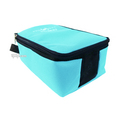
The Hybrid comes in an attractive sky blue zippered case with one set of headgear, three pairs (S-M-L) of nasal pillows and three (S-M-L) mouth seals. The case is quite roomy and bears the Hybrid logo. Included with the mask is a CD and users manual describing how to fit and use the mask.
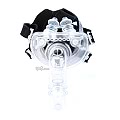
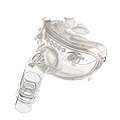
On visual inspection, the design of the Hybrid shows real ingenuity, combining the best features of a nasal pillows interface and full-face mask. The outer shell of the lower part of the mask, which covers the mouth, is a rigid clear plastic, which receives a soft silicone mouth seal that fits into a groove around the edge of the shell, much like a standard full-face mask. At the top of this mouth seal are two holes that receive the nasal pillows. The pillow sets are simply inserted into these holes and are held in place by friction – no complicated fitting, clips, or other attachment is needed. The pillows have two height settings on each set – adjustment is by simply pushing the pillows further into the holes in the mouth seal or pulling them further out. The nasal pillow sets are connected by a thin strip in the middle. Users with different-sized nostrils can cut this thin strip and use different sizes of pillow for each nostril.
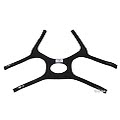
The mouth seal has a soft silicone shelf at the lower edge that fits under the chin, that is slightly more rigid that the rest of the mouth seal. The mask is extremely light. The headgear joins the mask by means of four small flat plastic clips that fit over four small pins that protrude from the face of the mask shell. The headgear is adjustable at all four points via Velcro fasteners.
The hose connection is a 90-degree coupling elbow that swivels 360 degrees, and a small exhaust valve is located at the top curve of the 90-degree angle. A small silicone flap moves freely against the vent with the user's breathing. The mask also has pinhole washout valves just above where the coupling joins the mask shell, and two supplemental ports that are covered with small silicone caps.
Fitting and Wearing
The CD that is included with the mask is short, well-produced, and easy to understand, showing how to put on the mask and adjust the fit properly. After reading the manual and reviewing the CD, I decided to try the medium mouth seal with medium nasal pillows.
Putting on the mask takes a little practice, but following the directions on the CD, I soon got the hang of it. First, I attached the headgear at the top two connection points, and let it hang down in front of the mask. Then, the pillows are inserted into the nostrils, and the mouthpiece rotates down over the mouth. Holding the mask in place, the headgear is then drawn up and over the head, and the bottom two clips are secured. It took me a few tries to figure out that the clips 'snap' into place – without fully securing them, they will fall right off the pins.
I put the mask on in the afternoon and wore it around the house, much to the amusement of my husband and cats, to see how it felt over time. The mask bears mainly between the bottom of the nose and the upper lip, but is not uncomfortable because the silicone seal is quite soft and pliable. By adjusting the straps of the headgear, I was able to get a good seal around the mouth, but the angle of the mouthpiece was such that the nasal pillows pushed forward and tried to pop out of my nostrils. I tried several combinations of mouth seal and pillows before settling on the large size of both, which seemed to work better and was very comfortable.
I hooked up to my machine and took a short nap. It was easy to turn on either side, and the seal of both the mouthpiece and the nasal pillows held well for the two hours I was asleep. I woke up feeling refreshed and comfortable. My nostrils were slightly sore, but not more than what I have experienced with other nasal pillows systems, and the soreness went away after a short time. The mask left no marks or indentations on my face.
That night I again used the large mouth seal and large nasal pillows. After about four hours of sleep, I awoke with a dry mouth and leaks around the nasal pillows. I reseated the mask, which took care of the leaks, and turned up my humidifier a bit. After another hour of sleep, I was again awakened by nasal pillows leaks. I changed out the large pillows for the medium sized pillows, to see if that would help, but could not get them to seal in my nose. Since it was late, I put on my Swift and went back to sleep.
The second night, I tried using the medium mouth seal and the large pillows, but could not get a good seal on either the mouth or the nasal pillows. I went back to the large mouth seal and large nasal pillows. I got the mask on and sealed and fell asleep easily. After a few hours I was awakened by one of the nasal pillows popping out of my nose toward the front. I pushed it back into place and went back to sleep. After another few hours I awakened with extremely sore nostrils and had to take the mask off.
On night three, I gave it another try, even though my nose was still sore. This time I adjusted the pillows down to the lower position, which seemed to help counter their tendency to want to pop out of my nose, but after a few hours I was awakened again with leaks at the nasal pillows. My nose was too sore to try the mask again the following night, so I reluctantly gave up on the Hybrid after three nights.
Conclusion
As I fiddled around with the different mouth seals and nasal pillows, it became clear to me that the problem was geometric disagreement between my face and the mask. My overbite, small chin, and pointy “nordic†(read: big) nose means that in order to get a good seal on the mouth part of the mask, I have to tighten the lower part against my chin, which causes the upper part of the mask to angle forward and push the nasal pillows forward. Since my nose is somewhat turned up, the pillows easily pop out of my nostrils as they are pushed forward. For people who don't have an overbite, I imagine the pillows will seat correctly and the mask will be comfortable for the full night.
In terms of humidity, it appears that people who use a nasal interface with a humidifier may want to turn up their humidity a bit to prevent dry mouth. I didn't notice any particular discomfort after adjusting my humidity the first night – I was neither too sweaty nor too dry under the mask.
I did notice that if the coupling is turned up to put the hose overhead, it makes a lot of noise, but this was not a problem for me because I prefer the hose to hang down in front. Noise could be a problem for people who like to route their hose overhead. In a hose- down position the mask is extremely quiet.
Even though the mask did not work well for me, I think it's really a leap forward in cpap mask design. I liked not having a bunch of straps, hoses and forehead rests in front of my eyes, and the mouth seal/nasal pillows interface is truly ingenious. The only thing that I found difficult to deal with (unrelated to my unfortunate face shape) was the headgear connection to the mask. It's difficult to manage all four connector points at once in the dark or when sleepy – some type of 'quick release' headgear for this mask would be ideal.
More Information
Teleflex home page: http://www.teleflex.com/
Teleflex medical division home page: http://www.teleflexmedical.com/
HudsonRCI home page: http://www.hudsonrci.com/
RespCare home page: http://www.respcare.com/
Hybrid home page: http://www.hybrid-mask.com/
cpap.com Hybrid page: https://www.cpap.com/productpage/RespCare-Hybrid-CPAP-Mask.html